More changes than just name likely for hospital
TONY BROWN/DAILY FORUM
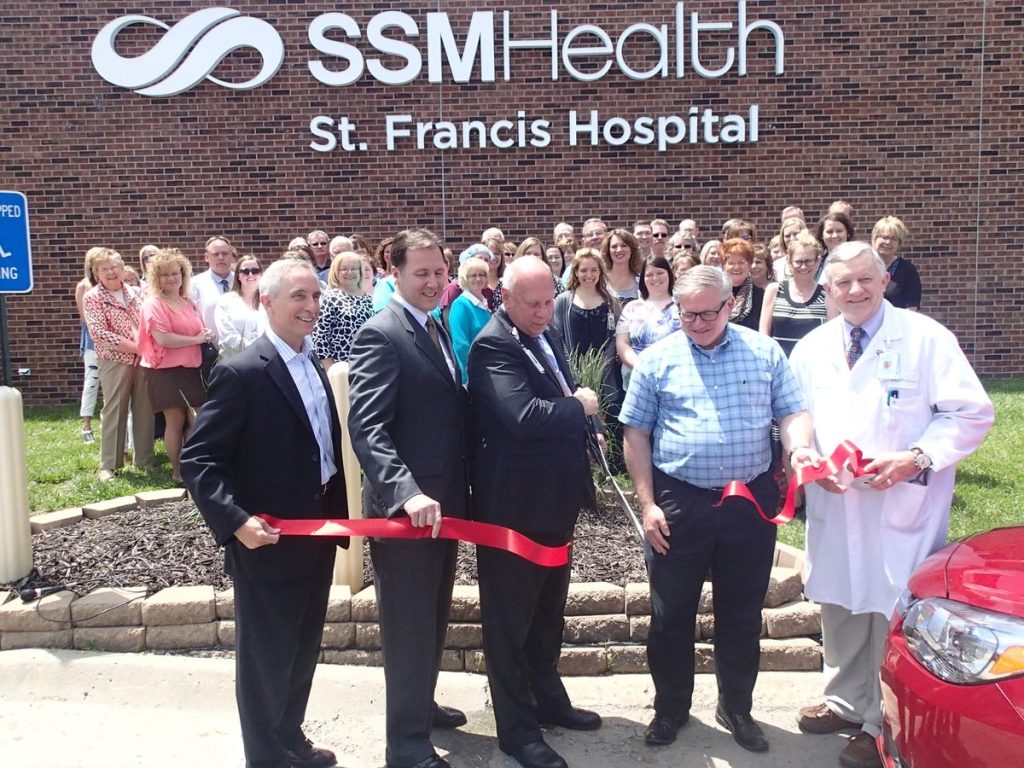
Dignitaries cut a red ribbon symbolizing the corporate rebranding of what is now SSM Health St. Francis Hospital in Maryville. Pictured in the foreground from left are Northwest Missouri State University President John Jasinski, state Rep. Allen Andrews, St. Francis President Michael Baumgartner, state Sen. Dan Hegeman and St. Francis Vice President of Medical Affairs Scott Holman. Shown at rear are members of the hospital staff and representatives from the Greater Maryville Chamber of Commerce.
A large group of local business leaders, elected officials and St. Francis Hospital staff gathered at the hospital’s main entrance Monday for a ribbon-cutting ceremony celebrating a rebranding initiative announced earlier this year by the health care center’s corporate parent.
St. Louis-based SSM Health Care has changed its name to SSM Health, and the local hospital, one of 19 owned by SSM, will henceforth be known as SSM Health St. Francis Hospital.
St. Francis President Michael Baumgartner said the name change symbolizes a “recommitment” to patient care and service to the community.
“By uniting under this common name, “Baumgartner said, “our patients will know to expect exceptional care every time they see the SSM Health name.”
Though the new name brings with it no immediate changes in programs or services, Baumgartner did say the rebranding is intended to position St. Francis and SSM’s other care sites with regard to major national trends expected to alter the way health care in the United States is both provided and paid for.
In essence, he said, those trends represent a shift from “volume to value,” adding that the ultimate goal is to provide a “better patient experience” while at the same time pursuing greater efficiency and lower cost.
Baumgartner predicted that smaller hospitals like St. Francis will eventually pursue treatment and billing strategies already in place at some larger health centers, such as outcome-based payments and “bundle” payments, systems under which patients are billed once for multiple procedures related to a given condition or malady.
Another possibility, he said, would be regular payments made by hospital customers who would then simply come in for treatment or tests whenever they were needed.
While such changes have not yet arrived at St. Francis, Baumgartner said he expects some kind of “payment reform” will be “coming to Main Street,” as opposed to large metropolitan areas, sometime within the next year or two.
Also in the offing under the SSM Health banner, Baumgartner said, are administrative and technology improvements designed to enhance both patient care and convenience.
“SSM Health St. Francis Hospital is working within the SSM Health system to transform health care with the goal of providing affordable, high-quality medicine combined with a consistently positive experience,” he said. “To accomplish this goal, St. Francis will be offering more convenient hours as well as the tools and information patients need to stay healthy.”
Early news of SSM Health’s rebranding effort — and its local impact — arrived in April when the corporation announced similar name changes for its local hospice, home care and private-duty operations, now known as SSM Health at Home, SSM Health at Home Hospice, and SSM Health at Home Private Duty.
The SSM Health at Home brand was unveiled for the first time last fall when the system acquired Audrain County’s Home Health and Hospice Division.
The rest of SSM Health’s care sites, located in Illinois, Missouri, Oklahoma and Wisconsin, will transition to similar names during a continued rebranding effort to be rolled out over the next two years.
SSM Health traces it roots back to 1872, when a group of nuns in St. Louis began caring for sick and dying patients in their homes. The congregation received its formal name, the Sisters of St. Mary, in 1874.
St. Francis Hospital also has Roman Catholic beginnings, and traces its roots back to 1894 when Mother Augustine Giesen and four companion nuns arrived in Maryville with a mission to care for the sick.
In the mid-1980s, the SSM congregation decided to reorganize hospitals under its control into a network of centrally managed health care providers, an effort that led to the creation of SSM Health Care in 1986.
In addition to its 19 hospitals, the system now called SSM Health owns more than 60 outpatient care sites, a pharmacy benefit company, an insurance company, two nursing homes, several home care and hospice services, a technology company and two Accountable Care Organizations.