Study sets campus’ impact at $617 million
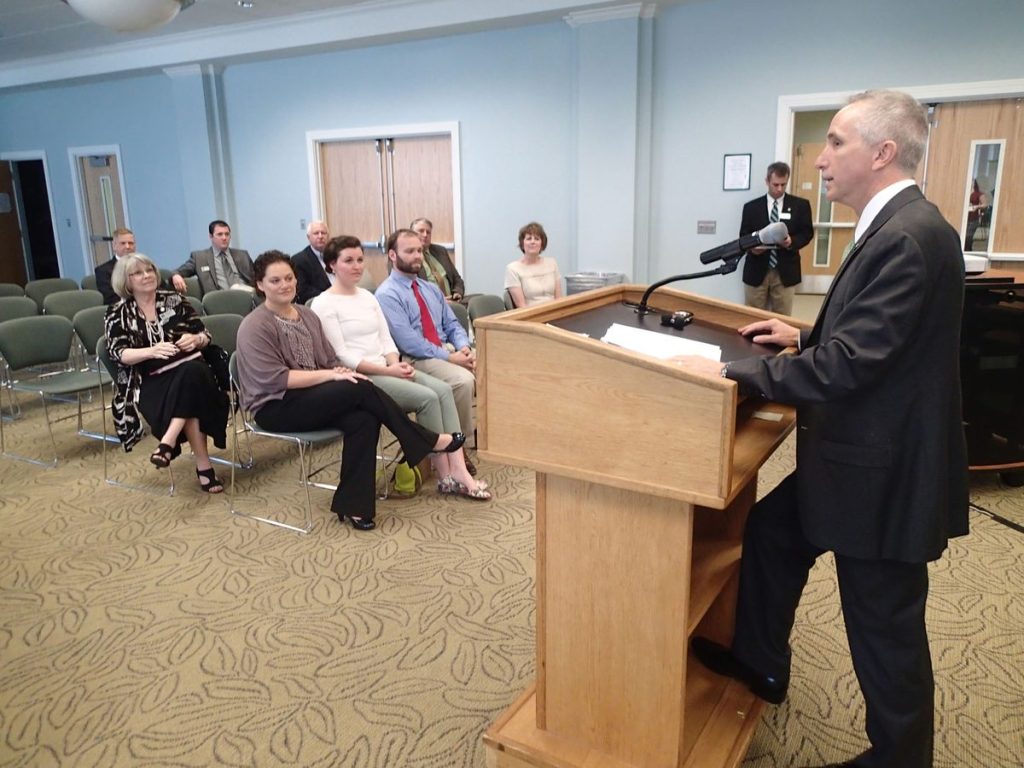
TONY BROWN/DAILY FORUM
Northwest Missouri State University President John Jasinski speaks Friday during a press conference called to announce the results of an externally conducted study detailing the university’s economic impact across a “Green and White Circle” embracing 79 counties in Missouri, Kansas, Iowa and Nebraska. The study maintains that for every $1 of public money spent on Northwest, an amount totaling around $30 million a year, taxpayers receive a $4 return in the form of increased revenues and public sector savings.
At a press conference preceding Friday’s Board of Regents meeting at Northwest Missouri State University, President John Jasinski unveiled an economic impact study stating that the institution generates more than $617 million a year across the region in terms of income, spending, employment, social advancement, productivity, and “return on investment” for taxpayers.
The $25,000 study, compiled by Idaho-based Economic Modeling Specialists International, equates Northwest’s economic footprint during the school’s 2014 fiscal year with the creation of 9,400 new jobs.
Most of that impact, it stated, benefits a “Green and White Circle” comprising 79 counties in Missouri, Kansas, Nebraska and Iowa.
Jasinski characterized the $617 million figure as “added regional income,” a concept he said could be compared to a “gross regional product.”
Economists use similar data to arrive at a nation’s gross national product — the market value of all goods and services produced by a country’s citizens in one year with regard to both labor and property.
Jasinski cited the report’s findings as proof that “the economy is fueled in part by investment in higher education,”
“This study confirms what many of us who live and work in northwest Missouri have suspected for a long time — that Northwest Missouri State is an important economic driver throughout the region,” he said. “We take tremendous pride in that role as well as our responsibility to taxpayers to be good financial stewards.”
The report breaks down the added regional income estimate into four broad areas: operational spending by the university ($91 million), student spending ($9.1 million), visitor spending ($1 million), and impact of human capital ($516 million).
Jasinski said, in his view, some of the most striking data from the study relates to the cost/benefits ratio and return on investment for taxpayers.
The study maintains that for every $1 of public money spent on Northwest, an amount that totals around $30 million a year, taxpayers receive $4 in value because college graduates earn more taxable income, enjoy better health and are less affected by crime and poverty than people who fail to earn a degree.
On average, Jasinski said, college graduates earn $22,000 a year more than non-degreed workers, or about $1 million in additional income over the course of their careers.
In addition, the report states, Northwest students receive an average annual rate of return of 13.9 percent on their investment in obtaining a post-secondary education, or about $3.60 for each dollar spent on college.
Elsewhere, the report noted that Northwest maintains a payroll of $55.3 million and institutionally spends another $47 million on goods and services used to support operations.
Commenting on the study, Maryville City Manager Greg McDanel said Northwest students and visitors spend about $10 million in the Maryville area each year, money that fuels local businesses while boosting sales tax revenues.
“The investment analysis performed in the report verifies that the benefit to students, society and taxpayers is staggering,” McDanel said.
Also impressed by the numbers was Nodaway County Economic Development Executive Director Josh McKim, who said the report would be useful in selling the Maryville area to prospective businesses and industries.
McKim said the study contains information that is “tremendously valuable for us,” and that “from an economic development standpoint, every project we deal with is touched by Northwest.”
Maryville Mayor Renee Riedel, co-owner of Carson’s Sports Grille on the downtown square, said the report highlighted the university’s importance to the local business community and the need for continued cooperation between the campus and surrounding community.
“Studies like this make me feel great about the decision we made to move to Maryville.” Riedel said.
During the regular Board of Regents meeting that followed the press conference, Northwest’s governing panel voted to approve three new majors while adding 15 courses to the university curriculum. A new math program configured as either a bachelor of science or bachelor of arts accounts for two of the degrees. The third degree program is a bachelor of science in data science and informatics.