Northwest works to make recycling pay
KELSEY COBB/DAILY FORUM
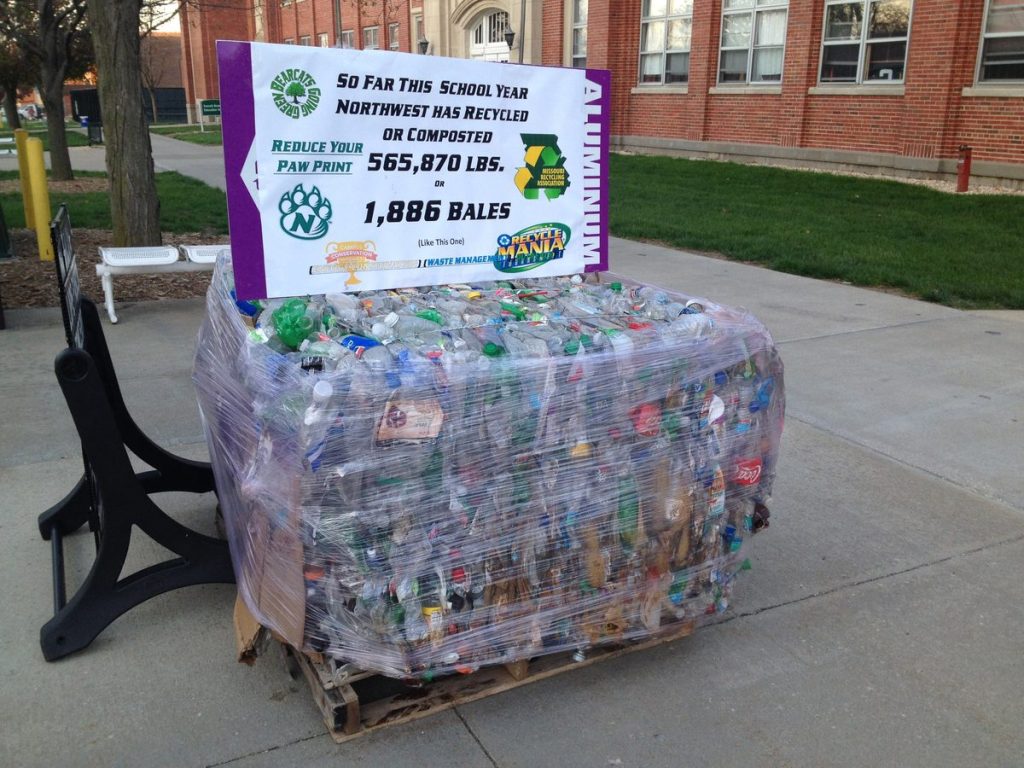
Bales of recycled material were recently displayed on the Northwest Missouri State University campus in an attempt to illustrate the success of the school’s sustainability program. Sustainability Coordinator John Viau said savings derived from recycling over the past academic year equaled 85 percent of Northwest’s total “tipping fee” bill, the amount charged for depositing landfill refuse at the city’s solid waste transfer station. Bales of recycled material were recently displayed on the Northwest Missouri State University campus in an attempt to illustrate the success of the school’s sustainability program. Sustainability Coordinator John Viau said savings derived from recycling over the past academic year equaled 85 percent of Northwest’s total “tipping fee” bill, the amount charged for depositing landfill refuse at the city’s solid waste transfer station.
As Northwest Missouri State University wraps up another academic year this week, the campus’ Landscape/Sustainability Services team is taking stock of recycling efforts carried out over the past eight months, and the results are significant.
With less than a week to go before graduation, according to Sustainability Coordinator John Viau, Northwest has recycled or composted more than 565,000 pounds of plastic, aluminum, glass and other materials, the equivalent of 1,880 300-pound bales.
“We try to recycle everything that comes off our campus,” said Viau, whose team recently placed several of the large bales on display around the J.W. Jones student union as a visual reminder to students and staff of the university’s commitment to sustainability.
“We wanted to let people know that it does make a difference,” he said.
Over the past 20 years or so, recycling has grown into a major initiative for the university, and the effort these days goes far beyond bottles and cans.
Working out of a facility on the west side of campus where clean paper and cardboard are processed into pellets burned as fuel producing 85 percent of the thermal energy used to heat and cool campus buildings, the university’s recycling crew also handles all types of ferrous and non-ferrous metal, construction debris, junked machinery and just about anything else they can get their hands on.
While committed to the idea that recycling is good for the environment and “the right thing to do,” Viau said diverting hundreds of thousands of pounds from Northwest’s landfill-bound waste stream each year also has a positive impact on the university’s bottom line.
The addition of a baler a few years ago, paid for with a grant from the Northwest Missouri Solid Waste Management District, plus a couple of motorized conveyor lines, themselves repurposed from other operations, has greatly increased the efficiency and capacity of the university’s recycling operation.
This year, Viau said, savings from recycling covered about 85 percent of the university’s “tipping fee” bill at the city of Maryville’s solid waste transfer station.
Disposing of trash and garbage at the transfer station, from which refuse is trucked to landfills, costs Northwest $48 a ton, and Viau said the university’s total waste stream for the current school year stands at around 380 tons, or approximately $18,000 in fees.
With the baler and conveyer lines, Viau and his team can truck 18 tons of recyclables to a processing plant for around $500. Back in the old hand-sort and plastic bag days, he said, a full load of unbaled recycling weighed only three tons but still cost the same $500 to transport.
In the near future, Viau said he hopes to acquire a perforating machine that will allow plastic bottles to be compressed even more, upping the total recyclables load for a tractor-trailer rig to 20 tons or more and the average bale weight from 300 pounds to 700 or 800 pounds.
Aside from becoming more efficient over the years, Viau said Northwest has worked to make the recycling program visible to students and staff. There are currently 200 recycling bins in place on campus designed to accept plastic, glass, aluminum and paper.
Some of the bins, which can cost up to $1,000 each, are starting to show wear and tear, so Viau and his crew are recycling those as well. Refurbishing the receptacles with upgraded surfaces and new signage, he said, takes only $100 or so.
Viau said Northwest started investing in recycling infrastructure in the early 1990s, and that each year since more students have gotten into the recycling habit.
“I think that our students understand the value of recycling,” he said, “and we want to use that to open the door to the value of sustainability in general.”