Pelton’s thesis published in book form
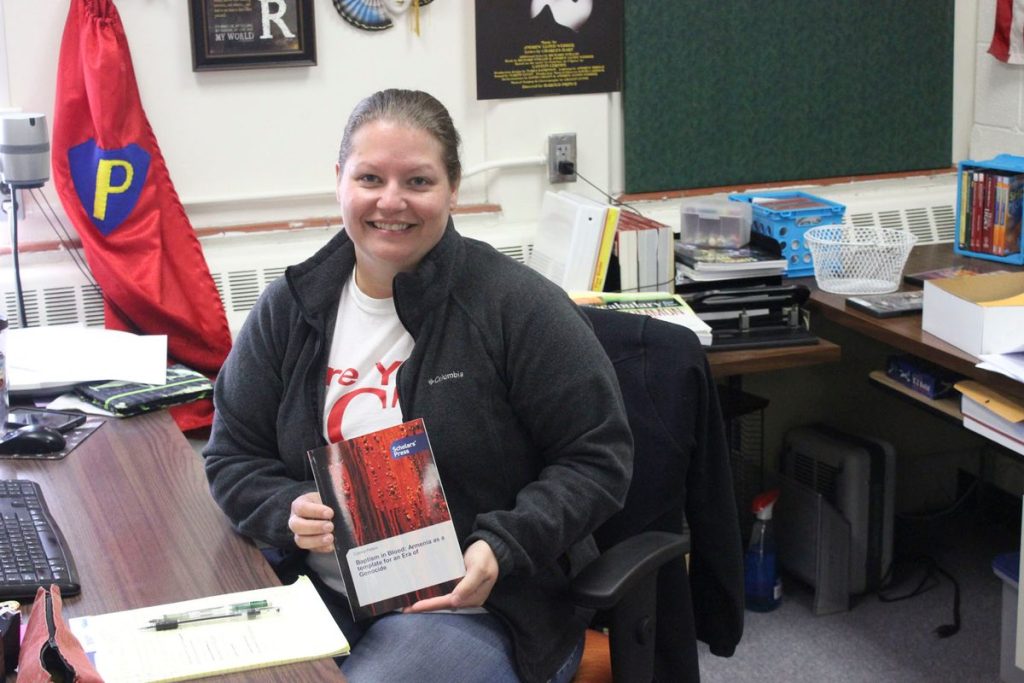
STEVE HARTMAN/DAILY FORUM
Maryville High School social sciences instructor Catrina Pelton has just had her work “Baptism in Blood: Armenia as a template for an Era of Genocide”published by Scholar’s Press.
Catrina Pelton, social sciences instructor at Maryville R-II High School, has added another title to her already crowded resume — that of published author. Her master’s degree thesis has been published in book form by Scholar’s Press. The work in entitled “Baptism in Blood: Armenia as a template for an Era of Genocide” and has been available for about two weeks.
“The publisher contacted me about the possibility of publishing my master’s degree thesis as a book,” Pelton said. “Apparently, they had a great interest in publishing a book about genocide, and they found my thesis through a nationwide search.”
Pelton said she did not intend to have the thesis published, but the process only took about a month from initial contact to the agreement to publish.
“Most of the book was already written since it comes from my thesis,” Pelton said. “There was minimal additional writing involved in getting the thesis prepared for publication.”
Pelton, an 11-year teaching veteran, has spent the past nine years at MHS. She currently teaches several honors-level social science classes as well as serving as the school’s scholar bowl coach. She first became interested in genocide during a Brown University teaching institute she attended between her undergraduate and graduate work.
“The genocide unit was one we could adopt and teach during that workshop,” Pelton said. “I became interested, and everywhere I’ve taught, students have shown a great deal of interest in the subject.”
The term “genocide” was first used by Polish lawyer and Holocaust survivor Rapheal Lemkin to describe the deliberate killing of large groups of people, especially those of a particular ethnic group or nation.
Lemkin made note of the fact that Nazi elimination of Jews during the Holocaust followed certain aspects of the design set forth by the Turks in their attempt to annihilate the Armenian population in 1915. In fact, all five acknowledged cases of genocide that occurred in the 20th century followed the same basic patterns of elimination first presented by the Turks.
Besides the Armenian Genocide of 1915 and the European Holocaust, the other acknowledged examples of 20th century genocide include those which occurred in Cambodia, Bosnia and Rwanda.
“This is why the genocide committed by the Turks against the Armenian population in 1915 is so important,” Pelton said. “Every modern-day case of genocide has followed the Turk model, so in order to combat genocide, the pattern must be studied.”
Pelton, a native of Woodbine, Iowa, received both her undergraduate and graduate degrees from Northwest Missouri State University. When doing the research for her master’s degree thesis, she traveled to Washington, D.C. and researched the topic at the Library of Congress.
“There just wasn’t a lot of information available at Northwest, or even in the Midwest,” Pelton said. “I had to go to Washington, D.C. to find the information necessary to finish my research. So I think when Scholar’s Press went looking for material to publish on genocide, they ended up contacting me, because I had written one of the few existing newer works on genocide.”
Pelton said the book has been out about two weeks, and she’s already had several email contacts about it.
“There still is not a lot of information out there on the Armenian Genocide of 1915,” Pelton said. “I am finding this out by the number of people who have contacted me.
“I wasn’t planning on being an author, but I am glad to fill the void in existing information when it involves something I’m interested in and passionate about.”