
SAVE reaches out to rape victims
TONY BROWN/DAILY FORUM
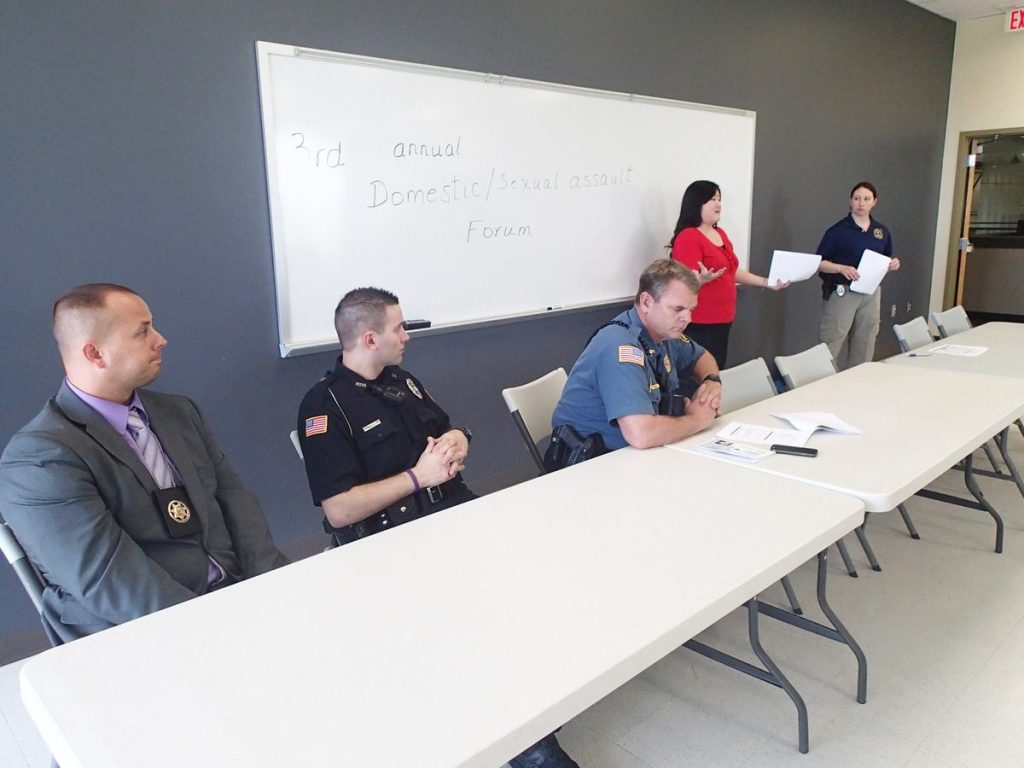
Meghann Kosman, second from right, gestures during a Sexual Assault and Violence Education presentation last week during the third annual Domestic/Sexual Assault Forum at the Maryville Community Center. Also pictured from left are Nodaway County Sheriff’s Sgt. Jamie Vicker, Maryville Public Safety Officer Ian Meyers, Sgt. Dave Merrill of the Northwest Missouri State University Police Department and MPS Officer Sarah Kahmann.
Representatives from law enforcement and the social services community gathered last week at the Maryville Community Center for the third annual Domestic/Sexual Assault Forum.
The keynote of the hour-long discussion was a presentation by Meghann Kosman, court and victim advocate for the Children and Family Center of Northwest Missouri and Maryville Public Safety Officer Sarah Kahmann.
The two women have been working together over the past year to develop a set of materials titled Sexual Assault and Violence Education — SAVE — which is now available to churches, community groups, student organizations and other organizations interested in increasing awareness about the prevention and prosecution of rape, sexual assault and related offenses.
Kosman and Kahmann presented a condensed, 20-minute version of their curriculum during the forum. The seminar is also available in a longer edition for organizations wishing in-depth training.
One of the central messages of the SAVE program is that timely reporting by victims and witnesses is key to the prosecution of sex crime cases, only a fraction of which end up in court.
Kosman and Kahmann claimed that only 40 out of every 100 rapes are reported to authorities, adding that the funnel flowing toward justice gets smaller from there.
An arrest is made in ten out of every 100 rapes, they said, and the rate of prosecution is eight out of 100.
Four percent of all rapes lead to a conviction, according to SAFE statistics, and three out of 100 rapists spend time behind bars.
Aside from the need, from a criminal justice standpoint, to move those percentages uphill, Kosman and Kahmann said it is crucial for sexual assault victims to be forthcoming with authorities in order to safeguard their own wellbeing.
Victims of sex crimes, they said, are three times more likely to suffer from depression than the general population. They are also six times more likely to display symptoms of post-traumatic stress disorder, 13 times more likely to abuse alcohol, 26 times more likely to abuse drugs and four times more likely to contemplate suicide.
As a police officer, Kahmann said she recognizes that, for the victim, reporting a rape is often a brutal and dehumanizing process. But she also said law enforcement officers are far better prepared for assisting victims of such crimes than once was the case.
Instead of heading for police headquarters, Kahmann said the victim’s first action following an assault should be the hospital. Emergency room personnel are trained, she said, to alert all appropriate agencies when a rape victim walks through the door.
Going to the hospital first also expedites the collection of evidence via a procedure called a SAFE exam, an acronym for Sexual Assault Forensic Evidence, which Kahmann admits is a thoroughly unpleasant procedure, but one that can prove vital to a successful prosecution.
Swabs are taken, hair samples are clipped from all parts of the body and orifices are probed.
“Basically the victim is violated all over again,” Kahmann said, “It’s not an easy thing.”
But submitting to such an examination is one of the best ways to hand authorities the evidence they need to make an arrest and build an effective case that will stand up in court.
And these days, there is a way for victims to soften the blow to an already shattered psyche. It’s called a Jane Doe report, which consists of microscope slides; boxes and plastic bags for storing skin, hair, blood, saliva and semen; and photographs. All of this evidence is placed in a sealed package and marked with only a number to identify the victim.
Police don’t open the parcel unless or until the victim decides to press charges.
“With a Jane Doe report,” Kahmann said, “the evidence is collected and preserved, but the victim’s health and well-being is the first priority.”
Kosman, during her portion of the presentation, talked about misconceptions with regard to sexual assault and other domestic and relationship crimes.
While many people may have an image in their minds of a rapist being a “creepy, grungy looking guy, somebody in a dark alley,” she said, this is seldom the case.
Most often, Kosman said, rapes are committed by someone the victim knows, trusts, and perhaps loves.
“Trust is used against the victim,” she said. “Trust is the weapon that allows the assailant to commit a crime.”
Another myth, Kosman said, is that during a rape the victim’s first instinct is either to flee or fight back. In fact, studies have shown that the most common reaction is simply to freeze.
Kahmann said the same response to a physical threat is common among law enforcement cadets during their academy training. Trainees, she said, will talk about how they’re going to respond aggressively when facing an armed assailant or other threat. But when confronted with the business end of a toy gun during a simulation the more common action is simply to do nothing.
“You can choose fight or flight instead of freezing,” she said, “But you have to be trained.”
Teaching more women — and men — that they have the choice to resist or flee during a sexual attack is one of SAVE’s major goals, Kahmann said.
Kosman said a second major misconception about rape involves the victim. While she urged women to “be clear about your message” in a given social or professional situation, she added that wearing a low-cut top or a miniskirt doesn’t imply one’s consent to be brutalized.
“The person who is at fault is the person who committed the crime,” she said. “Behavior is a discussion we can have all day, but we want to make sure that criminals are held accountable for their behavior.”




