
Sen. Hegeman addresses township officials
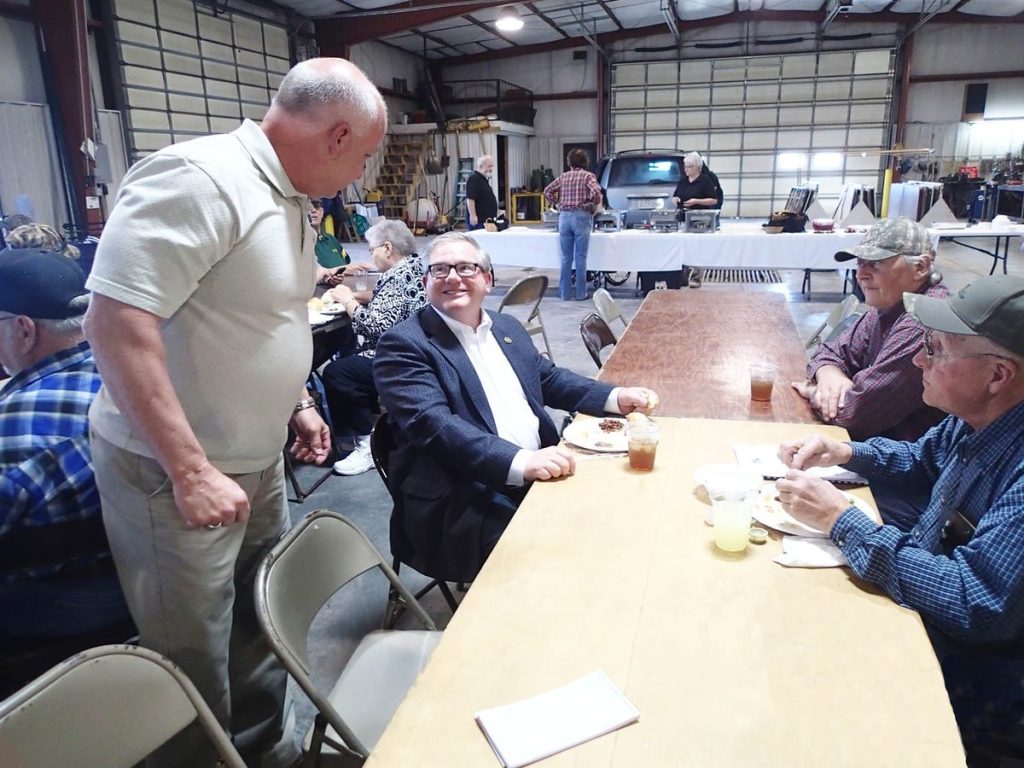
TONY BROWN/DAILY FORUM
Presiding Nodaway County Commissioner Bill Walker, standing, talks with state Sen. Dan Hegeman during Friday’s annual Nodaway County township meeting at the road and bridge maintenance garage on East Halsey Street. Hegeman spoke to township representatives about legislation he has sponsored designed to ease the transition from a township to a county form of government.
The number of Missouri counties retaining a township form of government — a 19th-century convention created back when the only way for many citizens to reach the county seat was an hours-long horseback or buggy ride — is steadily declining.
During last Tuesday’s statewide round of municipal elections, voters in Sullivan County in north central Missouri approved a measure to eliminate townships, meaning that only 21 township counties out of a total of 114 remain statewide.
One of those is Nodaway. And judging from a secret-ballot straw poll of township board members and employees taken during their annual meeting Friday with the three-member County Commission, townships are likely to be around a while in this neck of the woods.
Of 52 ballots cast, 39 indicated support for retaining Nodaway County’s 15 townships, each of which collects its own taxes and is represented by an elected panel consisting of a trustee and two board members.
Decades ago, townships served a number of governmental and political functions. But these days in the Missouri counties where they still exist, their primary function consists of laying gravel over and removing snow from unpaved country roads.
In Nodaway that’s a big job, since Missouri’s fifth-largest county in terms of land area also has the most miles of gravel thoroughfares in the state — 1,017.
The sheer size of the county’s transportation system is one reason township government still appears to have a lot of support among the approximately 10,000 Nodaway residents who live outside Maryville. But with the cost of gravel continuing to rise, and the population of most townships either flat or in decline, an official conversation about how long these political subdivisions can survive appears to have begun.
Addressing the township meeting last week was state Sen. Dan Hegeman, whose 12th District includes Nodaway County. Earlier this year Hegeman introduced Senate Bill 245, a measure that offers a way for counties where voters have decided to eliminate townships to continue collecting the taxes needed to keep gravel on rural roads.
Hegeman introduced the legislation at the request of Sullivan County officials who feared that voters might sign off on getting rid of townships but fail to approve a corresponding countywide gravel levy. Such a levy is necessary since townships that no longer exist obviously can’t collect taxes.
In the event, Sullivan voters approved both the switch to a county-only form of government and a new countywide gravel tax, but Hegeman said it is likely similar situations will arise in future elections.
Under SB 245, which has been passed by the Senate and sent on to the House of Representatives, counties that eliminate townships would be allowed to collect a countywide road gravel property tax equivalent to the lowest township levy in place prior to the election. The levy, which would not require voter approval, could stay in place for up to one year.
Hegeman said it is unlikely such a tax would bring in enough money to keep rural roads in decent shape, but it would at least provide some kind of revenue stream until county officials placed an adequate tax proposal on the ballot.
In addition, Hegeman said, the one-year timeframe would give counties three chances to submit a gravel tax to voters for approval.
Without “setting a floor” for road tax revenue after townships have been eliminated, Hegeman said, county commissions could conceivably “have all the responsibility for maintaining their roads but no way to take care of it.”
Hegeman told the township representatives his legislation does not mean he favors elimination of townships, but merely that he wants counties that do so to have some means of keeping roads in good repair.
“There are township counties that still work very well,” he said. “But there may be other counties looking more in the direction of Sullivan.”
Comparing Nodaway County, where support for townships remains strong, to a county like Sullivan, where such districts have been eliminated, reveals significant differences that basically boil down to size and money.
While Sullivan County has a total population of 6,700 and an assessed valuation of $88 million, Nodaway contains 22,000 people, including Maryville, and has an assessed valuation of $320 million.
Still, county officials here have had to adapt to a new reality in which the fiscal health of several of Nodaway’s 15 townships continues to decline.
A key step toward preserving Nodaway townships was passage last year of a half-cent county sales tax, revenues from which are earmarked for purchasing gravel.
In the past, the county has subsidized township gravel at $525 per mile of road with each township chipping in $150 per mile. Now, with about $1 million a year coming in from the new sales tax, the townships’ share has been eliminated, and the county has pledged to provide each township with 65 tons of rock per year for each mile of road.
That means township tax revenues can now be spent on additional gravel; trucks, graders and other heavy equipment; and small drainage tube crossings not maintained by the county.
The additional dollars also mean the county has more money to spend on bridge replacement and repair, a part of the budget under increasing strain due to decreased gasoline tax revenues as consumers switch to fuel-efficient automobiles.
South District Commissioner Robert Stiens said Friday that this year’s road and bridge budget totals around $7 million, about double the usual amount.
Aside from the new gravel tax, the increase comprises an estimated $750,000 in anticipated funding from the Federal Emergency Management Agency for infrastructure repairs necessitated by late-summer flooding as well as federal dollars allocated for construction of four “off-system” bridges.




