E-car charging stations arrive at Northwest
DARREN WHITLEY/NORTHWEST MISSOURI STATE UNIVERSITY
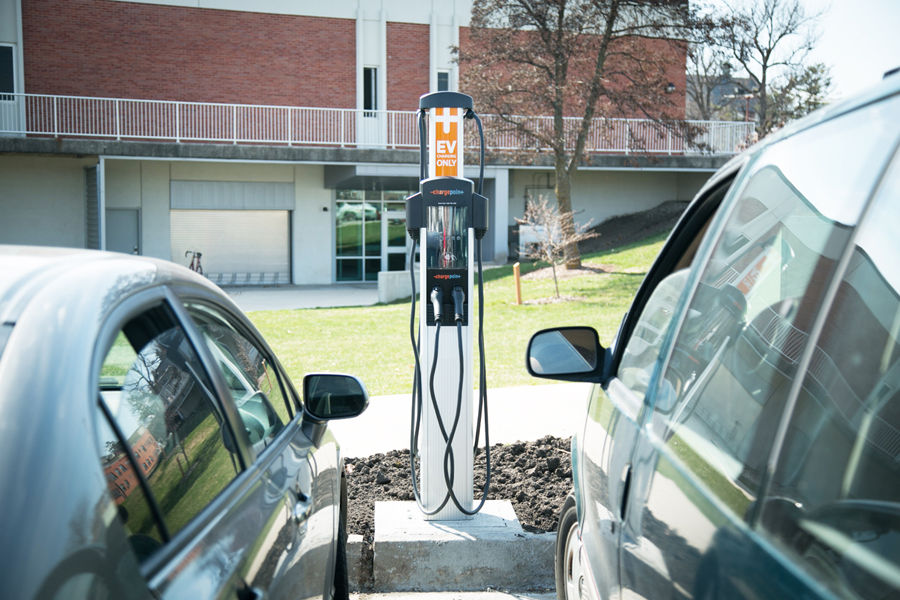
Shown is one of three electric vehicle charging stations recently installed on the Northwest Missouri State University campus. The stations serve two parking slots in lot No. 20, east of Valk Center, shown here, and four slots in lot No. 59 south of the Jon T. Rickman Electronic Campus Support Center. Beginning with the fall 2015 semester, all six places will be reserved for electric vehicle only.
Owners of electric cars can now fill ’er up at Northwest Missouri State University.
Since late last year, Kansas City Power & Light Co. has been in the process of installing more than 1,000 electric vehicle charging stations across its Missouri-Kansas service area and earlier announced that at least one of the stations would be in Maryville.
The utility expects to compete installation of all proposed stations by the end of this summer.
Three electric vehicle-charging stations have been installed on campus. They serve two parking slots in lot No. 20 east of Valk Center and four slots in lot No. 59 south of the Jon T. Rickman Electronic Campus Support Center.
Beginning with the fall 2015 semester, all six parking places will be reserved for electric vehicle only.
Under an agreement between the university and KCP&L, the utility provided and installed the stations while Northwest is to pay for the electricity used over two years. During that time, motorists will be able to charge their vehicles free of charge.
“This has the potential to be a great benefit for faculty, staff and students who commute a modest distance,” Northwest Energy Manager Daniel Boyt said.
Robert Dewhirst, a professor of political science at Northwest, owns an electric car and said he is excited about the opportunity to charge its battery on campus.
“I love my electric car and am pleased that Northwest is taking the lead in supporting alternative energy vehicles,” Dewhirst said. “I hope this provides a further incentive for everyone on campus to drive an electric vehicle.”
When completed this year, the 1,000-station KCP&L Clean Charge Network will be the first such major installation by an electric utility in the United States.
KCP&L spokesperson Casey Hughley said at the program’s outset that the though the vast majority of the power company’s stations are to be located in urban areas — including a total of 10 in and around St. Joseph — the utility realizes electric vehicles won’t always be a strictly big-city phenomenon.
“This is not just in the metro areas,” she said. “That defeats the purpose. We want people to be able to travel across our region.”
“… Our goal is not really to drive business into specific locations but to jump-start electric vehicles in this region. It’s a more holistic approach.”
The campus stations are of the “standard” type, meaning they are capable of providing a full battery charge in four to six hours and a partial charge, good for 25 miles or so, in about an hour.
KCP&L also plans to set up several fast-charger stations across its service area that can deliver an 80 percent charge in about 30 minutes.
The fast-charge stations are being provided to the network by the Nissan Motor Co., which has made a major investment in the development and marketing of electric vehicles.
The stations are manufactured by ChargePoint and will be part of the ChargePoint network of more than 20,000 charging locations across North America.
Cost of electricity dispensed at the stations will vary according to local rates, but will likely go for between 6 and 10 cents per kilowatt hour.
To utilize the stations, drivers must sign up for a ChargePoint membership at na.chargepoint.com/register. Drivers can find charging stations and see their availability in real-time at ChargePoint.com or with a free ChargePoint mobile app.
To use the stations, drivers wave their ChargePoint card in front of the station or use the app.
Initially KCP&L expects its Clean Charge stations to service a total of about 2,000 cars, though the network is designed to support up to five times that many vehicles.