Council approves Kawasaki bonds
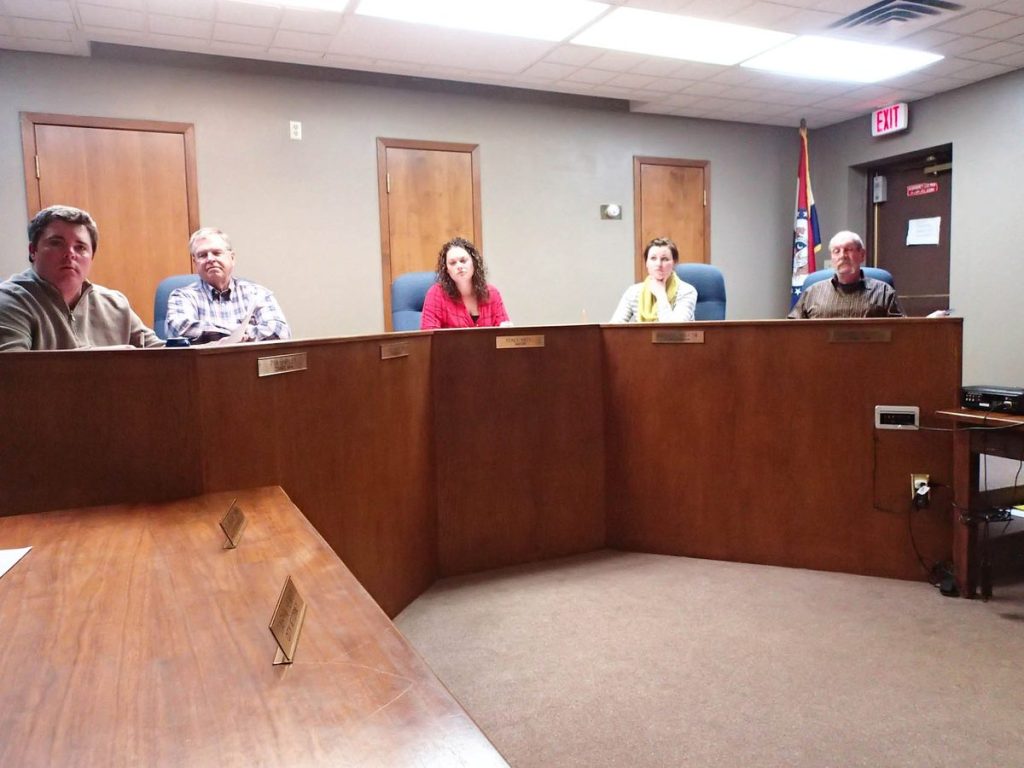
TONY BROWN/DAILY FORUM
The City Council this week moved ahead with approval of a tax abatement deal based on municipal issuance of $25.5 million in Industrial Development Revenue Bonds to finance construction at the Maryville small-engine plant operated by Kawasaki Motors Manufacturing Corp. U.S.A. The planned expansion would add 100,800 square feet of production space and create an estimated 30 new jobs. Pictured from left are council members Tim Shipley, Jeff Funston, Mayor Renee Riedel, Rachael Martin and Jerry Riggs.
The City Council voted unanimously this week to accept an Industrial Development Revenue Bond tax abatement package designed to finance a $25.5 million expansion at the Maryville small-engine plant operated by Kawasaki Motors Manufacturing Corp. U.S.A.
If carried out, the planned expansion would add 100,800 square feet of mostly production space to the facility and create an estimated 30 new jobs.
The bonds will be issued by the city and purchased by Kawasaki.
Under terms of the agreement, both Kawasaki’s existing facility and the expansion, including new fixtures and machinery, will be transferred to city ownership, with the corporation paying rent equivalent to principal and interest over the 10-year life of the bonds.
Should the corporation fail to service the bonds, the city is under no obligation to repay the debt.
The agreement exempts Kawasaki from all real property and personal property (machinery, fixtures and equipment) taxes for 10 years, with the exception of personal property taxes assessed on equipment in the existing plant.
However, in order to preserve a portion of the revenue streams of various taxing entities, and especially the Maryville R-II School District, Kawasaki has agreed to make “pilot payments” — payments in lieu of taxes — equivalent to the 2014 assessed valuation of its real property and 50 percent of the property taxes anticipated over 10 years on $18.5 million in equipment purchases for the expansion.
According to City Manger Greg McDanel, the deal means Kawasaki will pay $256,269 annually through the 2424 tax year in lieu of real property taxes and a ten-year total of $610,889 in lieu of real property taxes.
Personal property pilot payments will begin at a high of $1176,704 in 2016 and decrease due to depreciation to $18,026 in 2025.
In addition to the pilot payments, Kawasaki is to enter into a performance agreement with the city pledging that its 800-employee workforce will not fall below 775 workers during the 10-year bond term. Actual employment when the expansion is completed, McDanel said, is expected to be around 830.
Should the employment level fall below what is specified, Kawasaki would be required to make additional pilot payments. If for any reason the corporation abandons the expansion, all property taxes would be reinstated at the full amount.
Under the performance agreement, tax penalties also apply should wages for the 30 anticipated jobs fall below the average Nodaway County wage as specified by the Missouri Works Program.
McDanel said the labor provision essentially guarantees that the local Kawasaki plant will not experience significant layoffs over the next decade. He said job creation at the plant is crucial regionally as well as locally, since about half the factory’s workers live out of town.
He also pointed out that though the agreement exempts Kawasaki from a significant amount of taxes on the expansion, the 50-percent pilot payments on purchased equipment (personal property) represents new revenue for both the city and school district, in addition to such entities as Polk Township, the NoCoMo Industries sheltered workshop, Nodaway County and the Maryville Public Library.
Of the in-lieu-of payments based on real property, $256,269 a year for ten years, a total of $164,492 a year will go to the school district, a little more than 64 percent.
In 2016, Maryville R-II will receive $132,283 of the $176,703 real property pilot payment, or a little less than 75 percent. The total in real property pilot payments benefitting the local school district over the ten-year span of the deal comes to $457,322.
According to figures supplied by the city of Maryville, the in-lieu-of-tax payments over the life of the bonds totals $3.17 million, not counting taxes on personal property (equipment, fixtures and machinery) attached to the existing part of the plant, which will continue to be assessed at the full rate, including depreciation. Of that amount, $2.1 million will go to Maryville public schools.
Without the abatement, assuming Kawasaki went forward with the expansion, the project would yield $4.15 million in new taxes, of which about $2.8 million would go to the R-II School District.
During Monday’s regular City Council session, R-II Superintendent Larry Linthacum said the district “wants to work with the community,” and that district officials understand the importance of “partnering” in support of jobs and economic growth.
However, he added that depreciation on existing Kawasaki personal property in addition to the closure of the Energizer battery plant has cost the district more than a half-million dollars a year in tax revenue.
Also addressing the council Monday was Josh McKim, executive director of Nodaway County Economic Development. McKim described the abatement plan as “an ideal project” and “economic development at its best.”
He said development bond projects, which are commonly used by cities and other political divisions to foster industrial expansion, often call for 100-percent abatements for terms of up to 20 years.
McKim and other officials have said in recent weeks that such abatements are simply part of today’s economic development environment, and that a similar package will likely have to be put together when and if the now-vacant Energizer plant acquires a new corporate occupant.
Councilman Jeff Funston suggested formation of an economic development incentives committee that would work to keep all players informed about what to expect when such deals are crafted in the future.
Funston also said it was important to support existing manufacturers in addition to seeking new recruits to bolster the city’s economic mix.
“You have to show support for our local industry,” he said. “We’re all in this together, and it’s important to Maryville. … We’re left out of the interstate system, we’re left out of the rail system, and if we’re going to survive we’re going to have to work hard to stay competitive.”