Lettuce Dream launches capital campaign
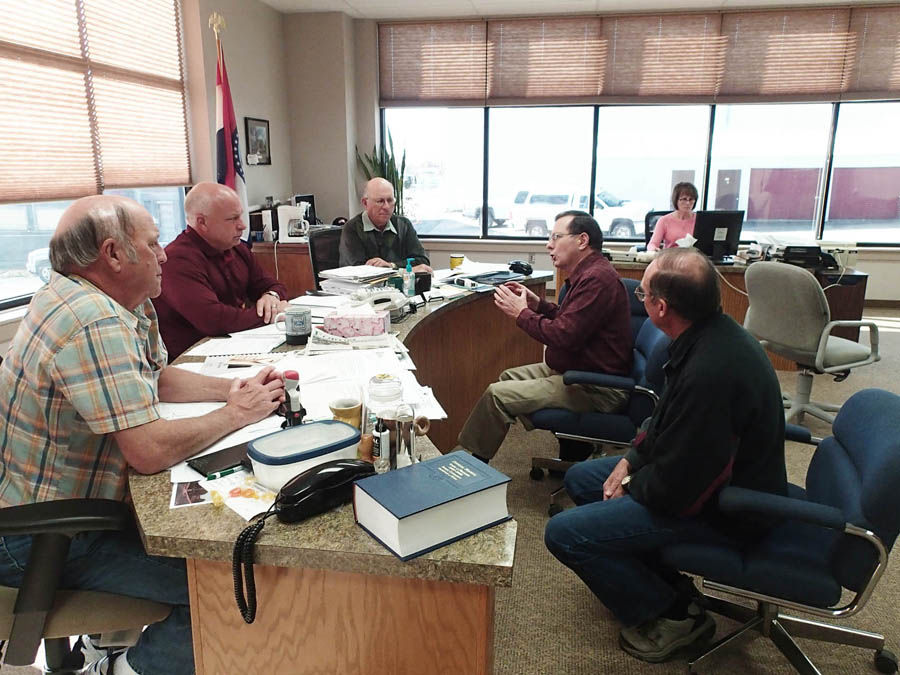
TONY BROWN/DAILY FORUM
Wayne Pierson, center, a member of the Lettuce Dream board of directors, addresses the Nodaway County Commission on Friday. Pierson and fellow board member Dick VanVactor, right, asked the commissioners to forward a letter on behalf of Lettuce Dream to the Missouri Department of Economic Development in connection with a request for Neighborhood Assistance Program tax credits. The credits would be sold by the local non-profit in order to finance a greenhouse complex used to provide vocational training to people with cognitive, developmental and physical disabilities.
Board members from the Lettuce Dream initiative — a local effort to provide post-high school vocational training for people with cognitive and physical disabilities — met with the Nodaway County Commission on Friday to request a letter of support with regard to a grant application to the Missouri Department of Economic Development.
The application will request permission for the sale of up to $300,000 in Neighborhood Assistance Program tax credits, proceeds from which would be used to construct a hydroponic greenhouse operation near the intersection of East First Street and the Highway 71 bypass.
The proposed greenhouses would be used to grow lettuce and other produce for sale to grocery stores, restaurants, institutional food service operations and wholesalers across the region.
Lettuce Dream board member Wayne Pierson said that the non-profit organization recently launched its inaugural capital campaign, which has raised about $10,000 in private donations over the past month. A “celebrity dinner” benefit last fall brought in another $20,000 for the initiative, which was organized two years ago by Maryville resident Diane Francis.
Francis and Pierson said Friday that the organization needs to raise at least $300,000 before it can begin construction on a 3-acre site donated by Maryville East Side Development, a corporation owned by local businessmen Mark and Myles Burnsides.
Pierson said that while the NAP application seeks that amount in tax credits, the odds of acceptance into the highly competitive program are “slim,” and that private donations remain vital if the project is to move forward.
NAP credits are sold to businesses or individuals with business income and essentially allow a $70 credit for every $100 of tax liability. In addition, the remaining $30 can be counted as a tax-deductible charitable donation.
The city of Maryville used similar tax credit financing to pay for a portion of the ongoing West Fourth Street streetscape project.
During their presentation to the commission, Pierson and fellow board member Dick VanVactor said that phase one of the proposed Lettuce Dream complex would consist of two green houses and an operations building containing environmental controls, office space and storage.
Francis said that one of the greenhouses will essentially serve as a training center for Lettuce Dream clients who would assist in cultivating produce while acquiring job skills designed to prepare them for the workplace. The second greenhouse, while still incorporating clients, is to function as a “production” facility.
Unlike sheltered workshops, like Maryville’s NoCoMo Industries, Lettuce Dream clients would not be paid.
Francis compared the proposed operation to a trade school or college for the developmentally disabled and other handicapped persons, who she said have few educational alternatives following high school.
However, Francis said, some clients would likely receive paid positions at the greenhouse complex after completing a series of training “modules” qualifying them to serve as trainers themselves or accomplish other specialized tasks.
After meeting with the commission, Pierson said Lettuce Dream would only serve clients that have a relatively high level of mental and physical ability, potentially qualifying them for employment in the private sector.
“We’re talking about a very specific group of people,” he said.
Following completion of “phase one,” consisting of the two greenhouses and operations building, the group wants to push forward with at least a pair of expansions comprising two more greenhouses, a warehouse and an office building.
Long-range plans call for as many as 16 greenhouses as well as additional support structures.
Pierson said initial professional staffing after completion of phase one will likely include an executive manager, operations manager and an assistant manger charged with client training.
Lettuce Dream is organized using a business model established by Wendie Blanchard, founder of Arthur & Friends, a New Jersey-based non-profit with a greenhouse operation serving wholesale and retail markets across greater New York City.
Blanchard’s organization, which has provided training materials and consulting services to similar organizations in various parts of the country, was engaged by Lettuce Dream in 2013 for a fee of $10,000 plus an additional $2,500 consulting fee over each of the next five years.