Workshop charts course for downtown
TONY BROWN/DAILY FORUM
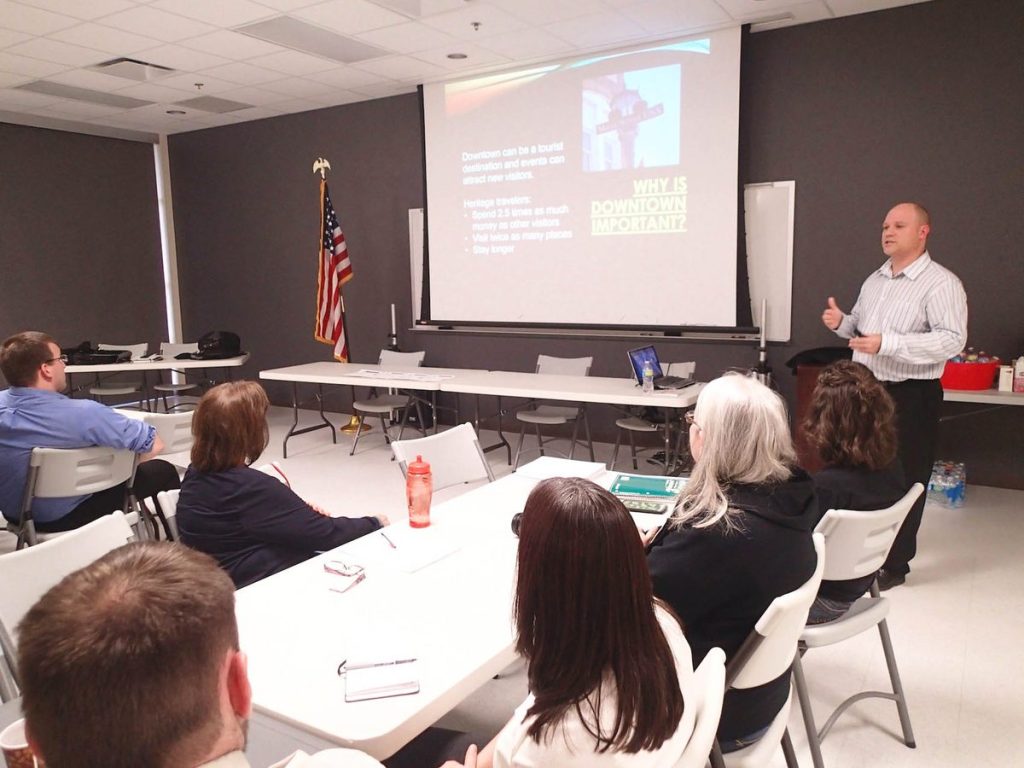
Keith Winge, standing, of Missouri Main Street Connection led a workshop Thursday for a group of business owners and other local residents seeking to lead an economic and social resurgence of Maryville’s central business district.
A cross section of public officials, business owners, City Council candidates, retirees and civic leaders gathered at the Maryville Community Center Thursday evening for a workshop designed to cover the gossamer vision of a vital, growing downtown Maryville with the flesh and bone of action.
The two-hour session was led by Keith Winge, a Northwest Missouri State University alumnus who is now the state community development director for Missouri Main Street Connection.
Winge’s non-profit consulting firm was hired by the Maryville Downtown Improvement Organization to help craft a plan for renewing Maryville’s shopworn central business district, an area centered around the courthouse square and extending from Jenkins Street north to Franklin Park.
Brought on board for $9,600 provided to MDIO by the city of Maryville, Branson-based Missouri Mainstreet has agreed to provide the downtown renewal organization with $24,400 worth of training and organizational resources over the next two years.
On Thursday, Winge said the two-year “grant cycle” would prepare MDIO, an organization made up mostly of downtown business and property owners, to “build the foundation with which to do great things with downtown.”
Winge, who started his career in the hotel industry, has been with Missouri Main Street about 18 months, but has years of hands-on experience in working to rebuild a blighted central business district.
As a board member and later executive director of the Downtown Excelsior Partnership, Winge helped lead the successful resurgence of the core commercial area in Excelsior Springs.
That effort culminated in a $27 million investment leading to the restoration and development of The Elms Hotel and Spa and the Villas Downtown, a residential project embracing 30 single-family homes and 12 restored historic apartments.
Winge said a key element in the success of the Excelsior Springs effort and other Missouri Main Street projects is R-and-D, an acronym that stands for “rip off and duplicate.”
In other words, the organization functions as a sort of library for practices that have proven successful one place and, with guidance, can be replicated elsewhere.
Missouri Main Street currently has 140 “aspiring” communities seeking to improve their downtowns. Additionally, 11 cities, including Maryville, have been approved for grant status, and six have become accredited by the National Main Street Center for making significant strides toward renewal.
Missouri cities achieving the national distinction include Liberty, Lee’s Summit, Chillicothe, Warrensburg, Washington and Cape Girardeau.
Since 2006, Winge said, Missouri Main Street communities have amassed $668 million in private investment, $128 million in public investment, and created a net total of 432 businesses and 2,605 jobs.
The engine driving those numbers, he said, is fueled by volunteers committed to making their downtowns better places to live and work.
Since 2006, Winge said, volunteers in Missouri Main Street communities have put in 245,000 hours of service, the in-kind equivalent of $5.2 million.
“That’s a big investment by people who believe in their downtown and want to be a part of it,” he said.
While Winge outlined numerous components that go into a successful downtown recovery, he emphasized that one constant is historic preservation, which he called key both to a sense of community pride and purpose and the growth of a local tourism industry.
Winge said that so-called “heritage visitors,” tourists interested in vintage architecture and local history, spend an average of two and a half times more money than other out-of-towners.
Following Winge’s presentation, the 35 people attending the workshop broke up into groups representing the four MDIO standing committees, each of which is responsible for a major component of the overall downtown revitalization effort: organization, economic restructuring, aesthetic design and promotion.
Committee chairs are Kevin Romig, an assistant professor of humanities and social sciences at Northwest Missouri State University, whose academic interests center on urban planning (design); Sam Mason, underwriting sales executive for KXCV/KRNW FM, the university’s public radio station (promotion); Josh McKim, executive director of Nodaway County Economic Development (economic restructuring); and Amy Strough, personnel director for the city of Maryville (organization).
The breakout meetings resulted in a list of “WIGs,” Winge’s term for “Wildly Important Goals.”
A few of the WIGs emerging from the small-group sessions included improved signage, continued preservation of the Nodaway County Courthouse, branding of downtown as a family destination, development of a major annual downtown festival, and more involvement in downtown activities by schools and youth groups.
On the economic development front, McKim’s panel suggested development of a menu of economic incentives designed to encourage building upgrades and other private investment along with a campaign to infill empty lots, such as those on the east and west sides of the Third and Main intersection.
TONY BROWN/DAILY FORUM
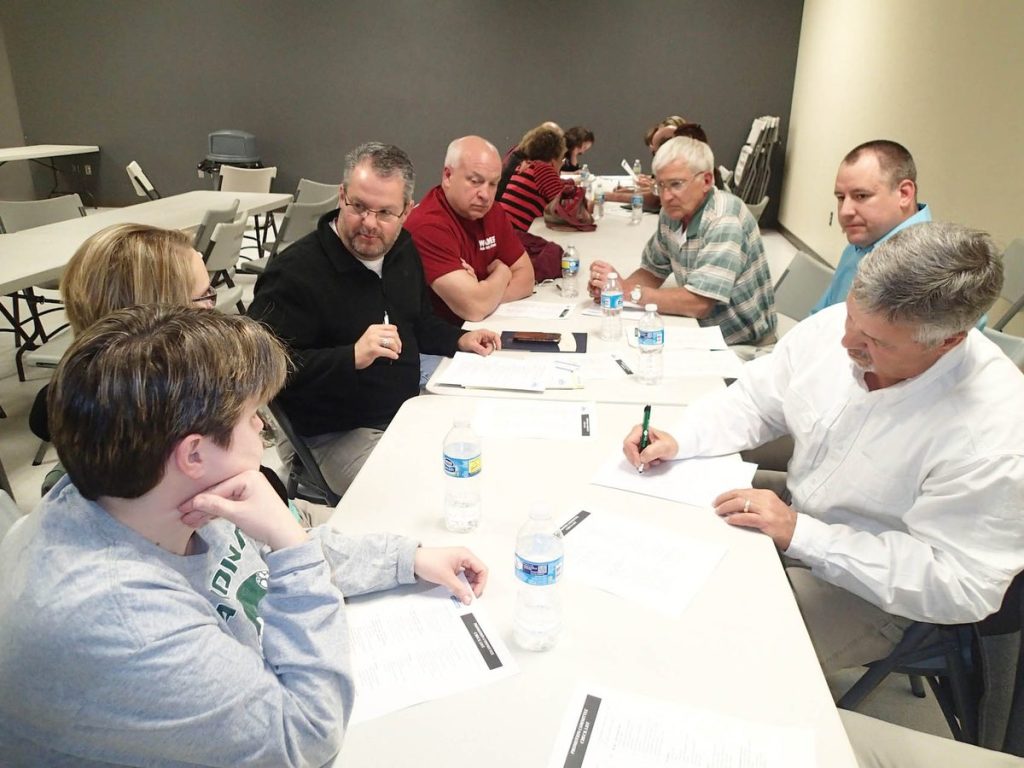
KXCV radio’s Sam Mason, third from left, leads a breakout group session Thursday evening that discussed ways to promote and market downtown Maryville. The discussion was part of a Maryville Downtown Improvement Organization workshop led by Keith Winge, a Northwest Missouri State University alumnus who is now the state community development director for Missouri Main Street Connection.