
Bill would mandate rural school mergers

TONY BROWN/DAILY FORUM
South Nodaway R-IV School Librarian Demise Bloom supervises a group of first-graders on their way back to class following a reading period. With a kindergarten-through-12th-grade enrollment of 160, South Nodaway is the county’s second smallest school district and would be one of six local districts forced into “administrative consolidation” under pending legislation in the Missouri House of Representatives.
While it’s likely just a shot over the bow during the current session of the Missouri Legislature, a House bill that would mandate the administrative consolidation of around 200 small, mostly rural school districts has caught the attention of educators and outstate lawmakers alike.
Introduced by state Rep. Kurt Bahr, a Republican from suburban St. Louis, House Bill 1292 would, if signed into law, force the consolidation of every Missouri school district with an enrollment of less than 350 students.
Just over a third of Missouri’s 572 school districts would be affected by such a law, including six of the seven public school districts in Nodaway County, the sole exception being Maryville R-II, which has about 1,400 students.
Also included would be all of the districts in Atchison, Holt and Worth counties and small schools like Stanberry and King City in Gentry County.
HB 1292 has been read twice in the House but has yet to be referred to committee.
State Rep. Allen Andrews, whose 1st District includes Nodaway County, said Tuesday the proposed legislation does not call for physical mergers involving the actual closing of school buildings but merely “administrative” consolidations of two or more districts.
That means the combined districts would operate under a single superintendent and school board and perhaps share other personnel as well.
However, Andrews believes the proposal’s wording illustrates misconceptions many urban and suburban lawmakers have about the way rural districts work.
“Administrative consolidation is bad enough,” said Andrews, adding that he has spoken at length with the bill’s sponsor. “But if this measure were to pass it would only be a matter of time before we begin to have physical consolidations where schools would be closed.
“I’ve had many conversations with urban legislators at the Capitol, and what they don’t realize is that schools and churches are the hubs of our rural communities, and once they close, it isn’t long before those communities fade away.”
Now in the first year of his two-year freshman term in the House, Andrews said the bill reflects an intrinsic rural-urban split that has been a component of Missouri politics for decades.
“People say that there is a big difference between Republicans and Democrats,” Andrews said, “and that’s true, but there is just as much of a difference between rural and urban legislators. On issues like agriculture and education, a lot of them have just not been exposed to the way our life is here.”
That tension, Andrews said, is fueled by the continuing decline in population in northwest Missouri and other rural parts of the state, which he admitted could make “redistricting” of small school districts inevitable at some point.
But not, he hopes, anytime soon.
“It’s something we will have to address,” he said, “and that’s why we have to make sure we do everything we can through economic development to bring businesses here. We have to make sure that northwest Missouri continues to be a viable place to work and raise our families.”
One reason, Andrews said, that administrative consolidation and school closings could well amount to the same thing in northwest Missouri has to do with the vagaries of the state’s foundation formula, the complex system through which legislative appropriations are allocated to local districts.
When the foundation formula was overhauled several years ago, a significant number of districts were classed as “hold harmless,” meaning that they would receive full funding under the old formula.
Some of those districts achieved hold-harmless status by raising their local tax levies. Others were placed into the category because not doing so would have cut their state funding to a level that would have made it virtually impossible to keep school doors open.
Administrative consolidation would probably make some rural districts large enough that they would no longer qualify for hold-harmless status, which South Nodaway R-IV Superintendent Johnnie Silkett said could lead to budget cuts so deep that building closures would become a fiscal necessity.
Like Andrews, Silkett doesn’t think HB 1292 has much of a chance of passing during the current session. But he added that this is the first such proposal to be framed as an actual bill.
“The odds of this getting out this year are very, very slim,” he said. “The worry is that it’s started. In my 19 years in education, this is the first such bill we have actually seen.”
Silkett described the measure as “basically a money grab” by urban lawmakers to free up more funds for districts serving thousands of students at the expense of those, like South Nodaway, that serve less than 200.
“My issue with the whole thing is that right now there is zero incentive for any small school to consolidate,” Silkett said. “What the majority of people don’t understand is where does the extra money (saved by consolidation) go? It goes right back into the pot, and then the large school districts receive more funding. You’re robbing Peter to pay Paul.”
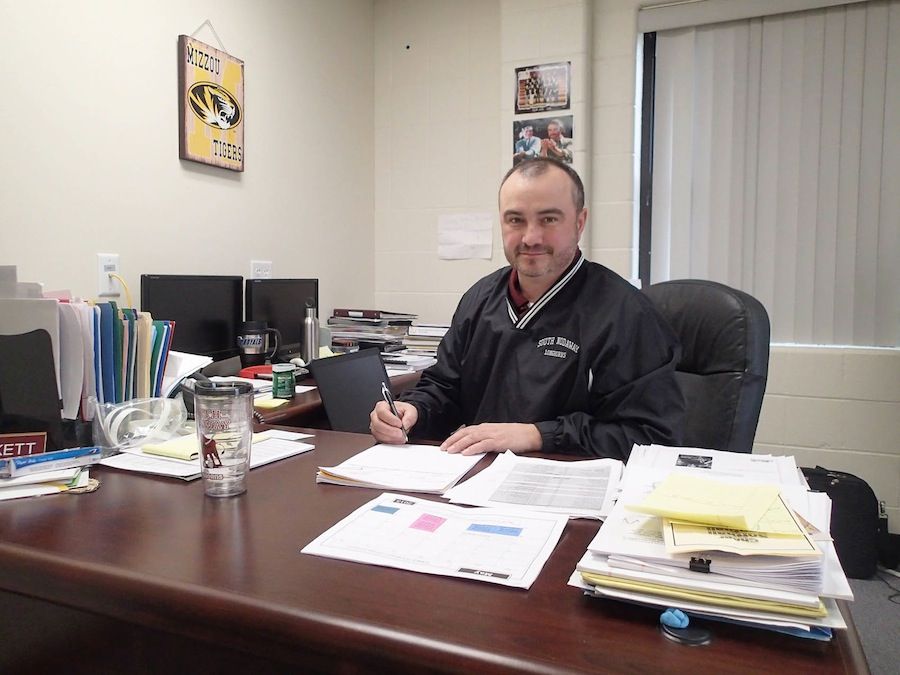
TONY BROWN/DAILY FORUM
South Nodaway R-IV Superintendent Johnnie Silkett, above, said there is virtually no chance that a small-schools consolidation bill will gain approval in the Missouri Legislature this year. However, he adds that the fact such a bill has been introduced means the issue isn’t likely to go away anytime soon. Silkett described the current proposal as “basically a money grab” by urban and suburban lawmakers to free up more funds for large school districts at the expense of rural communities.




