Northeast Nodaway team graduates from e2 Fellowship
SUBMITTED PHOTO
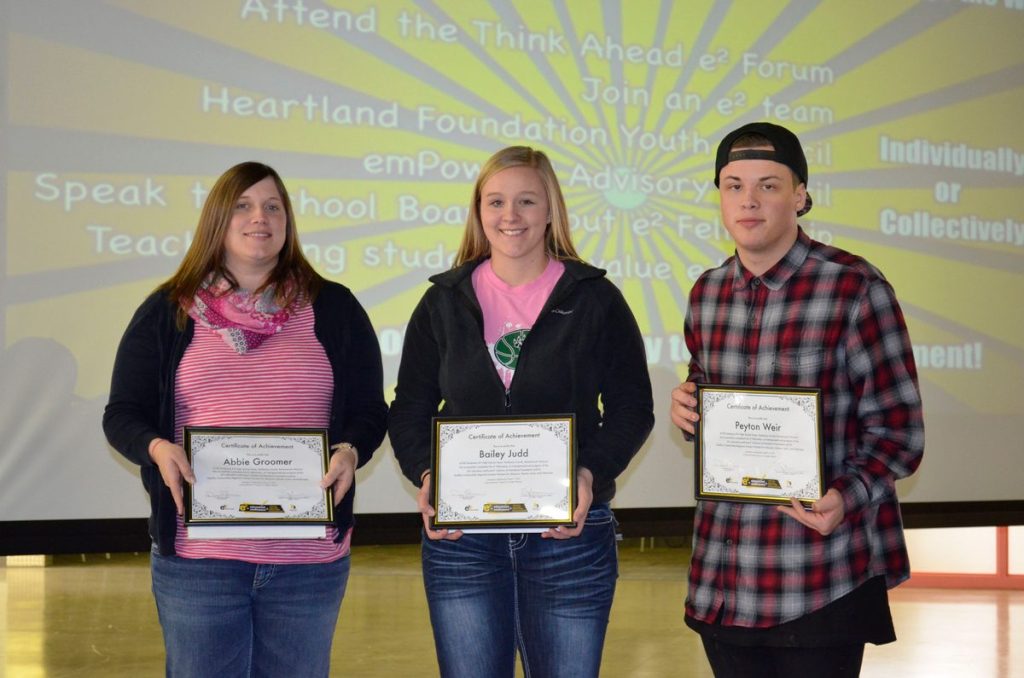
Northeast Nodaway R-V counselor Abbie Groomer (left) and Northeast students senior Bailey Judd and junior Peyton Weir participated in the 2014-2015 Heartland Foundation e2 Fellowship. The program was designed to develop a growing appreciation for lifelong learning and a greater understanding of education’s role in the region’s vitality.
Northeast Nodaway R-V counselor Abbie Groomer and two Northeast Nodaway high school students, senior Bailey Judd and junior Peyton Weir, graduated from Heartland Foundation’s e2 Fellowship program. The program was designed to give participants an appreciation for lifelong learning and a greater understanding of education’s role in the region’s vitality.
Twelve teams, including teams from Pottawattamie County, Iowa and Doniphan County, Ks. graduated in the initial 2014-2015 class.
“Basically, the program showed all of us just how important education is to working out community and regional problems,” Groomer said. “It also made all of us aware of the diversity that exists from community to community, county to county and state to state.”
Groomer said she was first made aware of the program in the spring of 2014, as the Heartland Foundation went from school to school outlining both the program and its mission.
“After I learned about it, I talked with our administration about participating, and they were for it,” Groomer said. “We all have learned lots of information that we can bring back to the school and to the students.”
The e2 Fellowship met in four sessions at the empower Campus in St. Joseph. Session one, held in September of 2014, dealt with understanding how important educational attainment and lifelong learning are to the overall health and well-being of individuals, households, neighborhoods, communities, the region, and our country. “Teachers always tell you how important education is,” Weir said. “The program really brought that home to me in a strong way.”
Session two, held in November of 2014, explored how America ranks compared to other countries in the area of educational effectiveness. The focus then shifted to the goal of finding agreed upon ways to work together to improve our national ranking and make our educational system more effective. Session three, held in January of 2015, gave participants an opportunity to experience power struggles and shifts first-hand to better understand how poverty and prosperity play a role in the decisions leaders make.
“It was interesting to see the differences in poverty levels from county to county,” Judd said. “It was also interesting to see the difference county-to-county in graduation rates, birth rates and death rates, and how those factors influence county affairs.”
March’s session four featured a presentation by former Missouri Representative Mike Thomson and made participants aware of how large a role emotions and value systems impact the very complex budgeting and lawmaking process our elected officials face. “As an adult, the program made me even more aware of the importance of education,” Groomer said. “To the students, this fact really hit home and made them aware of how critically important an education is.
“The students also had the opportunity to voice their opinions, and they appreciated that. It was interesting to see some of those opinions change as the program went on.”