City extends development incentives
TONY BROWN/DAILY FORUM
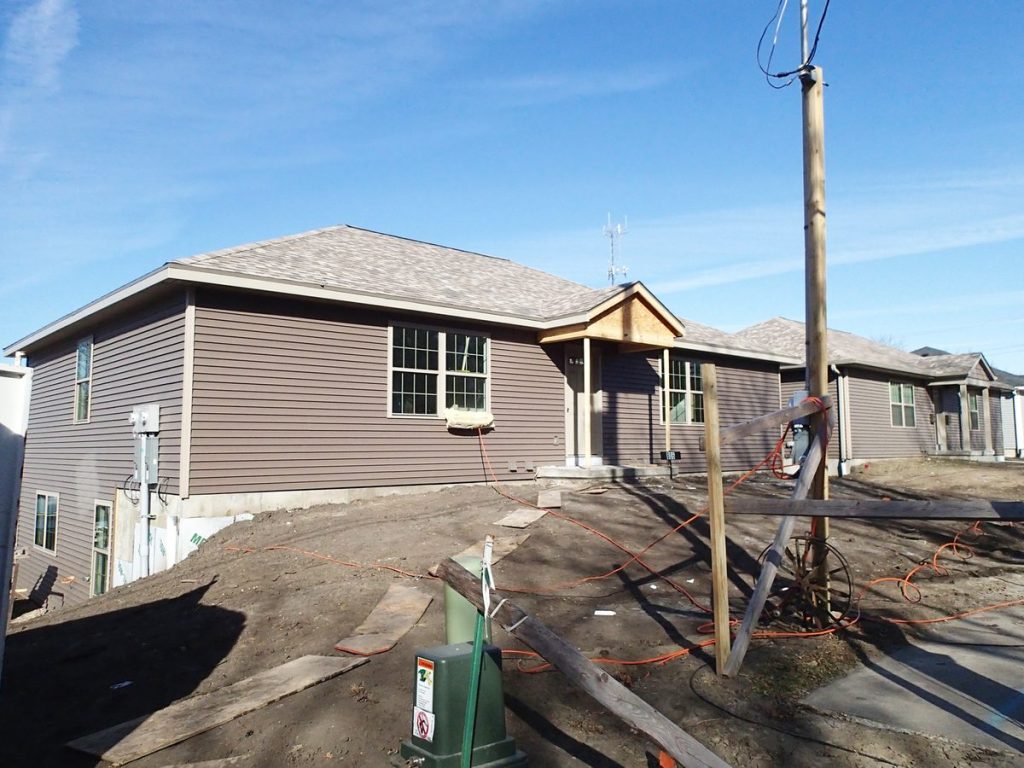
Ongoing construction of duplexes in the 800 block of North Walnut, pictured here, is one of a half-dozen development projects undertaken over the past couple of years under the city’s Campus Town Redevelopment Incentive Program, which allows builders to avoid debris disposal and permit fees in aging neighborhoods to the east of the Northwest Missouri State University campus.
The City of Maryville’s Campus Town Redevelopment Incentive Program, an initiative designed to encourage both the demolition of substandard housing and new construction in the neighborhoods immediately to the east of Northwest Missouri State University, will continue for two more years.
The Maryville City Council this week unanimously voted to continue the program, which City Manager Greg McDanel said has led to four completed apartment or duplex developments, plus a fifth project in the 800 block of North Walnut that is still under way.
The other housing units are located at 304 and 306 W. Ninth, 114 W. Ninth, the 500 block and vicinity of West Fifth, and 621 N. Walnut.
A sixth project, which included demolition of a dilapidated two-story house at the corner North Fillmore and West Fourth, has not yet resulted in new construction. However, according to McDanel, clearing and leveling the lot saved the ongoing Fourth Street streetscape project about $50,000 by eliminating the need for a retaining wall.
The CTRIP process allows landowners and potential developers working within the Campus Town zoning overlay district to submit an application and development plans that, if approved by the city, result in the waiver of demolition debris “tipping fees” at Maryville’s solid waste transfer station as well as all construction permit fees associated with redevelopment.
McDanel said each application is considered in light of a number of factors, including condition of existing structures, quality of the redevelopment plan, tax base impact and improvement to the overall appearance of the neighborhood.
Approved applicants must sign an agreement stating that they will demolish existing structures within three months and begin new construction within 12 months.
In renewing CTRIP for another two years, the council followed McDanel’s recommendation and eliminated a $20,000 cap on the tipping fee waiver. The city manager said tipping fees for individual CTRIP projects have so far have fallen short of that amount, and that he feared leaving the cap in place might, at some point, discourage large-scale development in the area.
The Campus Town overlay district was created in 2012 and designated in the city’s comprehensive plan as an area suitable for “infill and redevelopment” in the form of high-density rental housing. The overlay — an area to which special zoning restrictions or exceptions apply — comprises about 40 blocks generally east of the Northwest campus and stretching north to south from Twelfth Street to just north of Second Street and east to west from Main Street (excluding downtown) to the university.
Since CTRIP was established in April 2013, McDanel said Campus Town development has resulted in nearly $25,000 in new annual property tax revenues and $1.9 million in new appraised value on $3.3 million worth of construction. He said waived city permit and demolition fees over the past two years have totaled just over $28,000.
Councilman Jeff Funston said the CTRIP initiative has proven its worth and should perhaps eventually be expanded to include other parts of the city.
McDanel responded that preliminary staff discussions have addressed the possible creation of a downtown overlay that would both offer incentives for development while restricting “inappropriate” ventures such as storage facilities, convenience stores or fast-food restaurants.
In other business during its regular Monday session, the council:
• Approved street closings for the 27th annual World’s Shortest St. Patrick’s Day Parade, which will be held for the first time in the 300 block of North market Street in front of Burny’s Sports Bar. This year’s parade will take place at 3:17 p.m. Saturday, March 14.
• Approved plans for a second phase of construction at Southview Apartments on South Main Street that will include two 16-plex units on four and a half acres. As with 40-unit phase one, the apartments are being developed by Volunteer Management & Development Co. of Jackson, Tennessee. The project will also embrace a 440-foot street extension and a 180-foot extension of an existing water line.
• Agreed to accept a state grant for a paved “Spoofhound Trail” pedestrian walkway that will link existing trails running along South Munn Avenue and between Maryville High School and St. Francis Hospital. McDanel said the city has been notified by the Missouri Department of Transportation that the trail project has been approved for up to $130,942 in federal Transportation Alternative Program funds. Participation requires a 20 percent local match.
• Accepted a bid from Kansas Golf & Turf for the purchase of a new greens roller for Mozingo Lake Recreation Park at a cost of $11,030. Assistant City Manager Ryan Heiland said the new roller is needed to maintain the park’s golf complex, which will grow from 18 to 27 holes this year with the opening of the nine-hole Tom Watson Junior Golf Course.
TONY BROWN/DAILY FORUM
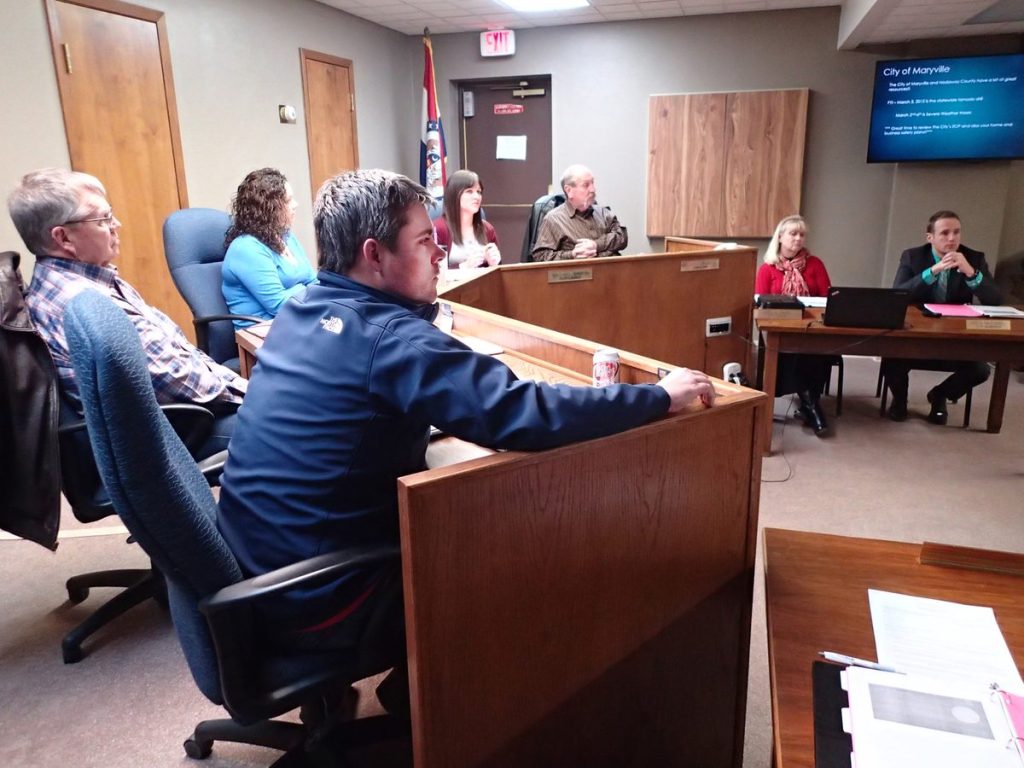
The Maryville City Council this week voted to extend the city’s Campus Town Redevelopment Incentive Program for another two years. City Manager Greg McDanel said the program has resulted in nearly $25,000 in new annual property tax revenues and $1.9 million in new appraised value on $3.3 million worth of construction. Pictured seated left to right clockwise around the council dais are council members Tim Shipley, Jeff Funston, Renee Riedel, Rachael Martin and Jerry Riggs.