Progress taking place at Northwest
ELIZABETH GOLDEN/DAILY FORUM
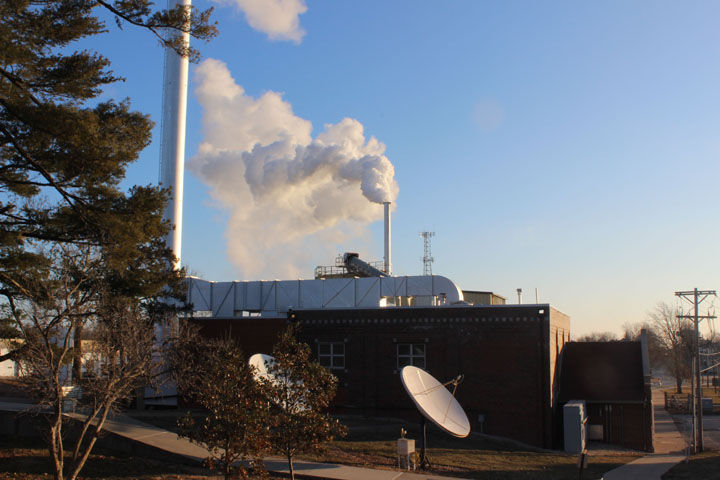
Northwest Missouri State University is in the process of qualifying for $6.8 million from the state dedicated toward deferred maintenance needs. The power plant, pictured here, is one of three areas identified as needing improvement in addition to window repairs and electrical system repairs.
Progress is definitely in progress this year at Northwest Missouri State University.
From a focus on interdisciplinary programs to receiving competitive state grants, Northwest has had a busy year and has an even busier one to come.
President John Jasinski said the university primarily boosted progress through a focus on performance.
“At the end of the day, people love to align themselves with winners,” he said. “Certainly Northwest is performing at championship levels.”
In December, Northwest announced that the university achieved all five benchmarks within the state of Missouri’s performance-based funding model for the third straight year. Therefore, Northwest will receive 100 percent of the funding appropriated to the university within the state’s FY16 budget.
“We are performing at the highest level against our competitive set in-state and across the nation,” Jasinski said. “There are only four other universities in the state who have received that level.”
As a result of high standards, Northwest’s career placement rose to 97.5 percent in August.
The most recent percentage is based on 2012-2013 data gathered by Northwest Career Services and shows a slight increase from Northwest’s 2011-2012 rate of 97.4 percent among bachelor degree recipients.
Additionally, 99 percent of Northwest students who have completed a master’s degree for the same period are in a job or continuing their education.
“We’re profession based,” Jasinski said. “We get what the industries need and we deliver, and obviously our students do what they need to do to be successful. The students, faculty and community really bring it all together.”
In addition, in March the Board of Regents approved no increase in undergraduate tuition, making the university have one of the lowest tuition rate increases in the country, Jasinski said.
The university also offers financial aid to 90 percent of first-time freshman, and offers employment to more than 1200 students.
“The real focus on access and affordability is crucial,” Jasinski said. “Then when we talk about quality, we’re constantly ranked in the top.”
Northwest was ranked by U.S. News & World Reports as a top regional university in 2014 in addition to other awards.
“We’ve had 15 national championships over the past five years in the academics,” Jasinski said. “We have an unbelievable faculty and staff. We’re very proud of our performance. There’s always opportunities to improve, but we’re very happy with the way things are going.”
Over the past year, Jasinski said the university has made significant changes in order to align with the strategic plan.
“We’re focusing on innovative enrollment growth and college completion,” he said. “That means get students here, but also get them through the end, whatever the end is for them.”
As for changes, the university has focused on international recruiting, recruiting across various markets, methods for recruiting, adding additional programs, deleting programs and analyzing college completion.
“We’ve studied the best practices for college completion,” Jasinski said. “We’ve implemented several measures to get the students through the pipeline.”
In December, the Behavioral Sciences Department passed a multiple action proposal to create a master’s program in Sport and Exercise Psychology.
Northwest Provost Timothy Mottet said there are no peer institutions offering similar programs.
According to the Association of Sports Psychology, there is an anticipated increase in occupations in this field, and those occupations are expected to grow rapidly.
Completion of the program will allow students to apply for Sport Psychology Consultant Certification through the Association for Advanced Sport Psychology.
This new requirement allowed for the creation of four new courses, including “sport and exercise psychology,” “advanced sport and exercise psychology,” “professional ethics and standards in sport and exercise psychology” and “practicum in sport and exercise psychology.”
Forty-five total hours are required for the program.
“We’re headed toward those kinds of programs that are interdisciplinary,” Jasinski said.”
Most recently, Gov. Jay Nixon awarded Northwest with a $450,000 grant to help fund the Northland Center for Advanced Professional Studies. This initiative gives young people the opportunity to earn college credit while still in high school in addition to serving as interns at Kansas City-area businesses.
The Northland CAPS Innovation Campus is a partnership between Metropolitan Community College; Northwest; Cerner Corp.; other Kansas City area businesses; and the Kearney, Liberty, North Kansas City, Park Hill, Platte County and Smithville school districts.
The program allows high school students from participating districts to earn dual college credit through MCC. Students also have the opportunity to acquire three hours of dual college credit from Northwest by successfully completing internships with one of approximately 90 Innovation Campus businesses and corporations.
“This is significant because they are competitive in nature,” Jasinski said. “We were up against every institution in the state. The grant is all about competency-based education. It’s one of the industry trends that is hear to stay and will put us on the cutting edge. The innovative partnership is something few can claim, but it’s really about doing what’s best for the students.”
Beyond academic programming and partnerships, Jasinski said the facilities have been a major focus over the past year as the university has invested more than $1 million in academic furniture.
“We wanted to bring it up to industry-wide standards in order to meet the needs of students today,” Jasinski said.
As for facilities, in November the Board of Regents approved the construction budget for the Robert and Virginia Foster Fitness Center.
The project calls for a complete remodel of the existing 4,000 square-foot Robert P. Foster Aquatic Center, which has been renamed the Robert and Virginia Foster Fitness Center.
Plans also call for a 1,330 square-foot entryway to be added to the existing structure along with a 2,300 square-foot mezzanine overlooking Colden Pond and the Joyce and Harvey White International Plaza.
The fitness center is set to open in the fall.
As of early January, the project was 12 percent complete.
Progress is daily on that project,” Jasinski said. “We’ll get to the grand opening and it will become part of the culture in terms of health and wellness, and help our students in this fast-paced environment. We see significant progress ahead for that.”
In terms of projected progress, the Missouri legislature is in the process of deciding to approve bonds, which would finance various long-delayed repairs and renovations at Northwest Missouri State University.
Senate Bill 723, approved during the 2014 state legislative session, increased the state’s bonding capacity to $600 million, including a $200 million increase for projects at the state’s universities.
In the 2015 legislative session, Nixon is planning to introduce a supplemental appropriation bill to authorize the issuance of bonds to fund $200 million in higher education maintenance and repair projects, which would be allocated proportionally between two-year and four-year institutions.
“We have a backlog of deferred maintenance needs,” said Stacy Carrick, vice president of finance at Northwest. “These are things you don’t see, they’re behind the scenes and not often funded by donors. These repairs go unfunded in a lot of situations since they’re ignored when the money gets tight.”
Out of the $200 million, Northwest’s share of the bonding funds is currently projected to be $6.8 million, Carrick said.
“One of the challenges we’ve had over the years is having funds to be able to address many deferred maintenance needs,” Carrick said. “Protecting our infrastructure while addressing life safety and energy efficiencies continues to be a priority in addressing our repairs.”
In addition to helping with repairs, Jasinski said these bonds will help with economic activity as well.
Jasinski also said he is looking forward to the progress with the fourth street improvement project.
“Phase one will be complete sometime this spring,” he said. “Beyond that, we see a second phase and signage on Main Street. We’ve been blessed to partner with the city. The project is a gateway back to the community; the synergy between town and gown. We know there is more to come.”
In the past year, the Board of Regents voted in December to increase the bandwidth on campus.
The university is currently paying $73,000 for bandwidth. This will now increase by $10,000, an amount to be paid through university grants, according to Roger Von Holzen, vice president for information technology.
“Student use of mobile devices is exploding,” Von Holzen said. “Our Internet traffic is just phenomenal. We’re maxed out almost every day because of how much students use it. We’re anticipating that so we can have things in place.”
The university has also focused on providing employees with a Health Risk Assessment, a biometric screening that tests employees for various health issues, including high cholesterol, blood sugar issues and blood pressure problems.
The test is free for university employees and funded through Blue Cross Blue Shield.
“Blue Cross Blue Shield provides it all,” said Anne Long, a Human Resources generalist for the university. “We are lucky to have a healthcare provider partner with us to say how we can help our employment population become healthy. It’s a good opportunity for employees to know what their health looks like, which is very important for them.”
In addition, Title IX training has also become a focus within the last year. All students and faculty are required to complete Title IX training.
“Nobody wants sexual assault training until they wanted it yesterday,” said Matt Baker, vice president of student affairs. “It’s not something someone needs until the moment they need it now. We’re trying to get students to recognize the value of being prepared, knowing their rights, knowing how not to get into those situations, as well as what to do if they do find themselves in a situation.”
To date, 88 percent of students and 99 percent of employees have been trained.
Title IX prohibits sex discrimination in all university programs and activities.
Enforced by the U.S. Department of Education and the Office for Civil Rights, Title IX outlines several aspects of sexual assault investigations.
“Title IX is a topic that was different in what it meant a few years ago,” Jasinski said. “Now it has a different connotation.”
As for academic departments, the College of Education and Human Services was reaccredited in 2014.
The college met standards in five out of six areas.
“It was a big boom to us that we had no areas for improvement in five out of six standards,” said Joyce Piveral, dean of the College of Education and Human Services. “But, they weren’t able to determine that we ensured our candidates had interaction with diverse race and ethnicity groups. We have some racial diversity, but maybe not in every class or every level of training.”
Although the progress in the past year and upcoming year seems more than usual, Jasinski said it is only because the long-planning processes have come to an end.
“While it feels more fast paced, it’s about at what you would expect,” Jasinski said. “We have a plan in place with objectives. We are committed to putting that plan in action. It’s been a strong planning process and we’ve been able to act. It’s not terribly abnormal, but the things we’ve been working on are exciting and big. All in all, we’re happy.”
Jasinski said the strategic objectives have allowed the university to prioritize and enact certain actions.
“The objectives have allowed us to align our actions and make sure they’re enacted through the budget process,” he said. “We’ve focused on the objectives and goals. It tied all of our university goals together.”
As for the future progress, Jasinski said he is looking forward to continued student success every day.
“I’m looking forward to the next great idea,” he said, “the next partnership, enacting what we have in place and making it better. We will be agile and continually serve the students, make them better citizens and better in the work place.
“Student success is our mission. If you’re not passionate about that, you shouldn’t be going to work each and every day. It’s exciting to think about what students and communities will need next year or five years from now.”
This article is a part of the Daily Forum’s Progress Report. Click here to see the full e-edition for FREE!