Dog-handling deputy completes training
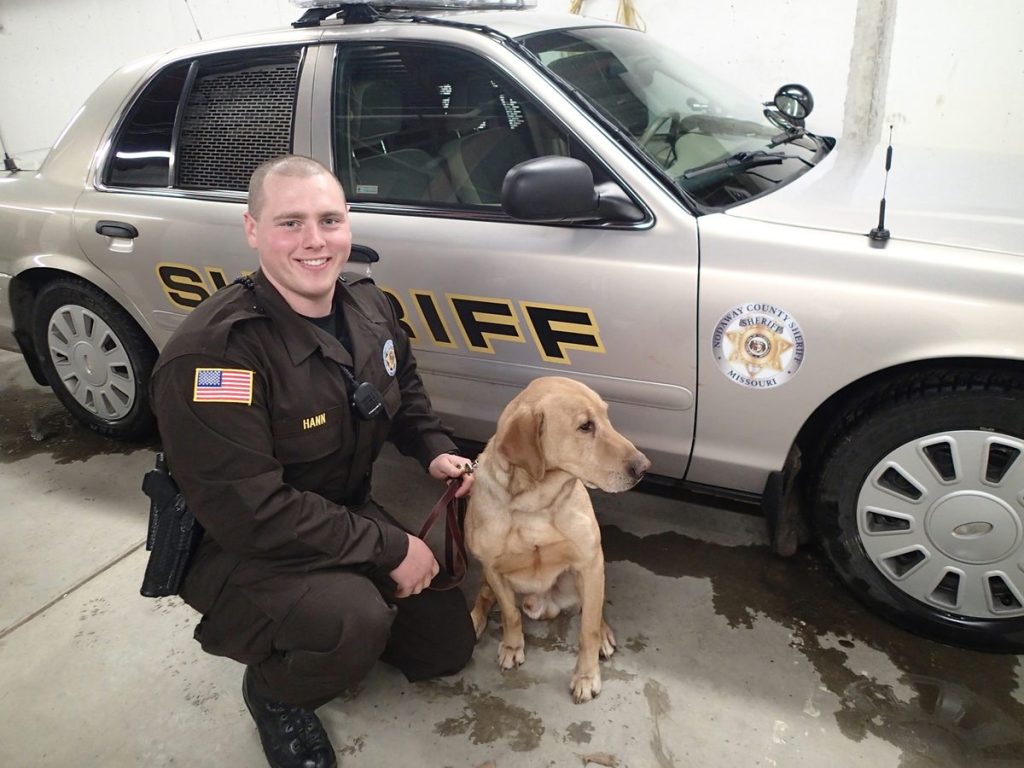
Nodaway County Sheriff’s Department K-9 handler Austin Hann kneels beside Jerik, the department’s veteran drug detection dog. Hann, who has replaced former handler Vince Lippincott, recently completed a three-week certification course and has been officially on duty with Jerik for the last several days.
Jerik, the specially trained drug detection dog owned by the Nodaway County Sheriff’s Department, officially returned to duty this week with a new partner.
Deputy Austin Hann and the 7-year-old golden retriever finished a three-week certification course Friday in Longford, Kan., and have been back on patrol for the past couple of days.
Hann is only the second handler Jerik has had. The county’s first-ever K-9 officer, Vince Lippincott, resigned last year after accepting a position with the Buchanan County Sheriff’s Department.
Though only just now serving as a fully certified team, Jerik and Hann have been unofficially in the field for some time during an extended bonding period required whenever a police dog is assigned a new partner.
Hann, a Grant City native with a public relations degree from Northwest Missouri State University, joined the Sheriff’s Department in 2010 as a dispatcher. He was commissioned as a deputy in December 2012 after completing law enforcement academy training in St. Joseph.
He said that when sheriff’s Capt. David Glidden approached him about the possibility of becoming the department’s new dog handler, he jumped at the chance.
“I love this job,” Hann said. “It’s an opportunity for me to be proactive and to do something that I really love doing.”
By “proactive” Hann means working with Jerik to find and seize illegal drugs before they can be sold or used.
Jerik, who receives a refresher course each year, is trained to sniff out cocaine, methamphetamine, heroin and marijuana and then alert officers to the presence of those substances.
“One of my favorite things to do is to get drugs off the street,” Hann said. “Obviously with a narcotics dog, that is what I’m going to be doing.”
While the training course in Kansas was old hat to Jerik, it was all new to Hann, who has never worked as a dog handler before.
He said the first part of the course involved learning about basic canine behaviors and responses. The closing days moved from theory to application, as Jerik and Hann ran through a series of exercises designed to simulate drug searches in a variety of environments.
The two will return for more training in a year’s time, but Hann said the refresher course will be both shorter and less intensive.
In some ways, Hann will face a different set of challenges than Lippincott due to Jerik’s age. Jerik will turn 8 this year, which for a working dog is well into late middle age.
“He still knows what he’s doing,” Hann said, “but obviously there will be things we’ll have to watch.”
Older police canines, he said, can be prone to arthritis, especially in cold weather, and it is also possible the dog will require vitamins, supplements and additional veterinary care in order to stay healthy and effective.
As time marches on, Hann said, it is also likely Jerik will spend fewer hours in field during extended searches.
Long searches are “a physical and mental strain on the dog anyway,” Hann said, “and age will add to that.”
Just how much longer Jerik will remain an active member of the department before being retired will depend largely on the dog itself, Hann said. He added that when the time comes, the plan, at least for now, is to acquire a new animal.
Since 2010, the year Jerik was purchased, a citizens group headed by Maryville resident Debbie Easterla has raised thousands of dollars for the dog’s training and equipment, meaning the K-9 program has cost very little in terms of tax dollars other than the handler’s salary.
Because Lippincott was and Hann is included in the department’s regular contingent of deputies, their paychecks represent no additional public expenditure.
Hann is assigned the same hours and patrols as other deputies but is considered essentially “on call” whenever the need for a drug search arises.
That hasn’t happened yet, but Hann said he is anxious to test his newly acquired K-9 skills in the real world.
“I’m looking forward to it,” he said. “It’s a tool we have that a lot of other agencies and departments don’t.”