Record crop exceeds highest projections
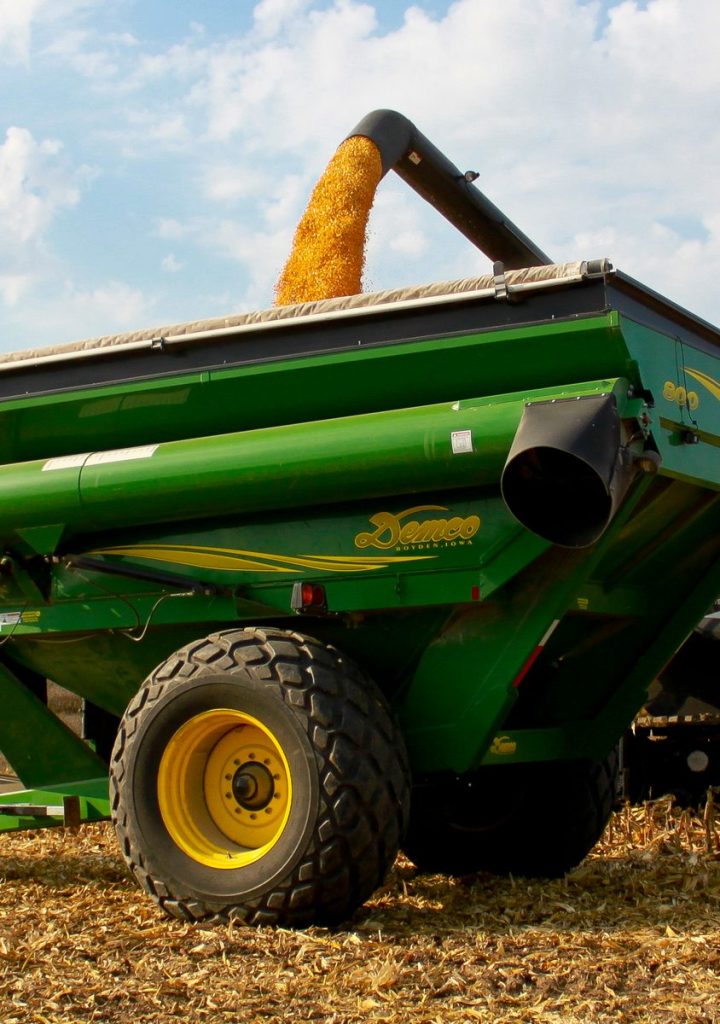
KAITY HOLTMAN/DAILY FORUM
The story of 2014 in Nodaway County was the record-breaking harvest and what that could potentially mean for the economic future of this region. Conditions for the growing season were described as “near perfect” and the results were a harvest which exceeded the highest of expectations.
As the New Year has come and gone, grain is very slowly leaving the heaping piles on farms and next to grain elevators across the county.
It was obvious farmers were breaking records, but until the 2014 harvest season ended, it was hard to know by just how much.
Official statistics from the United States Department of Agriculture’s National Agricultural Statistics Service show that the actual crop productions exceeded even their own projections set forth in November.
Missouri’s record corn yield of 186 bushels per acre, up six from the November estimate, broke the previous yield record of 162 bushels per acre set in 2004.
The total seed corn production was 628.68 million bushels, an increase of 162.1 million (35 percent) above the 2004 production records. The total production in 2014 was higher than 2011 and 2012 combined, and is a 50 bushel-per-acre increase over 2013.
Missouri’s soybean growers also saw a record yield of 46.5 bushels per acre, up 1.5 bushels per acre above both the November estimate and the previous record in 2004.
Total production was 260.4 million bushels, which is 29.8 million bushels (13 percent) above the 2009 harvest. With actual production up 8 million bushels from the November estimate, 2014 numbers show a yield increase of 11 bushels per acre and a production increase of 63 million bushels in 2014.
Tim Dreier, executive director of the Nodaway County Farm Service Agency, said he estimates comparable yields in this county.
“With the numbers farmers have mentioned to me, I think Nodaway County will mirror that of the state,” Dreier said. “That includes similar yields and record production.”
Consumer Oil manager Harold Spire echoed Dreier’s prediction.
“I’ve had guys coming in who were saying they had 50 to 75 bushels per acre over that statewide yield.
Nodaway County typically produces around 115,000 acres of corn and 130,000 acres of soybeans. Official yield and production numbers for each Missouri county will be released in February.
Dreier said 2014 was a once-in-a-lifetime crop year for nearly every farmer he’s talked to.
“Mother Nature played a huge role in having such a great crop here and across the country,” he said.
The Nodaway County FSA rain gauge showed 43.85 inches of total rainfall throughout the year, which is well above the 34.54-inch average since 1918.
Spire said the technology of the seed is the major driver for increasing grain yields and breaking yield records, especially when fewer acres are planted than in previous decades.
Looking at the 1946 yield, “80 to 90 bushels per acre was a big yield, now guys are aiming for 180 or more,” Spire said.
In December, the USDA-NASS estimated the 2014 capacity of on- and off-farm storage at around 765 million bushels. With a combined soybean and corn crop of nearly 890 million bushels, the production exceeded storage capacity by about 125 million bushels.
That excess grain lay on the ground for a long period of time, partly because there was no room for it in bins. However, most producers were in no hurry to sell grain because the markets favor buyers more than sellers.
“The market will likely correct itself if we see another normal year,” Dreier said.
During conversations in the early stages of harvest, Spire saidhe wasn’t worried about having enough room for the grain. Now looking at the ground where he just cleared out 180,000 bushels of excess corn, he admits he didn’t see this coming. While the pile is now gone, his bins are still mostly full.
“Low prices mean a lot of that will sit there longer than normal,” Spire said.
This record production reinforces farmers’ abilities to meet all the demands for feed, fuel and exports.
Historically, Missouri exports around 30 percent of the corn crop beyond the state’s border.s
Crops that stay in Missouri will be used for livestock feed and renewable fuels, including ethanol from corn and biodiesel from soybean oil.
“We have sold to a lot of different places, in Kansas City, Rock Port, and others,” Spire said. “Some corn has gone directly to the ethanol plants in St. Joe and Craig.”
He guesses fewer corn acres will be planted in 2015 because the increased supply has lowered prices.
“Input cost favors soybeans,” he said. “This area tends to have a 50/50 rotation of corn and soybeans anyway, but I could see some moving to 60/40 this year.”
Missouri ranked seventh in total corn production and sixth in total soybean production.
Leading states for both crops include Illinois, Iowa, Indiana, Minnesota and Nebraska.

KAITY HOLTMAN/DAILY FORUM
Consumer Oil manager Harold Spire has reduced the temporary surplus of corn the cooperative had stored on the ground at its Maryville facility for several weeks during the peak of this year’s record harvest.