
MoDOT funding woes could impact county
TONY BROWN/DAILY FORUM
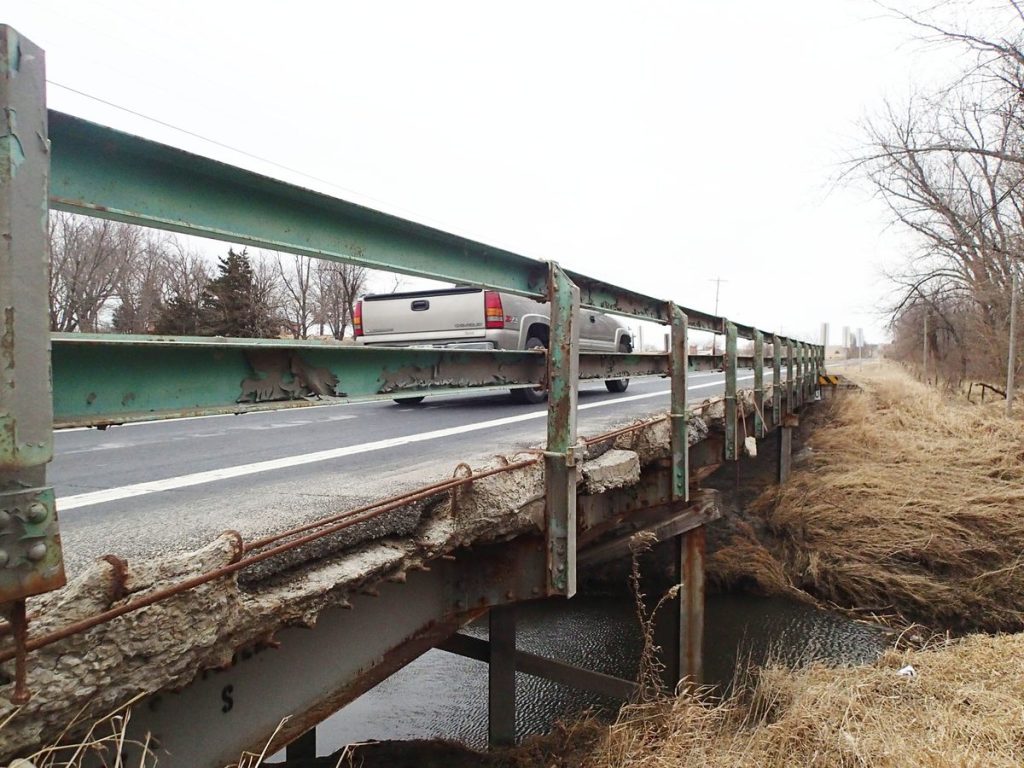
Decaying bridges, like this aging one-lane span on Highway 46 west of Maryville, could be weight limited or even closed under the 325 System plan proposed by the Missouri Department of Transportation. The blueprint is a worst-case scenario setting forth the agency’s response should state transportation funding drop to $325 million is fiscal 2017.
The rubber hasn’t quite hit the road yet, But Missouri Department of Transportation Area Engineer Michael Rinehart said this week that, when it comes to adequate funding, the state’s highway system — including the part serving Nodaway County — is rolling on worn tires.
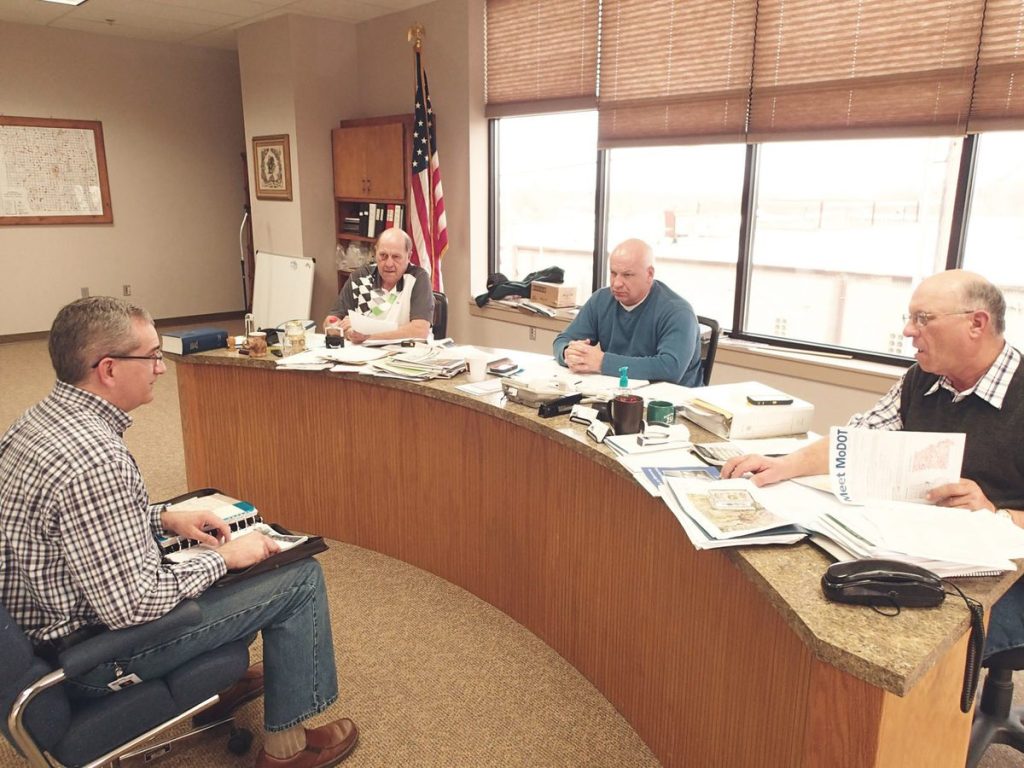
Rinehart met for about an hour with the County Commission on Wednesday, briefing them on an action plan MoDOT has christened “Tough Choices Ahead.”
The tough choices revolve around the so-called 325 System, meaning those state highways that will likely remain eligible starting in fiscal 2017 for major-expenditure maintenance carried out by contractors, as compared to smaller jobs, such as pothole patching, chip-and-seal surfacing and snow removal, performed by MoDOT crews.
July 2017 is when MoDOT officials predict the agency’s funding will drop to $325 million, just enough, they say, to continue contracted maintenance on “primary routes.”
In Nodaway County such jobs, including bridge repair and replacement, would be limited to Highway 136, Highway 148 and Highway 71.
Conspicuously absent from the list are Highway 46 — the sole paved access to Northwest Missouri Regional Airport — Highway 113 and Highway 246, along with all of the lettered farm-to-market blacktops that form a lifeline each fall for farmers trucking row crops to area gran elevators.
A draft version of the 325 System plan is to be submitted for approval to the state Highways and Transportation Commission on Feb. 4.
“We are facing significant insufficient funding on this issue,” Rinehart said, “and we invite our legislators to address it as soon as possible.”
Should the 325 System blueprint be adopted, highways not considered primary routes will receive only “limited routine maintenance,” Rinehart said, which, according to a MoDOT handout, means their condition will deteriorate into “a patchwork of repairs.”
One of the biggest concerns is bridges, many of which could be reduced to a single lane, weight limited or even closed. Examples close to home include two aging spans on Highway 46 just west of the airport that due to their to their decrepit condition have already been taken down to one lane.
“Roads will get rougher and bridges will close,” Rinehart told the commission. “That’s where we’re headed.”
If Tough Choices goes into effect, it’s unlikely either bridge would be repaired or replaced in the near future, and they could even be shut down.
“If there is a safety issue, we will close bridges,” Rinehart said.
Failing to perform large-scale maintenance on all but the busiest routes in the county would have a significant impact on Nodaway County residents, said newly elected Presiding Commissioner Bill Walker.
“This has the potential to have a major impact,” Walker said. “We (the county) don’t have money to fix it. Closing down a bridge on a dirt road is one thing, but on a highway?”
The effective closure of portions of state routes could also strain the county’s road system, said North District Commissioner Robert Westfall, noting that if highways close, gravel roads will be a preferred option for motorists seeking to avoid long detours.
“It doesn’t take long to wear down the gravel,” Westfall said. “It gets beaten up and used, especially by truck traffic.”
Missouri’s transportation funding woes came into sharper focus following last August’s primary election, when voters rejected a three-quarter-cent highway sales tax. In the months since, MoDOT has been getting the word out about its Tough Choices initiative, and a number of options have been discussed, including turning Interstate 70 into a toll road. The department has also responded to the cash crunch by cutting staff and closing facilities.
Funding for transportation infrastructure is more critical in Missouri than other states simply because it has so many roads. Rinehart said the 34,000-mile system is the seventh largest in the nation, and that the Show-Me State has more paved highways than Iowa, Kansas and Nebraska combined.
The reason for that goes back to 1952, when MoDOT took over responsibility for almost 12,000 miles of county routes. The action was intended to achieve the lofty goal of allowing 95 percent of all Missourians to live within 2 miles of a paved road.
Those were MoDOT’s salad days. But more than 60 years later the reality of keeping all those miles of pavement in good repair is an increasingly heavy burden that taxpayers have proved hesitant to carry.
The state’s sales tax on gasoline, set at 17 cents per gallon, hasn’t gone up in 20 years. During that time, according to MoDOT, inflation has reduced the purchasing power of each dollar collected by about 50 percent.
Not only that, but the cost of asphalt, concrete and steel has risen dramatically over the past 20-plus years, as much as 200 percent in some cases.
A related problem is that fuel tax revenues — the way Missouri has traditionally paid for roads and bridges — continue to diminish as drivers switch to fuel-efficient, hybrid and electric vehicles.
Rinehart said Missouri currently ranks 46th out of 50 states in revenue spent per mile on roads and bridges.
The 325 System plan is MoDOT’s attempt to respond to those pressures even as funding continues to decline. What that means for the state’s drivers is that only 8,000 miles of highway, out of the 34,000 total, will remain eligible for contract repairs.
These “primary” routes are generally highways that connect the state’s larger towns and cities. Another 26,000 miles of pavement, mostly roads like Highway 113 linking Burlington Junction to Skidmore, simply didn’t make the cut.
MoDOT is also under the gun in terms of federal funding, which Rinehart said could become a critical factor in 2017 when the state will no longer be able to provide a match for the full amount of federal dollars to which it is entitled.
He said unless additional revenue sources are found, Missouri stands to lose $167 million in highway funding in fiscal 2017, a figure that could balloon to nearly $400 million in subsequent years.
With the real crunch for Missouri’s roads still a year or two off, Rinehart said he is optimistic the Legislature will do something to bring in more dollars.
He said the lawmakers he’s talked to all realize the “foundational” need for more funding, but that the sticking point is who pays the bill.
“The transportation system is one of those things people want to take for granted,” Rinehart said.
TONY BROWN/DAILY FORUM
Missouri Department of Transportation Area Engineer Michael Rinehart, left, talks with the County Commission about the possible local impact of the 325 System plan, which would limit contract highway maintenance to primary routes linking the state’s larger towns and cities. In Nodaway County such jobs, including bridge repair and replacement, would be restricted to Highway 136, Highway 148 and Highway 71.




