
County, FEMA work to restore bridges
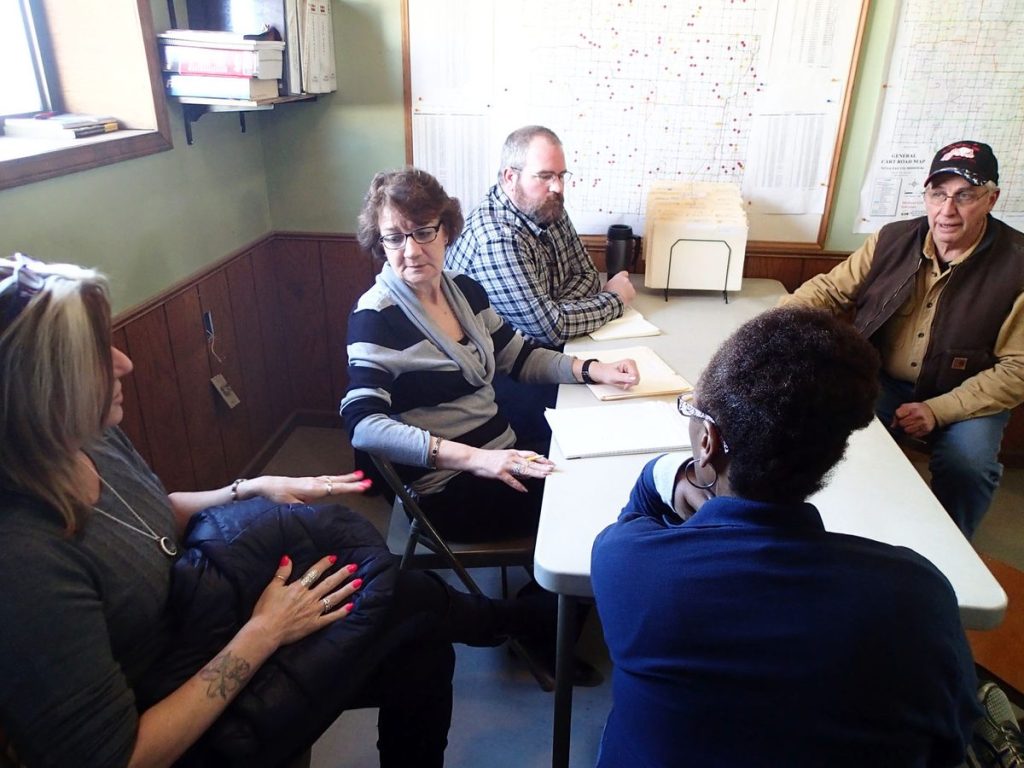
TONY BROWN/DAILY FORUM
Nodaway County Road and Bridge Supervisor Larry Dougan, right, and Road and Bridge Clerk Kathie Dougan, second from left, meet Wednesday morning with project and mitigation specialists from the Federal Emergency Management Agency. The discussion concerned federally assisted repair projects affecting numerous bridges and tube crossings damaged by widespread flooding late last summer. Also pictured from left are FEMA’s Peg Kemler, lead public assistance coordinator for this area; mitigation specialist Jack Malone; and project specialist Shon Foster.
It’s still the middle of winter, but the Nodaway County Commission and Road and Bridge Supervisor Larry Dougan are already mapping out their spring campaign for a challenging season of bridge repairs and replacements.
Because of damage caused by flooding during one of the wettest summers in recent memory, more the $1 million in bridge repair work remains to be completed across the county’s 15 townships. Dougan said approximately $225,000 has already been spent on 26 flood-related projects, with up to 75 percent of the $1.5 million total to be reimbursed by the Federal Emergency Management Agency.
Dougan met Wednesday with a team of FEMA specialists to talk about the possibility of “mitigating” a number of flood-repair projects. In government-speak, mitigation differs from reconstruction or repair. Structures aren’t just fixed, they’re improved.
The idea, said FEMA Project Specialist Stan Carrier, is to remove problems or weaknesses that may have contributed to the damage in the first place.
For example, if a bridge was damaged because the bank washed out, FEMA mitigation funds could be used to reinforce the bank with rock in order to prevent the same thing from happening after the next big storm.
Though mitigation funding adds to the total cost of bridge replacement, Carrier said, the goal is to save money over the long run.
In addition to fixing broken bridges, the county is also putting together an ambitious plan to replace up to 10 spans this year using either county funds or federal dollars funneled through the Missouri Department of Transportation by the federal Bridge Replacement Off System Program, usually referred to as BRO.
Under U.S. Highway Bridge Program legislation, states are required to use at least 15 percent of their total federal bridge appropriations on roads classified as local or rural transportation arteries. To qualify for BRO money, counties must come up with a local match, but the matches are usually “soft,” meaning that materials and labor expended on other transportation projects can be included.
In other words, every time Nodaway County builds a bridge on its own, part of that expense can be submitted as a match for a federally funded structure.
With approximately 2,000 miles of gravel roadways and more than 350 bridges, Nodaway County depends on BRO funding for a significant portion of its bridge replacement and repair budget. As many as four BRO bridges are to be funded this year, and it’s possible three of those structures could be completed before next winter.
South District Commissioner Robert Stiens said this year’s planned scope of work with regard to bridge construction is one of the biggest for the county since the flood years of 1993 and 1995.
Scheduled off-system projects for 2015 include: the bridge at 250th Street over Honey Creek northwest of Ravenwood; a bridge on Noble Road near 230th Street crossing Honey Creek north of Ravenwood; a third Honey Creek bridge on 100th Street east of Route E at the Iowa state line; and a bridge on 365th Street over Jenkins Creek south of Route A near Graham.
The last bridge listed above was severely damaged in a September storm accompanied by torrential rains and high winds that heavily damaged the Nodaway-Holt High School. It could conceivably have been replaced using FEMA money, but the commission opted to use BRO funds instead. Stiens said taking advantage of one program precludes remaining eligible for the other.
BRO bridges are significantly more expensive to construct than those the county builds itself using its permanent three-member bridge crew. Both federal and county-funded spans are similar steel and concrete structures, but BRO projects are bid out to private contractors at prevailing wage in addition to requiring additional engineering and concrete abutments.
County-built bridges are typically supported by metal sheet piling, and prevailing-wage requirements don’t apply.
So while the commission can build a bridge for between $135,000 and $150,000 dollars, similar federally funded projects generally cost around $300,000.
Depending on the weather, the commission plans to build as many as six new bridges this year on its own hook. They include spans at: Neon Road near Honey Creek northwest of Ravenwood; 130th Street over Bushy Creek in northeast Nodaway County near the Worth County line; 120th Street over Clear Creek near the Route JJ intersection in the northern part of the county; Fairway Road between 330th and 350th streets northeast of Graham; Orion Road at Turkey Creek south of Route M in southeast Nodaway County; and Fairway Road at Muddy Creek at the 190th Street intersection east of Highway 71.




