New year begins for county government
TONY BROWN/ DAILY FORUM
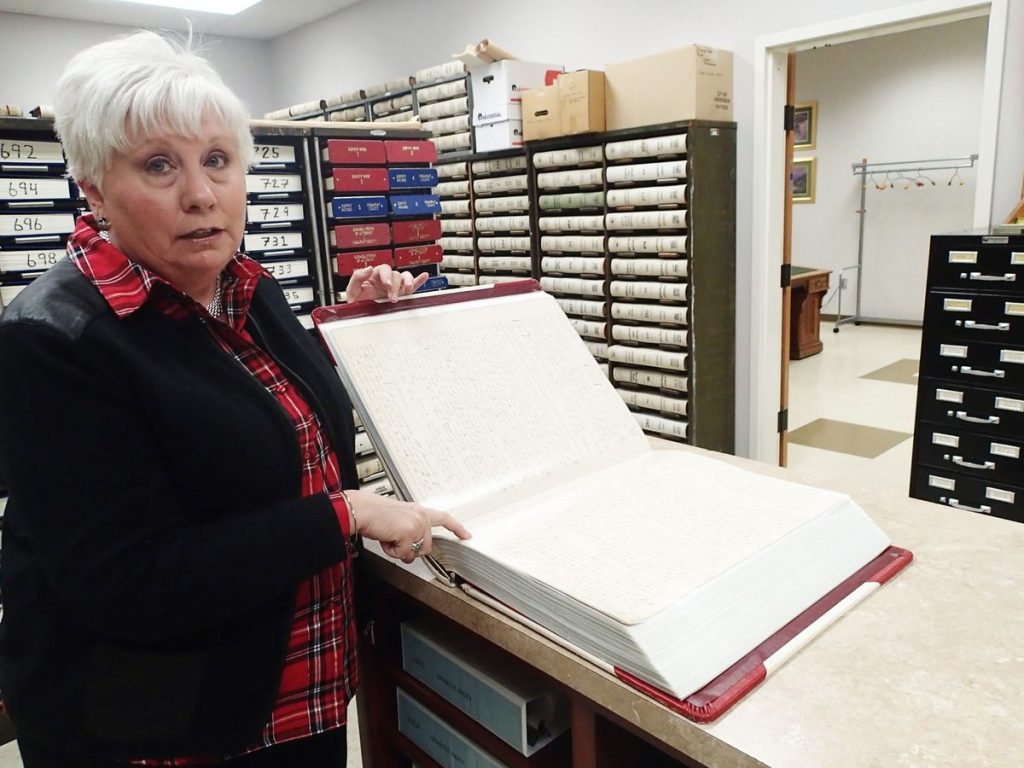
Nodaway County Recorder of Deeds Sandra Smail displays one of the nearly 300 pre-1967 deed books her office plans to convert to digital form over the next several years. Smail said improvements in technology mean the electronic documents will be both searchable and easier to read.
On a post-holiday Friday when many area residents were taking vacation in order to string together a four-day weekend, Nodaway County elected officials assembled in the County Administration Center for the first of four officeholder meetings scheduled for 2015.
The quarterly meetings generally last less than an hour with only a partial roster of officials in attendance. While this session, too, was relatively brief, almost everybody showed up. The sole exception was Dr. Vince Shelby, the county coroner. Assessor Rex Wallace said it was the best turnout he could recall in the 15 years since he was first elected to office.
One reason for the near-unanimous turnout was likely a change in personnel on the commission dais. Newly elected Presiding Commissioner Bill Walker called the three-member governing board to order for the second time after being sworn in on New Year’s Eve. His first session in the middle chair was Wednesday shortly after taking the oath across the street at the courthouse.
That meeting included commission approval of a 1 percent cost-of-living pay increase for all county employees, effective immediately. The decision was taken as the three-member governing board prepares for approval of the 2015 budget later this month. Nodaway County’s fiscal year runs from Jan. 1-Dec. 1.
On Friday, aside from welcoming Walker, several officials also had business to discuss. Recorder of Deeds Sandra Smail, for example, unveiled plans to begin making digital copies of nearly 300 deed books covering the years 1845 — when Nodaway County was founded — through 1967.
The ending year has to do with the advent of copying machines in the 1960s, when large, bound deed books were reduced in size to accommodate copyable 8.5- by 14-inch sheets of paper. These smaller books contain documents that can be digitally scanned by Smail’s staff in-house, a process that has been going on for about the last five years and should be complete fairly early in 2015.
Copies of thousands of hand-written documents stored inside the pre-1967 books, however, exist only on microfilm cassettes produced back in the mid-1990s At the time, Smail said, the belief was that microfilm was of sufficient quality to constitute a permanent, archival record.
That has turned out not to be the case. Evidence exists, Smail said, that the film may be beginning to decay, rendering some of the documents difficult to read.
In addition, a second set of microfilms, made as a backup and kept in a local bank vault, was examined recently and found to have a strong vinegar-like odor, which Smail said indicates at least some of the film may have disintegrated beyond recovery.
Though the original microfilm records kept in Smail’s office suite in the basement of the County Administration Center remain usable, the assessor said the time has come to convert the entire archive into a digital format that can be stored on CDs and computer hard drives. The documents, all of which are public records, would then be searchable and could eventually be made available on the Internet.
The digital copies are to be created by imaging the original documents bound inside the books, not by digitizing microfilm. Smail said advancements in technology mean the resulting electronic images should be “very, very readable” compared to the aging paper records.
A big consideration in the planned conversion, of course, is money. Converting a single book to a searchable, digital form costs about $100, Smail said, meaning the price tag for the entire remaining archive will be around $30,000.
That amount will come mostly from fees charged by the office each time a deed is recorded. The current charge is $24 for the first page and $3 for each page thereafter.
Funds for the digital conversion project may be hard to come by if recording revenue remains at the same low level produced in 2014, when 2,693 documents were recorded bringing in total fees of $104,871. That compares to 3,514 documents and $135,658 in fees in 2013 and 4,021 documents and $155,712 in fees in 2012.
Depending on available funds, Smail said she expects the digital conversion project to continue over the next several years.
As for reports from other county office holders on Friday, Prosecuting Attorney Robert Rice and Sheriff Darren White said a new “Prosecution Team” formed late last year to increase cooperation between local law enforcement agencies appears to be bearing fruit.
The team, which meets monthly, was formed after a new agreement was reached between Maryville Public Safety and the Sheriff’s Department setting forth requirements for housing city prisoners in the county jail.
Last year, White declined to accept several city prisoners, citing concerns about proper bail and suspects’ medical fitness for incarceration.
In order to avoid such problems in the future, the new agreement requires city and county law enforcement officials to meet on a regular basis in order to discuss concerns. Rice subsequently decided that such meetings should be held at least monthly.
“The purpose is to review everything we deal with from initial contact through prosecution,” Rice said. “I really like (the Prosecution Team), and I think it’s doing good things for us.”
In addition to Rice and White, the team consists of Maryville Public Safety Director Keith Wood, Northwest Missouri State University Police Chief Clarence Green and a representative from the Missouri State Highway Patrol.
Recent topics discussed include revised paperwork used in booking suspects, fingerprinting protocol, controlled drug buys and accident reporting.
Other officials speaking during the officeholders meeting included County Clerk Beth Walker who recommended implementation of sexual harassment prevention training for all county employees. The current absence of such training, Walker said, exposes the county to significant liability and could lead to punitive fines from the state of Missouri should a formal complaint be filed.
Walker said the training will likely consist of a mandatory once-a-year session conducted by Prosecutor Rice.