Senior Olympians still enjoy competition
STEVE HARTMAN/DAILY FORUM
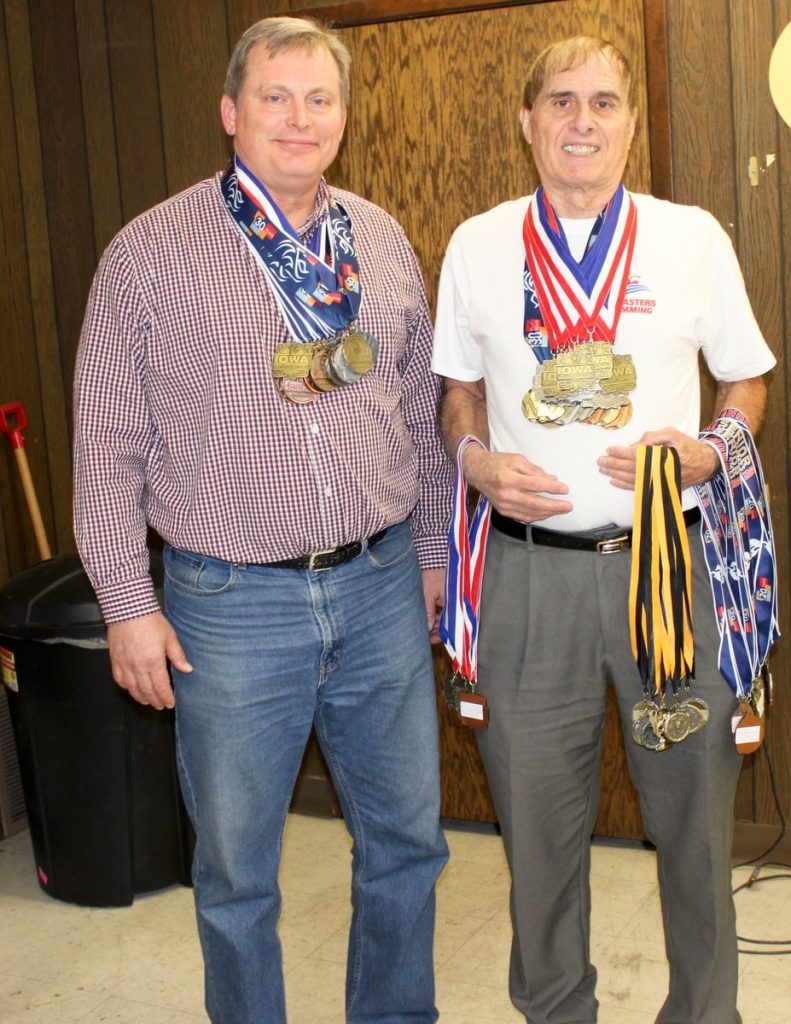
Maryville senior Olympians Ted Goudge (left) and David Easterla pose with some of the medals they won at the 2014 Senior Olympic State Games in Missouri, Kansas, Nebraska and Iowa. Senior Olympics is for athletes 50 and over, and divisions are divided into five-year increments.
Two Maryville athletes have continued active athletic careers through participation in Senior Olympics, and both have been very successful.
Dr. David Easterla, a retired Northwest Missouri State University professor, and Dr. Ted Goudge, current professor of geography at Northwest, have found senior Olympics as a way to channel their competitive nature and derive the health benefits from training for their respective sports.
Senior Olympics provides competitions for athletes over 50 to continue to compete. Age divisions are determined in five-year increments.
Easterla, who is soon to turn 77, began participating in senior Olympic swimming events eight years ago.
“I started competing in the swimming events,” Easterla said. “At that time, the Aquatic Center was still open on campus and I could train year-round. I started doing it for the health benefits and the competition just gave me extra motivation.
“I’ve always been active in sports and have always been competitive. Senior Olympics gave me an outlet for my competitive nature.”
Easterla grew up in Versailles, located just north of the Lake of the Ozarks, so swimming was a natural starting activity for Easterla.
“Any doctor will tell you that swimming, cardiovascular-wise, is the best exercise in the world,” Easterla said. “Plus, I thought it would be easier on my body than running. I was worried about pulling or tearing muscles running.”
A turning point for Easterla’s participation in Senior Olympic events came a few years back at the Kansas state games.
“I went the first day, competed in all 13 swimming events that I could and finished everything in about three hours,” Easterla said. “I wasn’t tired, but I started to drive home and I called my wife to tell her my results. She encouraged me to stay the night and enter the track and field events the next day. I was very successful and even set a senior high jump record.”
In 2014, Easterla competed in the Butterworth Indoor Masters track meet in Wichita, Kansas, the Iowa Senior Olympics in West Des Moines, Iowa, the Missouri Senior Olympics in Columbia, the USA Track and Field meet in Ames, Iowa and the Show-Me State Games in Columbia.
Participating in those five events, Easterla won 65 medals, including 46 gold medals. Nineteen of those gold medals came in swimming, but he has also won gold in long jump, high jump, triple jump, 400-meter dash and pentathlon (long jump, high jump, shot put, 1,000-meter run and 60-meter hurdles) in his age group, just to name a few of the events in which he has seen success.
Goudge, a football and track standout at Northwest, came to the Bearcats from Shenandoah, Iowa. As an undergraduate, Goudge was very successful in the throwing events in track and field, and continued to work out and compete in those events after college.
“I coached track at Oklahoma State while I attended graduate school there,” Goudge said. “My one claim to fame is that I was Garth Brooks’ college track coach.”
Once Goudge, now 58, returned to Northwest, he continued to train and compete in throwing events. As soon as he turned 50, he began competing in Senior Olympics.
“I was competing in the throwing events, and David convinced me to try a swimming event,” Goudge said. “So I tried the 50-meter freestyle and had some success at it.”
Besides the traditional throwing events, Goudge competes in the softball and football throws (for distance and accuracy), tennis and basketball.
“I still have kids at home, so getting time to train is tough for me,” Goudge said. “But I really enjoy the competition and meeting new people at the different meets.”
Both athletes feel that competing in Senior Olympic Games in Missouri, Kansas, Iowa and Nebraska plus a national-level meet is more than enough competition, although Easterla has also began competing in United States Masters Swimming competitions.
“US Masters swimming is different than Senior Olympics,” Easterla said. “I just try to finish in the top 10 in each category in my age group.”
With the closing of the Northwest Aquatic Center, Easterla has had to cut back on his training schedule.
“I drive up to Clarinda to their indoor swimming facility on Sundays,” Easterla said. “They are gracious enough to rope off a lane just for my use, and I swim from 1 p.m. until they kick me out at 4:45 p.m.
“I swim the 200 individual medley for training. That consists of 50 meters of butterfly stroke, 50 meters of backstroke, 50 meters of breaststroke and 50 meters of freestyle. During a Sunday training session, I swim 21 or 22 of these. I don’t take a break.”
Both athletes plan to continue competing, as both still enjoy the training, the camaraderie they enjoy with fellow athletes at each meet, and most importantly, the health benefits that training and competing provides.
Goudge joked that as he gets older, an on-going conversation he has with fellow competitors involves moving up in the rankings just by not dying.
“We had two top competitors in throwing events who were both in their 50s tragically pass away the same year,” Goudge said. “That’s kind of an eye-opener when you go to a competition and people you’re used to seeing aren’t there.”
Easterla said he will train and compete until the day he dies.
“I feel fantastic and have so much energy, and I’m sure my training is mostly responsible, so I want to keep competing until the day I die,” Easterla said. “Plus, the competitor in me takes pride in the fact that I’ve never been beat in the high jump.”
Goudge sees Easterla as a great example of why he should continue to train and compete.
“David thinks everyone 77 years old feels like he does, and I know that’s not the case,” Goudge said. “I look at him and I know I want to have that energy and level of fitness when I’m 77.”