No worries yet about lake level
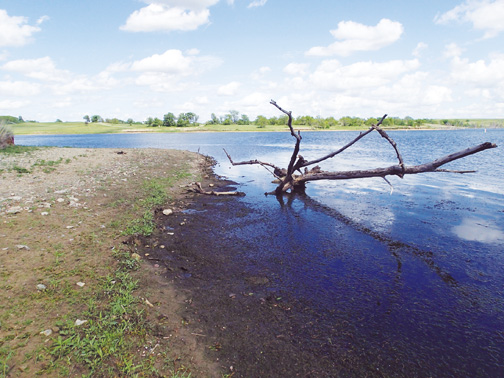
TONY BROWN/DAILY FORUM
Exposed trees and grass growing along shoreline that is usually underwater are shines that Mozingo Lake is suffering from the effects of an unusually dry spring and early summer. However, city officials say there is no immediate danger of a water shortage.
Anyone who boats, camps or fishes at Maryville’s Mozingo Lake Recreation Park has undoubtedly noticed that the lake’s water level is somewhat below “full pool.”
Heck, even golfers have seen that the “water holes” can be just a bit more forgiving than normal because of receding shorelines.
So, just how far down is the lake?
And when does water rationing begin?
Maryville Public Works Director C. E. Goodall and Steve Guthrie, regional director for PeopleService, which operates the city’s water — and wastewater — treatment facilities, agreed this week that the lake level would have to drop significantly before the water supply becomes critical.
And there’s rain in the forecast this week.
“We always want to be conscientious about our water conservation practices,” Guthrie said Monday, “but we still have plenty of water for our needs.”
Because the answer to the initial question — “how far down is the lake?” — is easier to quantify, Guthrie and Goodall both had ready answers.
The water level in what both men refer to as the “wet well,” the storage reservoir located below the pump house at the city’s water intake structure on the west side of the lake, is considered to be at “normal, or optimal, level for operating conditions” when it is “somewhere between 19 and 21 feet.”
Monday, following Sunday night’s .6-inch rain, the level stood at 17.4 feet, according to Guthrie.
“The lowest the water level has ben since 2006 was last March,” Guthrie said.
“We will begin to be concerned when the levels in the wet well start getting to around 13 feet,” Goodall said.
“I’m not saying that can’t, won’t, ever happen, but that is a 1,000-acre lake,” Guthrie added. “That’s a lot of water.”
If the city should be put into the position of having to take steps to reduce water consumption, Goodall said they would be “phased in” as needed.
Municipal ordinances outline what steps can be taken to control water usage in the case of an emergency situation, and specify how the restrictions can be imposed. All user restrictions must be applied equally, with the only exemptions provided to health care-type facilities and fire departments.
Mozingo Lake accumulates water from a 20.9-square-mile drainage area that runs generally north to the Iowa state line. Guthrie noted that during one recent extended “dry spell, we got four or five inches of rain in a day’s time, and the lake rose four to five feet.
“It (Mozingo Lake) serves (drains) a sizeable area very efficiently,” he said.
According to statistics related to Mozingo Lake and its intended uses, construction of the 77-foot high, 2,750-foot wide rolled-earth dam created a 1,009-acre lake with a capacity of 24,877 acre-feet of water.
An acre-foot of water contains 325,851 gallons.
Extrapolation of those statistics indicates Mozingo Lake has an overall capacity of some 8.1 billion gallons of water. The “average” volume of water treated by the city, including what is used by Public Water Supply District No. 1 of Nodaway County, tops out at approximately 2.5 million to 3 million gallons per day, according to city officials.
Two stories relating the city’s demands for water to the reservoir’s capacity make those numbers somewhat easier to comprehend.
When Mozingo Lake was still under construction in 1993, a question was asked during a public hearing about what would happen when conditions got very hot and very dry, as can be the situation in northwest Missouri in the summer.
The chief engineer on the project responded that on a maximum-use day in the summer, with a temperature of 95 degrees or more, the lake would lose more water to surface evaporation than the city would use.
Another frequently repeated illustration regarding the lake’s capacity is that it could be a reliable source of water, without rainfall, for two years.
“Can you imagine the city still getting its water from the 102 River?” one observer asked recently, noting current levels as he crossed the river on the way back to Maryville from Mozingo.
Not hardly.