‘It just kind of hangs over things’
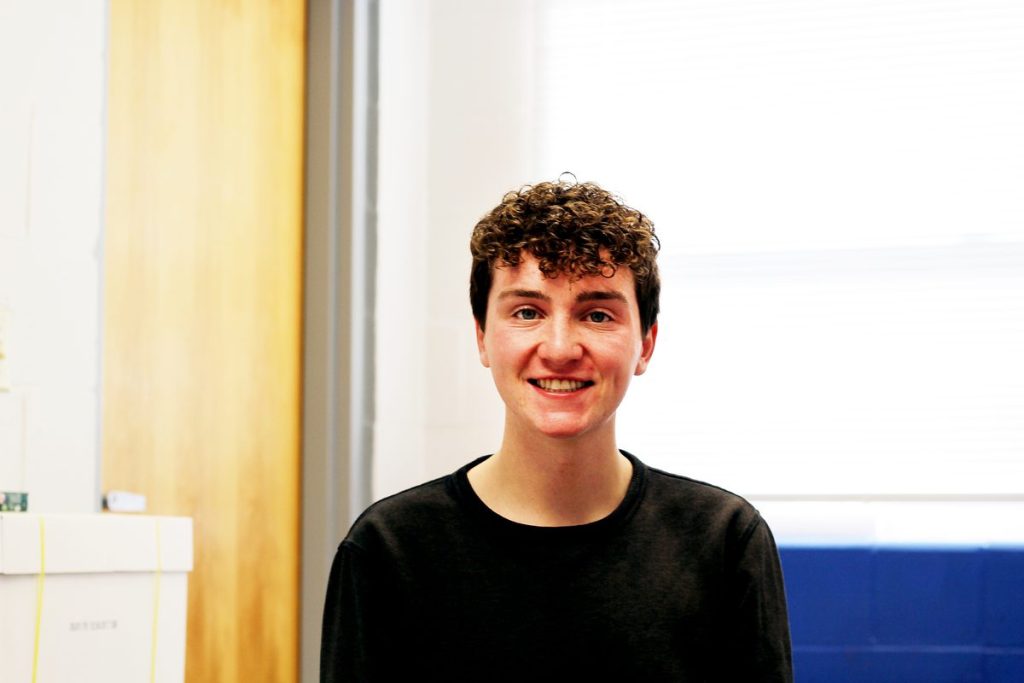
Corby Schmitz Northeast Nodaway Senior
Whether you’re a senior citizen, or a senior in high school, chances are even if a conversation with friends doesn’t start out being about the novel coronavirus, by the end, it’s impossible to ignore.
“When it first started … almost every single time we got together, that was what we would talk about,” said Corby Schmitz, a senior in high school at Northeast Nodaway R-V. “But it’s almost kind of become a norm now, so, it’s not talked about as much now. Obviously when there’s a new case at our school or new people getting quarantined, it always comes up — which is about every other week it seems like.
“But, it’s always there, it’s always going to be talked about. It just kind of hangs over things, and we all know that it kind of sits in the back of our head, like, hey, there’s still a global pandemic going on.’”
Like most students, COVID-19 started disrupting Schmitz’s school life in the spring. But as student council president, he had more agency to do something about it than most.
“When school shut down in March, it was just kind of, confusing, I guess,” Schmitz said. “Because like, we would reach out to the school and stuff, but, nobody really knew what was happening, so there was no full source of communication there.”
Schmitz set out to remedy that, contacting representatives from each class through social media and collecting their questions and concerns to pass on to Principal Luke Cox. The next week, Cox and the student council officers met over Zoom — then just entering the lexicon as the ubiquitous video platform of the pandemic — to discuss those concerns.
“Back then, it was the grading system,” Schmitz said. “Everyone was worried about their grades and everything.”
After that, it quickly became apparent that many students were worried about communicating with their teachers, a common theme throughout most of The Forum’s interviews with students about their early fears of how the pandemic may affect their learning environments.
This semester, the district has been using Canvas, an online learning management system used by many colleges and universities across the country, which Schmitz said has allayed many of the fears that students initially had.
“It wasn’t very great when we first started off, but more and more teachers started reaching out and saying that if you want to Zoom, just contact me,” he said. “Now, it’s good. We’re still in-person, so we haven’t shut down, but we’ve had a lot of 1-on-1 communications with our teachers and everything still, and then, students who get quarantined will still have that access — they can Zoom into classes, they can use Canvas and everything. And Canvas has been a big success so far with assignments and grading and stuff.”
In fact, Schmitz pointed to more online-centric experiences as a silver lining for preparing for the future.
“It’s also opened it up to a lot of new things,” he said of the pandemic’s effect on education. “Like the online learning — because almost every college campus has some sort of online learning. So, that’s really actually kind of preparing all students, so even the younger grades, they’re really going to be ahead when they get to college and that’s how it is.”
But outside of learning, there are some things that can’t be replaced or replicated.
“We don’t get the normalcy of a senior year, we don’t get to experience the things that, like, all of my siblings — I’m the youngest of five — so they’ve all gotten to experience kind of the same atmosphere for a senior year,” Schmitz said. “And that’s just something that I won’t get to experience.”
That extends to social life, too.
“So like, a year ago now, I was a junior in high school and I was thinking, this’ll be my last ‘hard’ year — because usually senior year you just kind of breeze by — so I was just kind of living (on) a day-to-day basis: just going to school, going to work, having fun, going out and hanging out with friends,” Schmitz said. “But now, when I’m doing stuff, it’s always in the back of my head: ‘Well, if I do (this), there could be a consequence if I don’t follow the set procedures that are in place.’ Now, it’s just: go to school, go to work and go home.”
Overall, Schmitz said he’s trying to take the long view.
“It’d definitely say that it’s difficult,” he said. “It’s a huge change from what we’re used to. While you’re worried about all these things, it’s still kind of exciting. It’s bad to say that, because there’s obviously a lot of deaths and everything, but there’s kind of the aspect of, this is something that nobody’s experienced before, at least in this lifetime. Like, I’ve never experienced it, and none of my family have ever experienced it, so it’s something completely new to kind of, 40 years from now, look back on and say, hey, I was part of history. I lived through that and everything.
“I survived that.”
Editor’s Note
This feature was published in The Maryville Forum as a two-part series on Thursday, Dec. 3 and Thursday, Dec. 10. Articles may have been edited for space within the print edition, but will be available at full length at The Forum’s online focus on COVID-19 in the Community.
To give readers an idea of student knowledge and concerns regarding the pandemic, one student’s story will be posted each weekday at 6 p.m. through the end of 2020.