My Word: Notes from the bunker

LARRY ANDERSON
Larry Anderson
With other events overshadowed by the coronavirus, it would be easy to miss a major victory for President Trump and the American people. On April 23 SCOTUS ruled 5/4 that the United States government could indeed expel people who had entered this country illegally and committed crimes.
Now, this seems like a no-brainer. Why should America (or any country) play host to those who broke our laws initially to enter and then abused the privilege of living here by committing more crimes? Why should citizens be obligated to provide legal defense and likely pay the cost of incarceration for defendants who aren’t citizens? Obviously, it makes no sense to do so or even to consider it.
This was a biggie for the president who has worked incredibly hard to bring immigration under lawful control. As is typical, the four liberal justices voted against the ultimate ruling. The five conservative justices supported it because it is constitutional for the country to protect itself from immigration abuse.
Liberals would have you believe the ruling is evidence of racism, xenophobia and right-wing extremism. In other words, lefties don’t care if the country has reasonable protections or how much illegal immigration costs society. They cling to their position for purely political reasons.
Indeed, liberals have long made no distinction between legal and illegal immigration because they see advantage for them through sheer numbers. The fact is America admits approximately one million legal immigrants annually to fulfill a variety of needs. Many become welcome citizens instead of shadows dodging justice. This is a desirable process supported by this president and most Americans because this course respects the law and supports the country’s best interests.
In California a federal judge recently ruled it unconstitutional for the state to stop the sale of ammunition to gun owners wishing to make a legal purchase. In other words, the government can not decide what is legal or illegal, what can or can not be sold, based on its political proclivity or an extenuating circumstance. Clearly, this limits government reach in favor of law as written and translates to another victory for President Trump and the Second Amendment. An unconstitutional power play was stopped.
Thanks to Trump’s appointments to federal benches, the huge western Ninth Circuit Court is no longer a liberal rubber stamp for leftist progression. That may not seem important to us here in Missouri, but I assure you it is because federal rulings reach far beyond district confines. A more conservative federal court will impact the grip the left has on a heavily populated region by providing balance, logic and the likelihood of constitutional fidelity.
In a different area, the coronavirus experience has given us an enlightening glimpse into what life would be like in a socialist state.
For one thing, we Americans have now experienced empty store shelves, shortages and subsidies that are part of life in socialist countries like Venezuela. Here, the inconveniences were comparatively minor and short-lived, but they weren’t pleasant, were they? What if the shortages were permanent, broader and extended to essentials such as food?
We all saw how quickly government can take control of a situation, ostensibly for the public good. We also know now how government can use technology to reach into your living room with instructions, orders and lessons. We understand better how rapidly and efficiently social behaviors can be modified for a desired end. These things can easily become tools for change via a radical centralized government. You understand this threatens freedom if it gets out of hand. Fortunately, President Trump is a close guardian of our rights.
For the most part, law-abiding people are obedient. In matters of a health emergency, this can be a good thing, but in matters of politics deference can soon lead to unchecked control. We must be careful of this. It is one reason the president left it up to the governors to determine when states could begin to return to a degree of normalcy. It is unlike a socialist state to decentralize authority, but it is very much like a democracy to do so in defense of itself and in the interest of its citizens.
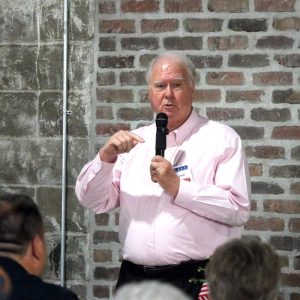
Larry W. Anderson is a retired educator.