Sen. Hegeman recaps 2019 session
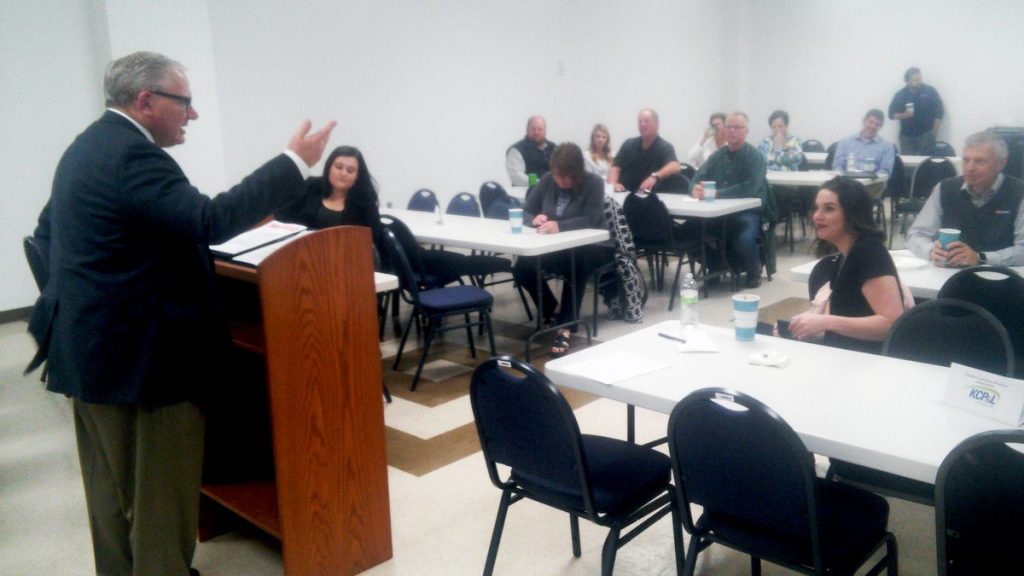
ANTHONY BROWN/THE FORUM
State Sen. Dan Hegeman addresses a group of civic leaders and Greater Maryville Chamber of Commerce members during Tuesday’s chamber-hosted Legislative Breakfast at the Nodaway County Administration Center.
MARYVILLE, Mo. — State Sen. Dan Hegeman, R-Cosby, briefed local civic and business leaders Tuesday on the recently concluded legislative session in Jefferson City during remarks at the Greater Maryville Chamber of Commerce’s spring Legislative Breakfast.
Taking advantage of the cooperative tone set early on by Gov. Mike Parson, the Republican-controlled General Assembly had one of its more productive sessions in recent years, passing legislation on a wide variety of fronts, including agriculture, roads and bridges, higher education and workforce development.
As chairman of the powerful Senate Appropriations Committee, Hegeman exercised a guiding hand over virtually all spending bills, including the second core-funding increase for higher education in the past 10 years.
The appropriations boost provided an additional no-strings-attached $1 million to the base budget of each of Missouri’s public four-year universities, including Northwest Missouri State.
State Rep. Allen Andrews did not participate in the breakfast. The Grant City Republican and his wife were traveling to Colorado for the birth of their first grandchild.
In addition to more money for higher ed, Hegeman said the $29 billion state budget — which must balance under state law — included a tax cut and fully funded the state’s “foundation formula” for public schools for the third year in a row.
Hand in hand with new funding for elementary, secondary and higher education, as well as school busing, Hegeman said the legislature also lent support to a number of workforce development initiatives, including Missouri Excels, a program that encourages colleges and universities to develop employer-driven education and training programs designed to promote career readiness.
On the local front, Hegeman helped secure $170,000 for a “next-generation” agriculture program at Northwest along with $2.5 million for development of a proposed Agricultural Learning Center at Northwest’s R.T. Wright Farm north of Maryville.
Hegeman said Learning Center funding comes with the expectation of $2.5 million in matching funds to be provided by university donors.
The senator also addressed what many see as one of the legislature’s signal accomplishments in 2019, a $300 million bonding package, coupled with $50 million in general revenue funds, earmarked for the repair or replacement of about 250 substandard bridges statewide.
Hegeman said he is hopeful the investment, which represents the first time the legislature has spent general fund dollars on transportation, will “leverage” additional federal highway dollars. The bonds, in fact, cannot be issued unless sufficient federal funding becomes available.
He added that another $50 million in general revenue funds, subject to dollar-for-dollar matches, is being made available for road and bridge projects undertaken by counties and other local governments.
But while additional highway dollars will help, Hegeman said a permanent solution to the state’s longstanding transportation funding woes remains elusive.
Voters have rejected a number of fuels tax increases over the years, and Hegeman said he is reluctant to support any fuels tax hike that doesn’t pass muster at the ballot box.
In the long run, Hegeman said, bonding schemes and general fund appropriations were “not the way to solve our transportation problems in the state of Missouri.”
Other bills passed this year, the senator said, provide some funding for water infrastructure, broadband internet access in rural areas and flood recovery efforts along the Missouri and Mississippi rivers, including high water-ravaged Holt and Atchison counties in northwest Missouri.
With regard to flooding, Hegeman said the legislature continues to exert whatever pressure it can on the U.S. Army Corps of Engineers to rewrite river management plans in ways that emphasize the protection of agricultural land and businesses over environmental concerns and recreational use.
On other fronts, Hegeman said the legislature approved a 1.5 percent pay increase for state employees in addition to “market rate” adjustments for many of those same workers.
Increases in pay and staffing are especially needed by the state Department of Corrections, said Hegeman, who characterized DOC workers as “understaffed and overworked” to the point where security has been compromised at some penal institutions.
Speaking for his colleague Andrews, Hegeman said the 1st District House member “had a wonderful year” that included passage of a wind farm bill ensuring that tax dollars from wind installations owned by publicly traded utilities will stay in the counties where those installations exist. Under current law, such revenues would be dispersed throughout the utility’s service area.
The senator also briefly addressed a bill stripping county commissions and health departments of the power to pass regulations governing confined animal feeding operations that are stricter than those imposed by the state Department of Natural Resources.
Hegeman said state government was the “appropriate” level for CAFO regulation, and argued that some local ordinances, which he described as based on “emotion” rather than science, “were just designed to stop animal agriculture — and they did.”
He said local governments could still, perhaps, use watershed district regulations to protect drinking water reservoirs, but added that he didn’t think cities and counties could prevent CAFO development via zoning ordinances, since Missouri does not permit zoning of agricultural enterprises.
Also speaking Tuesday was Brandt Shields, the northwest Missouri district office director for U.S. Sen. Roy Blunt.
At the federal level, Shields said Blunt was working to improve affordable access to higher education through Pell Grants and the TriO program, which seeks to provide academic and social support for students who are the first members of their families to attend college.
Infrastructure is another Blunt priority, said Shields, citing the recent $10.4 million BUILD grant awarded to the city of Maryville, which will use the funds to construct traffic-flow and pedestrian improvements along the South Main Street retail corridor.
Additional legislative goals for Blunt, Shields said, include improved access to medical and mental health care, especially with regard to Alzheimer’s disease, treatment costs for which, he said, could exceed the U.S. Defense budget by 2050.
Shields also announced that President Donald Trump has signed a disaster declaration for parts of Missouri inundated by this spring’s flooding, a move that will allow for the expenditure of recovery funds through the Federal Emergency Management Agency.