Pastor, author offers conflict resolution guide
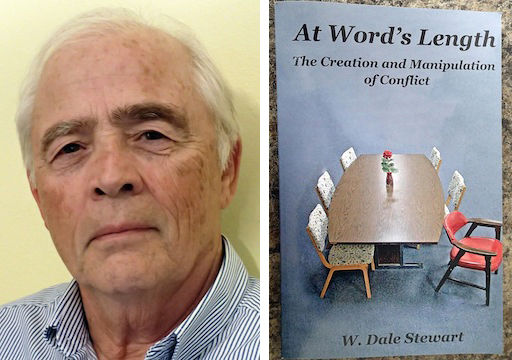
W. Dale Stewart, pictured, a former police detective, pastor and professional mediator, is the author of “At Word’s Length: The Creation and Manipulation of Conflict,” a book designed to provide non-professionals with effective tools for resolving conflicts arising between both individuals and organizations.
MARYVILLE, Mo. — W. Dale Stewart knows something about conflict.
A former police detective for the City of Overland Park, Kansas, and now retired after serving for 10 years as the senior pastor of the First Christian Church of Maryville, Stewart also had a third career as a mediator specializing in conflict resolution, particularly disputes involving young people and families moving through the juvenile court system.
Over the years, Stewart also spent a lot of time leading conflict resolution workshops in both the United States and Canada.
So one can assume when Stewart writes a book — as he now has — about conflict resolution, that the man knows what he’s talking about.
The 122-page paperback, “At Word’s Length: The Creation and Manipulation of Conflict,” self-published by Stewart’s company, the Brence Group, is now available through Amazon and has won praise from 4th Circuit Presiding Judge Roger Prokes, himself no stranger to parties at odds with one another.
“This book needs to be read by every spouse, parent and person who wants to communicate effectively in society,” Prokes states in a cover blurb.
Folks who know Stewart are aware that the former pastor is a master of making his point through stories — often folksy an amusing — that nevertheless manage to drive home the intended message.
In that spirit, “At Word’s Length” opens with an anecdote about Stewart on an airline flight taking him to a conference in Phoenix, Arizona.
During the flight, a fellow passenger asks him if he is on the way to visit family or traveling on business.
“I’m here for a conference on conflict in the church,” Stewart responds.
“There’s conflict in the church?” his questioner responds.
A little taken aback, the pastor answers, “Have you ever been part of a church?”
Several chapters later, Stewart, an admittedly struggling golfer, compares the roots of conflict to a golf ball, the hard, central core of which represents an initiating event — a divorce, a violent crime, a personal slight, a childhood trauma — that has been incorporated into a person’s belief system.
That core, Stewart goes on to say, is wrapped tightly with yards of rubber string representing “perception and power” attached to the life-changing central event and ultimately encased in a hard, white shell of generalization.
When people come into conflict, Stewart believes, they often seek to confront only that generalization, which is all they can see, rather than the core issue that has shaped the outlook of the person on the other side of the table.
A man who says, “I have to carry (a firearm) just to protect myself” may have been mugged by an armed assailant. A longtime church member blurts out, “No one respects women around here,” secretly outraged by a pastor’s overheard comments she perceives as sexually demeaning.
“In far too many cases,” Stewart said, “a person’s view of life is reflected in the rounded view of that golf ball. Unfortunately the reflection from a rounded surface gives a distorted view.”
He explains that he wrote “At Word’s Length” to help everyday people “identify their own emotional investment in conflict.”
Expanding on that concept, Stewart said one of the keys to resolving disagreement and easing discord is “to listen to what other people say and how they say it” in order to “begin to understand how invested they are in a particular outcome and also to understand how deeply invested you are.”
“At some point,” he said, “winning the argument becomes more important than the actual discussion itself, and that is what happens so often. But when we really listen to the words being used, we begin to understand what the ultimate goals may be of the people doing the speaking.
“A lot of times, the further you get into a discussion, the poorer job people do of listening. You become more interested in what you have to say than what the other person has to say.”
Learning to appreciate, or at least understand, an opponent’s point of view, Stewart said, is an essential step toward transforming conflict into accord, or at least compromise.
“Take the phrase, ‘You always drive me crazy,’ he said. “That’s a broad generalization that doesn’t tell you anything. But there is a process using what I call ‘clean language’ you can use to back that statement up.
“You have to get back to the event that causes conflict. If you get to the event, you can deal with that. You can’t deal with generalizations, you have to deal with specifics.”
While conflict is often seen as an inevitable part of being human, Stewart likes to believe it doesn’t have to rule one’s life. Resolving and diffusing conflict, he said, is a learned skill that almost anyone can acquire and employ — if the argument doesn’t go too far.
Most conflicts, he said, have five phases: discussion, debate, disregard, dismantlement and destruction.
“Each of those becomes more and more personal,” Stewart said, “and you can usually understand what phase you are in simply by the language. “But once you get to phase three plus, you usually have to get another person to help resolve the conflict.”