Mozingo Lake down, not out, during dry spell
TONY BROWN/THE FORUM
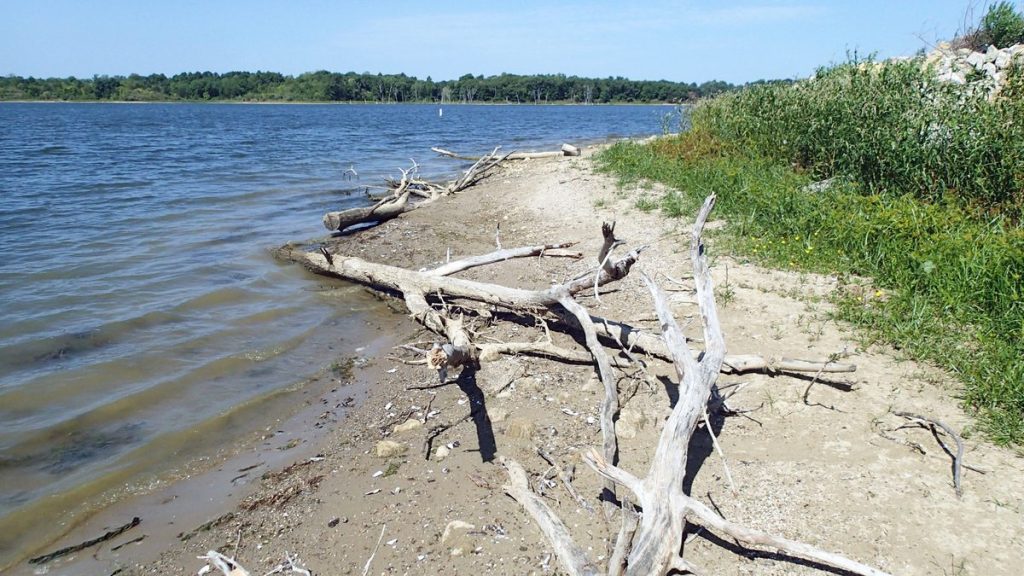
With its pool average hovering around 17 feet, Mozingo Lake, the primary water supply for the City of Maryville and the Nodaway County Public Water Supply District, is still above the level where usage restrictions on such activities as lawn watering and car washing could be implemented. Prolonged drought conditions this summer have produced the lowest lake levels since 2014.
MARYVILLE, Mo. — Despite this week’s thunderstorm, virtually all of Nodaway County remains in the grip of either “extreme” or “severe” drought conditions, as reported by the National Integrated Drought Information System.
Ponds and rivers are low, hay production is down and row crops are stressed.
But the driest summer in five years has yet to impact municipal and rural water customers supplied by City of Maryville-owned Mozingo Lake, a 1,000-acre reservoir east of town built 23 years ago to ensure an adequate local water supply under precisely the kind of conditions that now exist.
City Manager Greg McDanel said recently that while water shortages and usage restrictions often accompany such drought-related problems as crop losses and wildfires, Maryville and the Nodaway County Public Water Supply District, which serves about 2,600 rural households and businesses, remain unaffected by the dry spell.
“Fortunately for the Maryville community, we have Mozingo Lake,” McDanel said. “While conversations (about Mozingo) often center around the recreation, Mozingo is an ample water supply for thousands.”
McDanel continued that while the lake appears low compared to last year, which included a period of significant mid-summer flooding, the Mozingo pool averaged more than 17 feet during July. “Full pool” is considered between 19 and 21 feet deep.
After last summer’s heavy rains in late June, this year’s lake level may appear deceiving to some, McDanel said, since July 2017 saw lake pool depths of up to 24 feet.
The lowest lake levels in recent years occurred during the 2013-14 drought, when Mozingo pool levels dropped as low as 16 feet, still too high to trigger water-usage restrictions.
After Sunday evening’s storm, the lake pool level was reported at 16.9 feet on Monday morning, a number that is expected to rise due to continuing watershed inflow, McDanel said.
“The level of concern to begin initiating basic water restrictions such as washing cars, lawn watering and so forth is 14 feet,” McDanel said. “While conditions can change, one expert anticipates conditions would have to continue with no rainfall until the end of the year to reach this point.”
The city manager added: “We will continue to monitor lake levels and thank those with the foresight to construct Mozingo over 20 years ago. Hopefully we will get moisture soon to assist area farmers and those impacted by these prolonged conditions.”
On other fronts, Maryville Public Safety fire division Capt. Phil Rickabaugh said that while pastures and woodlands are dry, no major wildfires have been reported so far this season, including the often blaze-ridden days around the Fourth of July.
“As of yet, dry weather hasn’t presented any fire issues for us,” said Rickabaugh, who believes most rural residents are well aware of the dangers posed by wildfires and are simply taking the steps necessary to prevent them.
“I think it’s just the community being extra cautious,” he said. “People are using common sense and being careful.”
All or parts of about 30 counties across northern Missouri are suffering through a D3, or “extreme,” drought, including the southern three-quarters of Nodaway County.
The rest of the county is classed D2, considered a “severe” drought, except for a tiny area in the northwest corner, where moisture conditions are classed as moderately dry (D1), according the Drought Information System reports.
In an attempt to help out farmers in need of increasingly scarce hay, the Missouri Department of Transportation has implemented a special overwidth hauling permit.
According to a department release, hay loads must still be of legal height, length and weight.
Permits can be requested by phone and will, in most cases, be issued within minutes via fax or email. The $32 permit fee will be waived through Oct. 31.
Drivers must obtain the special permit when planning to transport loads wider that 8 feet, 6 six inches. Maximum overwidth allowed is 12 feet, 4 inches.
Haulers are also required to map out a route that avoids work zones, restricted bridges and other areas that have weight, narrow lane or height restrictions. This information, including a bridge and height restriction view, is shown on the MoDOT Traveler Information Map, accessible at modot.org.
In addition to the higher width allowance, the special permit allows drivers to move hay during holiday periods and at night.
At night, or when visibility is less than 500 feet, drivers must use a reflective, oversized load sign and clearance lights instead of the normal flags required at the edges of the load.
To obtain a permit, hay haulers should call MoDOT’s Office of Motor Carrier Services Office at 800-877-8499 and be able to provide their truck or power unit’s year, make, license plate number and vehicle identification number. They must also submit their farm/business name and address.
MoDOT permits cover movement within Missouri only and are required for each truck.
“Missouri’s agriculture community thrives when neighbors and rural communities rely on one another, and that is exactly the support this waiver will encourage,” said state Director of Agriculture Chris Chinn.