Officer: No easy answer to school shootings
TONY BROWN/THE FORUM
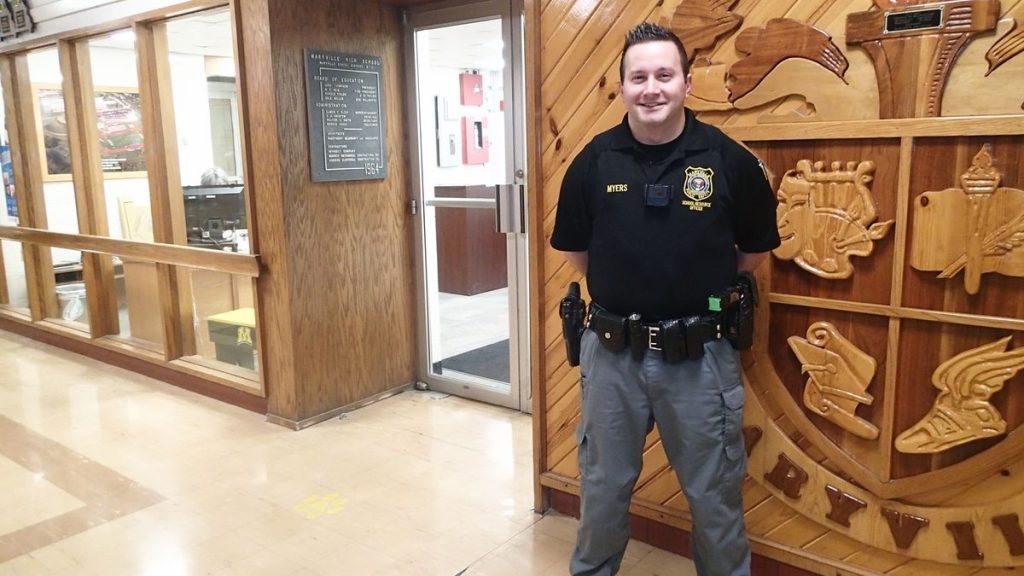
R-II School District resource officer and Maryville Public Safety policeman Ian Myers stands outside the administrative office suite at Maryville High School. Speaking at length this week about the district’s preparedness for an “active shooter” attack, Myers said he and school officials are working to implement policies that emphasize both prevention and an effective incident response.
MARYVILLE, Mo. — With mass shootings apparently just a fact of life in the United States, increasing pressures have descended on what for many schools, favored targets of “active shooters,” is the front line of defense — the school resource officer.
For the Maryville R-II School District, the person holding that line is Maryville Public Safety Officer Ian Myers, who began his first school year as R-II’s SRO this past fall.
And while the district’s three campuses have not been the site of any gun-related threats or incidents, Myers admits that both nationally and statewide 2017-2018 has proved dangerous and deadly when it comes to school violence, both real and threatened.
Myers said that since the horrific Feb. 14 massacre at Marjory Stoneman Douglas High School in Parkland, Florida, where 17 people died during a killing spree by alleged perpetrator Nikolas Cruz, at least nine reported gun-related threats or incidents have occurred at Missouri schools alone.
That estimate, he added, is probably on the low side.
In a society that appears saturated with firearms and deranged, rage-filled people willing to use them, Myers said Maryville is fortunate to have so far escaped the epidemic of school bloodshed.
However, he also believes the era of perceived safety and security associated with small schools in small towns, where relationships between teachers and students are often social as well as academic, is long gone.
“Those days are over,” said Myers, explaining that continuous training and preparation for an armed attack on any of R-II’s campuses has become part and parcel of both his job and district policy.
“We train for fires, earthquakes and tornadoes,” he said, “and unfortunately in the current climate we have to be prepared for an active shooter.”
To that end, in addition to participating in active-shooter simulations, like the one conducted at Northwest Missouri State University last spring, Myers recently conducted a “refresher course” for all R-II faculty, administrators and staff.
The training, he said, reflects the widely accepted law-enforcement strategy of “run, hide and fight,” meaning that people who find themselves under attack by an armed assailant should first attempt to flee the scene altogether then hide in the most secure location available if escape is not possible.
Finally, when directly threatened, and if no other options are available, potential victims are urged to physically resist, with the aim of disarming and subduing the shooter.
As for the SRO, Myers said his role as soon as shots are fired is to simultaneously radio for backup, draw his weapon and take down the suspect, if necessary with deadly force.
While declining to voice direct criticism of the law-enforcement response at Marjory Stoneman Douglas High, Myers said the shooting spree’s aftermath raised questions about how well standard police procedures were implemented in terms of both red flags displayed by Cruz before the attack and a reportedly delayed reaction by officers after the killing began.
“I was as shocked as anybody when those details came out,” Myers said. “I don’t know why the system failed.”
Avoiding such failures in Maryville, he said, is the SRO’s top priority. So every day he goes on duty, Myers works toward perfecting policies and training opportunities intended to eliminate the sorts of miscues that some claim made the Florida tragedy deadlier than it need have been.
It is not a simple task.
“The problem is that an active-shooter situation is always fluid,” Myers said. “All of us, including police and school officials, would like to have a black-and-white answer for everything. But there are no black-and-white answers for these situations because they are constantly evolving and constantly changing.”
And the reality is that all the security cameras, searches, sign-ins, push-button locks and other security measures — Myers declined comment on the proposed arming of selected teachers and staff — probably won’t prevent someone determined to wreak carnage from doing so.
“That is the unfortunate reality.” he said. You can make schools like a prison. You can install bullet-proof glass and bars on the doors, but if someone wants to do harm bad enough, they are going to find a way to do it.”
The best answer, Myers believes, and the one he strives to implement at R-II, is a two-fold process.
His strategy involves vigilance focused on warning signs displayed by potential shooters — extreme aggression, for example, or a fantasy-like fascination with military and law-enforcement tactics — coupled with broad-based training, including training for students, designed to keep as many people as safe as possible when the unthinkable happens.
With regard to the proactive part of that strategy, the red-flagging of potential shooters, Myers said he has yet to identify or speak with anyone associated with R-II who “might be headed down that road,” and that, so far, the district’s active-shooter preparations seem to be “staying ahead of the curve.”
As for the reactive response, Myers and school officials are currently planning the district’s first-ever active-shooter presentation designed specifically for students, a program that will likely take place at Maryville High School.
“We want people to be prepared and know what to look for,” Myers said, adding that students are to receive the same instructions and information provided to faculty and staff. “But we also want them to know what to do and how to react (in an active-shooter crisis). Both those things have to go hand in hand because the unfortunate fact is that law enforcement can’t be everywhere at once.”
On the whole, Myers said he is satisfied R-II is doing all it can to prepare for an armed attack given existing personnel and resources.
“There is always room for improvement,” he said. “But I think we’re putting our best foot forward to be prepared for situations like this and to respond if they do happen.”