Educators present research
SUBMITTED PHOTO
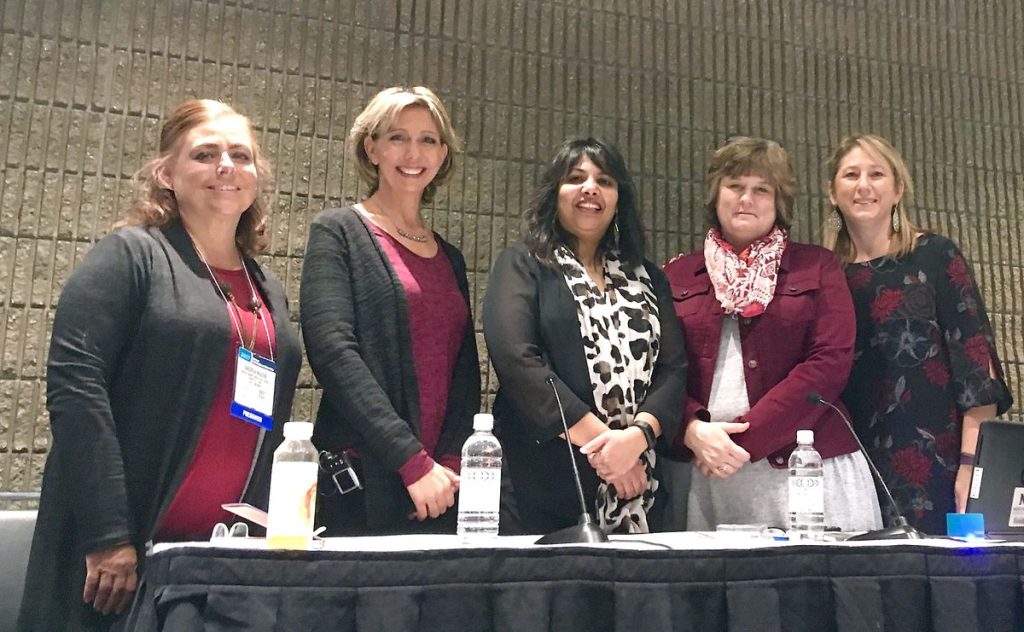
Shown last Wednesday, at the National Association for the Education of Young Children annual meeting are from left: Andrea Mason with the Horace Mann Lab School Faculty of Northwest Missouri State University; Debra Hull BSN, RN Diabetes Educator at SSM Health St. Francis Hospital; Pradnya Patet, assistant professor and coordinator of Early Childhood Programs at Northwest; Laura King of Horace Mann; and Meghan Sheil early Childhood Instructor at the Phyllis and Richard Leet Center at Northwest. The group presented its findings from research conducted in 2016, about young children’s capability of understanding the complex concept of diabetes with regard to food.
Five local educators presented research last Wednesday at the National Association for the Education of Young Children annual meeting held at the World Congress Center in Atlanta, Georgia.
“It’s the largest early childhood education conference in the world,” said Debra Hull, BSN, RN diabetes educator at SSM Health St. Francis Hospital.
Hull as well as Andrea Mason, Horace Mann Lab School faculty member of Northwest Missouri State University; Pradnya Patet, assistant professor and coordinator of Early Childhood Programs at Northwest; Laura King, Horace Mann faculty member; and Meghan Sheil early Childhood Instructor at the Phyllis and Richard Leet Center at Northwest, were members of the team that held an audience’s rapt attention during a three-hour presentation about educating young children in the ways of diabetes prevention.
A year ago, Patet and Hull published a children’s book called “Stop! Stop! No Sugar on Top!” Since then the two have worked on research with help from the faculty at the Horace Mann Lab School.
“She (Patet) always says the nutritional scripts in a child are laid down in the first five years of life we’ve got to get that message to them at a younger age,” said Hull.
Patet said she speaks to her students every semester about how to educate younger children about Diabetes in their own classrooms.
We began to see the importance of teaching it, not just to college-age students, but to go younger,” Patet said. “That’s how the book came about.”
They wrote the book and Patet wanted to evaluate its use, bring it into classroom and see if young children were able to understand a complex topic like diabetes prevention.
“She put together the research project, we did the research,” Hull said. “It was really fun. I’d never done research.”
Patet said she wanted to be able to trust the capability of the younger students to understand the topic, but that research would tell the tale.
“We worked with first, third and fourth grades to conduct the research,” Patet said. “While simultaneously, Meghan Sheil was working on very similar health-oriented lessons.”
The five women teamed together to research how young children could learn and put into action healthy eating habits. What they learned is children already do have a basic understanding of how to eat healthy.
“They know that an apple is healthy and cookies are not, but putting it into action,” Hull said. “Once they got the concept of why, boy they just started running forward with it.”
The book taught the children on a cellular level what happens in the body when you’re eating junk versus healthy nutrition.
“The teachers got a lot of credit,” Hull said. “There were three classroom teachers that we worked with. The teachers started turning it into all different kinds of classroom projects focused on health, but still getting in the math and the science, you know all aspects. But the end message was Health, Health, Health. Hearing that message multiple times the kids just started flourishing with it. The teachers started seeing it in their play.”
Laura King faculty member at Horace Mann and member of the research team said her students started asking for healthier foods for their birthdays.
“We’ve actually had banana splits with yogurt and fruit,” she said. “One student said she wanted mixed cut fruit. We’re seeing a lot less of cupcakes.”
King is working with some of the same students used in the research last year, in her first and second grade class this year and said that their ideas on health have carried over.
“They’re really interested in food,” she said. She said there is a parent who has a subscription to Universal Yums, which delivers foods from different areas across the world. She’s even used it to create lessen plans about those area of the world.
“We’ve had food from Pakistan and Colombia,” King said. “We’ve even had guest speakers. Next will be Belgium. Food has been an avenue to explore some of those other cultures.”
She said the kids started talking to their families and it was really inspiring how much they got out of it.
“I started overhearing in their play, ‘Oh you had too many carbs, your pancreas must be really unhappy.’”
Hull said the year of research and focus on health started changing their culture. They began to see it in all levels of their life, not just in the classroom.
“Their parents said they were impacting their whole home life in the way they were eating,” Hull said.
So, they took the message of that project here locally and the research they to a national level so other teachers could see that they might have that positive impact on a child’s health.
“We used to call Type 2 Diabetes adult onset diabetes, but now we see it in children,” Hull said. “When kids have Type 2 Diabetes, the younger you have it the more detrimental it is on your health throughout your life. We’ve got to stop that progression at a younger age. We were able to take that to a national level and show people how.”
Patet said the research team was accepted for a 3-hour session and they were very excited about that, but they weren’t sure how many teachers would want to hear three hours about children’s health. They didn’t create handouts, because they weren’t sure how many would show up for the session, but she was surprised because many teachers did come to their presentation.
“Clearly, there is a need in talking about this,” Patet said. “It’s not something you’re taught when you’re learning how to become a teacher. People are thirsty for this knowledge. All those people were interested. They all signed up for the handouts.”
She said the research will continue to look at ways to help get the research findings to teachers everywhere. Maryville Public Library also helped with the project, by focusing on health-related books and readings.
“All our teachers did a great job. It wasn’t just Horace Mann. It was Maryville as a community. That consistent message is what children need and not just from within the classroom. It truly takes a village.”