Ambulance board considers rate increase
SKYE POURNAZARI/DAILY FORUM
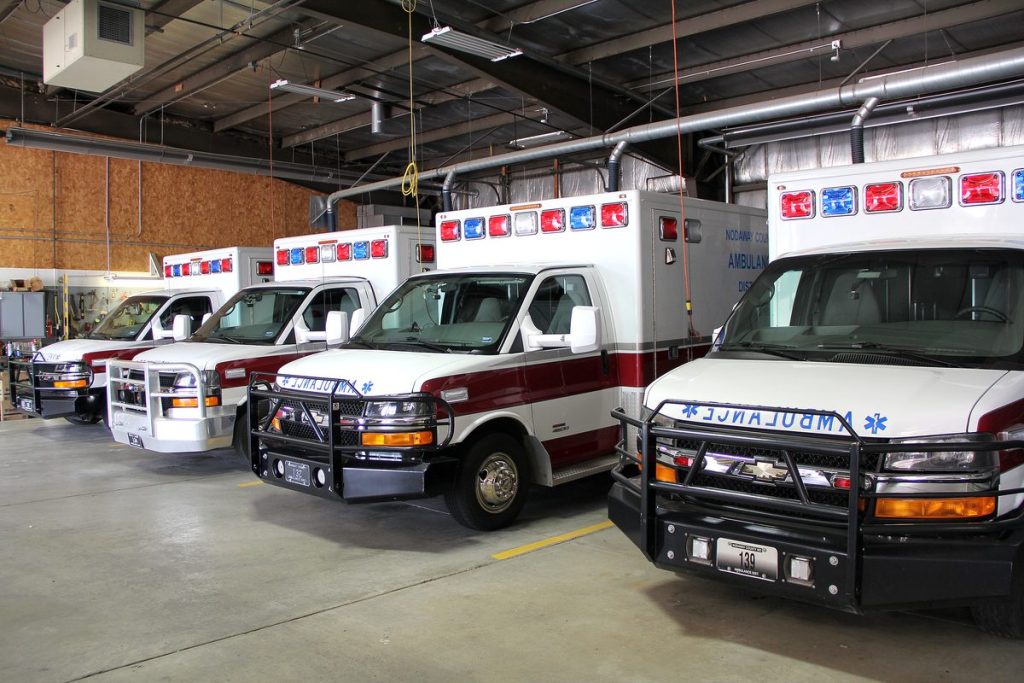
This photo from September shows four of the six ambulances owned by the Nodaway County Ambulance District. District board members are considering raising ambulance fees.
The Nodaway County Ambulance District board met Wednesday night at the district office, crunched numbers and discussed the possibility of raising the base rate of an ambulance ride.
After completing a draft of the 2018 district budget, Director of Operations Bill Florea came up with a $187,135 shortfall and started looking at the possibility of raising the base rate.
“We haven’t increased our rates since 2002,” Florea said. “We’re not even getting the Urban Rate right now.”
What staff is proposing the board do, is raise the rates to the Urban Base Rate that Medicare pays. Medicare has different rates it will pay based on locations of services, Super Rural, Rural and Urban.
Super Rural has the highest payout from Medicare, but it isn’t always approved at the congressional level. Urban has the lowest payout from Medicare. Current Nodaway County rates are even lower than those.
“We’re in, what is considered, super rural here, Florea said. “… but that rate isn’t always approved,” Florea said. “We’re recommending setting our base rate at the allowed Medicare Urban Rates.”
Currently for an ALS (Advanced Life Support) nonemergency, the district’s base is $225. This year so far, the district reports having had 236 of these calls. The increase for this rate would be 18 percent and take the base rate to $265.
For an ALS 1 emergency call, the district’s current base rate is $350. The district reported 736 of these calls thus far this year. The increase for this rate would be 20 percent and take the base rate to $420.85.
For a BLS (Basic Life Support) nonemergency call, the district charges $200. The district reported 137 of these so far in 2017. The new rate would see an 11 percent increase to $221.50.
The highest percentage rate increase would be on the BLS emergency calls which currently are charged at $188.75. The district reported 207 of these calls this year so far. The rate would see a 42 percent increase to $354.40.
The final base rate that would see an increase is an ALS 2 emergency which is charged out at $485. LaRee Lager, business manager for the district said they’ve only had 6 of these this year. The rate would see a 26 percent increase to $609.12.
“Why haven’t we done this before?” asked Board Member Julia Crady.
Lager responded, “We had some board members who were very vocal against raising the rate.”
“And I was one of them,” said Board Member John Redden. “… So, if we raise these rates we’re just going to send more people to collections.”
Lager said 75 percent of the calls the district gets are Medicare, which wouldn’t be sent to collections. But Florea said they can’t charge two different rates.
Board Treasurer Scott Walk took what would be the highest percentage increase for a call, did the math at the table and broke it down for the board.
If he, himself, who has Blue Cross Blue Shield were to be picked up by an ambulance on a BLS emergency, the increase of the base charge would be $104.40. With his 80/20 plan, it would be an extra $20.88 out of his own pocket. He said if a person was on a 70/30 plan it would be around $30.
“That is the biggest jump here,” Walk said. “It’s not that much considering how much time it’s been from then until now. Health insurance costs have gone up. You (Redden) and I have always been on the same page, but I believe we need to raise the rates.”
He said those who will really be hurt by this increase, will be those without insurance.
Redden then turned his attention to other potential cuts in cost asking how many ambulances they have in the barn.
Lager said six.
“How many vehicles do you actually have to have?” he asked.
Florea said there are a few times when five are out all at the same time.
“And what happens when you’re out,” Redden asked? “You call for help.”
He suggested the possibility of lessening the amount of ambulances as a way of decreasing future maintenance costs.
“Is (six) too many, more than you can actually afford to maintain,” he asked. “I remember times when we didn’t have money. Look at the people we have on staff.”
Florea said he recalled borrowing money one July in order to make payroll.
An increase to the mileage rate also was discussed, though it was not Florea’s main focus.
He suggested using a blend of the current rate of $8.21 per mile until 18 miles and then after increasing from the current $6.84 per mile to the Urban Rate of $7.29 per mile.
Board Member Charlie Standiford urged the board to table discussion until the next meeting.
As of Oct. 31, total revenues for the district are $1,732,669.10. Much of that comes from the sales tax the district receives. The district received $1,002,706.66 from the sales tax so far this year. Total expenditures have been $2,238,713.98, which is a difference of $506,044.88.
“We have enough money in our reserves to cover that shortfall,” Lager said. “They had that million-dollar liability and we’ve drained some CDs to pay for that.”
The district has been back-paying into a retirement system, LAGERS. The board approved a total of $949,837 to be put into LAGERS as benefit for its employees. The district is set to make its last payment today.
That money had been coming from reserves, which as of Wednesday, totaled $2,528,392.49. Most of those funds, $2,049,478.90, are invested in CDs. However, there is $478,916.59 in general funds available for district use.
In other business:
Districts 1 and 4 are up for election in April 2018. Those seats are currently held by board members Rick Allen and Redden. Interested parties may file their declaration of candidacy no sooner than Dec. 12 and no later than Jan. 16, 2018.