Grant renewed for victims’ advocate program
TONY BROWN/DAILY FORUM
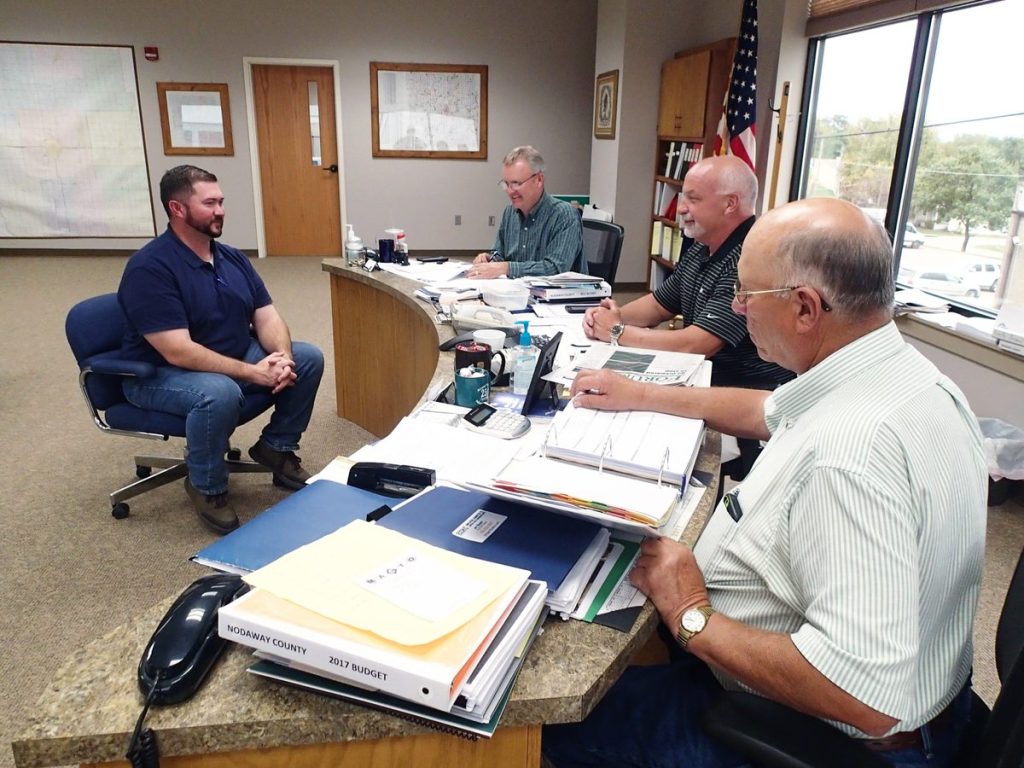
Prosecuting Attorney Robert Rice, left, is shown meeting with the Nodaway County Commission on Friday, when he urged the board to provide reimbursable up-front funding for the 4th Judicial Circuit’s victims’ advocate program, which was recently approved for a second two-year grant through the Missouri Association of Prosecuting Attorneys.
Prosecuting Attorney Robert Rice met with the Nodaway County Commission on Friday to discuss a two-year-old crime victims’ advocate program designed to support and guide victims navigating what can be an emotionally harrowing path leading from an offender’s arrest to their prosecution and ultimate conviction.
Rice told the commissioners the program, which is staffed by a full-time advocate working out of the prosecutor’s office and serving crime victims across the five-county 4th judicial circuit, has been approved for another two-year grant cycle through the Missouri Association of Prosecuting Attorneys.
Administered by the association, the initiative is ultimately funded with federal dollars from the Office of Victims of Crime, a part of the U.S. Department of Justice.
Though the 4th Circuit is relatively new to the program, it has been around nationally since the late 1980s and was organized in response to the Victims of Crime Act, or VOCA, signed into law in 1984 by President Ronald Reagan.
Rice appeared before the commission in the early stages of the county’s annual budget-writing process, which will continue through the end of the year. He said he wanted to give the governing board early notice that the victims’ advocate operation requires $60,000 in up-front county funds, most or all of which will be gradually reimbursed over the 12-month period beginning Jan. 1.
The funds cover the advocate’s salary and benefits, mileage and most incidental expenses.
He added that while advocate Karen Kepka is responsible for serving crime victims throughout the circuit, the vast majority of her caseload originates in Nodaway County, which functions as the program’s administrative hub.
Essentially, Rice said, Kepka’s job is to serve crime victims — in particular women victimized by domestic abuse and relationship violence — by making them aware of their rights and supporting them in any way possible while the prosecutor builds a case.
Services include keeping victims informed about court dates and the legal and custody status of their abusers; helping arrange for social services, such as housing, clothing and nutritional assistance; and facilitating financial assistance through Missouri’s Crime Victims’ Compensation Program.
On a more personal level, Rice said, Kepka offers moral, and often physical, support by accompanying victims to court sessions or simply by telling them, either in person or over the phone, that they don’t have to go through their ordeal alone and unaided.
“One of the biggest things we deal with on a daily basis is getting the victim to hang in there long enough” to mount a successful prosecution, Rice said.
In many cases, he added, just having someone who knows the system in a position to tell victims “We’re going to get through this” can make the difference between conviction and dismissal.
Without such encouragement, Rice said, many women — some of whom he described as having been “beat to hell” — simply ask for the charges to be dropped, expressing a variety of reasons ranging from emotional attachment to their abuser to fears about losing health insurance coverage for their children.
He said statistics compiled by his office show that if offenders can be induced to “plead to something,” even a reduced charge, they are less likely to renew the cycle of violence or commit a criminal offense of some other kind.
Since 2015, Rice said, the advocate has typically served about 400 victims a year.
While the prosecutor said he was unsure how many of the abusers involved in those cases have been convicted, he believes there is little doubt that keeping a victims’ advocate on staff has resulted in “getting more dispositions in domestic violence cases.”