Sewer repairs remain a priority for City Hall
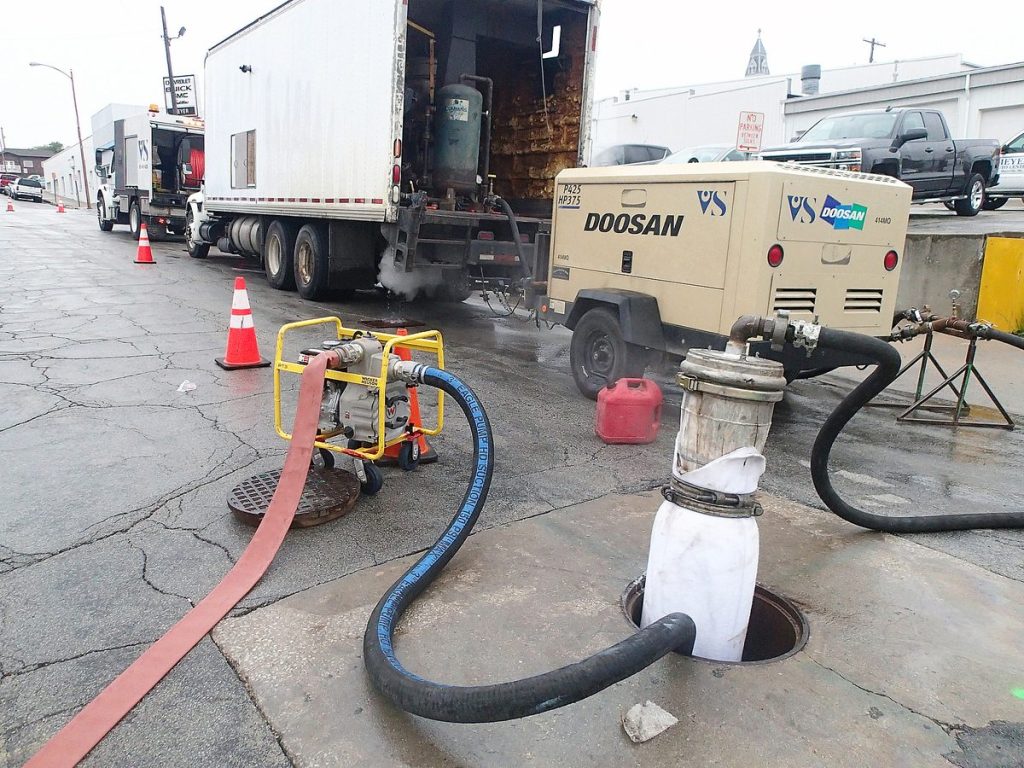
TONY BROWN/DAILY FORUM
Crews from Wisconsin-based Visu-Sewer Clean & Seal Inc. are in Maryville this week using special equipment, pictured, designed to coat aging sewer mains with a felt-like material that hardens into a thin, concrete-like liner. The process repairs cracks and leaks and prevents rainwater from entering the sanitary sewer system.
It’s not as glamorous as a new conference center, like the one the City of Maryville is building at Mozingo Lake Recreation Park, and it’s not as noticeable as a repaved street, but municipal officials decided a long time ago that rehabbing underground sewer lines is a top priority when it comes to allocating infrastructure dollars.
The city’s fiscal 2017 budget contained $500,000 for projects designed to reduce inflow and infiltration of storm water into the sanitary sewer system. In addition, the City Council chose low-bidder Visu-Sewer Clean & Seal Inc. of Pewaukee, Wisconsin, to conduct this year’s round of sewer pipe lining at a cost of nearly $343,000.
A number of other projects designed to reduce “I&I” were funded well.
Depending on the weather, Public Works Director C.E. Goodall said Wednesday that Visu-Sewer should complete its work here within the next two weeks.
The sewer-lining effort embraces more than 2.5 miles of pipe identified during citywide smoke testing conducted earlier.
Goodall said the city has spent several hundred thousand dollars on pipe lining, manhole replacement/repair and other sewer-upgrade tasks in each of the past six years.
Plugging I&I leaks has been a major issue for City Hall since completion of a $13.7 million mechanical wastewater treatment plant in 2015 under a mandate from the state Department of Natural Resources.
Unlike Maryville’s old lagoon system, which basically treated water by allowing human waste to settle at the bottom of a series of large ponds, the mechanical plant employs multiple machine-driven processes, including massive clarifier tanks equipped with metal arms that churn through sewage in order to remove particulates and suspended solids.
That means every gallon of sewage requires electricity to treat, and that anything causing a reduction in wastewater volume saves the city — and therefore ratepayers — money.
However, digging up thousands of yards of aging sewer mains and replacing them with new pipe would be prohibitively expensive. So the city settled on pipe-lining technology to plug the inevitable leaks.
It’s an interesting process, but one that is a little difficult to visualize.
Imagine a sock pulled over your arm wrong side out. That’s the felt-like pipe-lining material. A blast of water is then used to unroll the “sock” down your arm — that is the sewer pipe — so that all the cracks and crevices are sealed.
After the pipe is lined, hot water or steam is forced through it, which turns the felt-like material into a cement-like waterproof coating.
A robotic saw, guided by a small camera is used to cut out the portals connecting the sewer main to individual homes and businesses.
Goodall said the effort to keep rainwater out of sanitary sewer lines will likely never be complete. But he added that the yearslong effort to plug as many leaks as possible appears to be paying off.
Following heavy rains, he said, technicians with PeopleService, the company contracted by the city to run its sewer and water plants, have reported improved — that is diminished — peak intake volumes at the wastewater treatment facility.
“We’ve made some big strides,” said Goodall, adding that the pipe-lining budget might even decrease somewhat in a year or two.
“At some time, I think we’ll get to the point where we’re not spending this kind of money every year,” he said.