
Conservation Days teaches importance of conservation
TOM PINNEY/DAILY FORUM
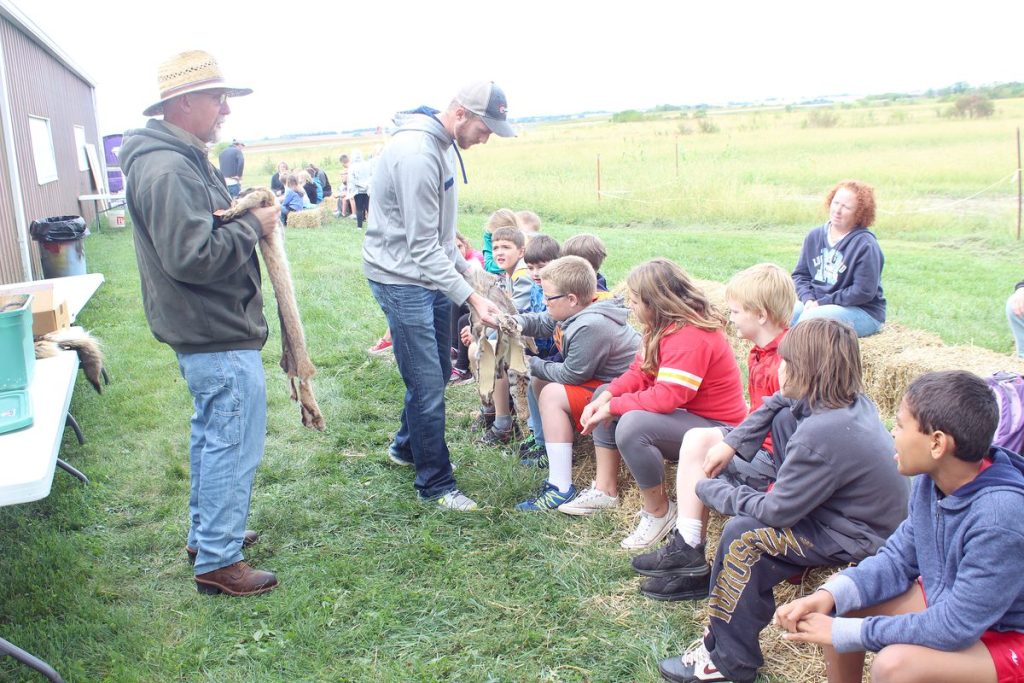
Two representatives from the Department of Conservation describe different wildlife that roam the area and show bobcat pelts to area fourth graders. The activity was part of the annual Conservation Kids Days held at the Nodaway County Community Building west of Maryville.
Area fourth graders are getting a hands-on opportunity to experience northwest Missouri.
The Missouri Department of Conservation’s annual Conservation Kids Days took place yesterday and continues today at the Nodaway County Community Building west of Maryville. The annual field trip gives area fourth graders the chance to participate in several activities and hear a few speeches all based around natural preservation and conservation.
Colton Holtman, a soil conservation technician with the United States Department of Agriculture’s Natural Resources Conservation Service, said it was important to reach people at a young age in order to develop skills and habits early.
“We live in Nodaway County, so conservation efforts impact us directly, whether through farming, Mozingo, or the ponds, lakes and rivers around us,” Holtman said. “Conservation means we’re trying to save what we have so that people in future years can enjoy it and take part, whether it’s recreation or putting food on the table, so it’s important to start talking about it early.”
That’s what Conservation Kids Days is all about. Holtman has been involved with the effort in Nodaway County since joining the staff at the Natural Resources Conservation Service in 2012. The day contains several 35-minute sessions where the different groups of fourth graders rotate between six stations – bees, streams, soils, wildlife, aquatics and forestry.
The bee station allows students to learn general knowledge about bees and what makes them important to our ecosystem and environment. The stream station gives insight into how the Corps of Engineers straightened rivers decades ago, and now those rivers are naturally trying to take their original path. Holtman said the discussion at the booth talks about how straightening the rivers harmed crops and wildlife, among other things.
At the soil station, Holtman said the speaker discusses erosion and talks about the difference in runoffs and water quality between pastures, mild crop fields, and frequently-tilled crop fields. “You definitely see a difference in clarity and cleanliness of the water from tilled soils,” Holtman said.
For the wildlife station, students get a background on the types of wildlife in the area and how that wildlife is affected by the human population. Holtman said they talk about species that are extinct and why certain species exist as they do now. As an example, the conservationists talk about the bobcat and how it went from close to extinction to the high population they currently have.
At the aquatic station, helmed by Holtman himself, the discussion revolves around understanding ecosystems. Holtman said he talks a lot about state symbols, such as the state fish, the state amphibian and the state aquatic animal.
After the discussions, Holtman said the students were allowed to go hands-on and dig for samples of crawfish, rocks and other things. Then the kids put them into tubs and played with the different animals in order to experience what they eat. He also said they have a tank full of fish to describe the differences between the fish.
Finally, the students visit a forestry station run by a partner to the Missouri Department of Conservation. At that station, the students hear about the different species of trees in Missouri and why trees are important for humans and wildlife conservation.