
Council sets stage for 2018 budget approval
By TONY BROWN Staff writer
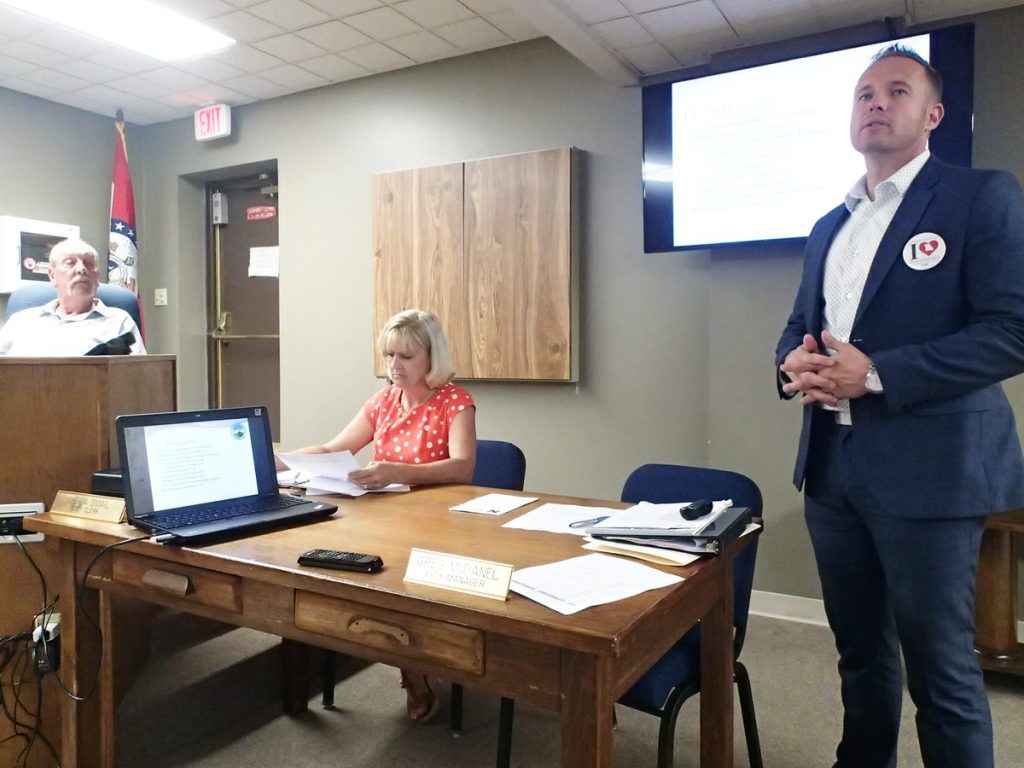
City Manager Greg McDanel, right, speaks before the Maryville City Council Wednesday during a budget workshop covering proposed spending for municipal water and sewer operations and capital projects during the new fiscal year, which begins Oct. 1
The Maryville City Council on Wednesday concluded budget deliberations for the approaching 2017-2018 fiscal year, which begins Oct. 1.
During a special study session held prior to a brief regular meeting at City Hall, the council listened to a presentation by City Manager Greg McDanel, who went over projected revenues and expenditures for the Water and Sewer Fund, which, unlike revenue categories based on taxes, depends on income from user fees paid by residents and businesses.
Next year’s Water and Sewer Fund spending is projected at $6.86 million, a total that breaks down into $2.84 million in operating costs, $2.03 million in capital expenditures and $1.98 million in debt service.
Revenues from water and sewer operations in fiscal 2018 are estimated at $5.34 million, meaning that municipal staff is proposing $1.52 million in spending from the existing fund balance.
McDanel said dipping into the fund balance will decrease water and sewer reserves from around $4.5 million to just under $3 million by this time next year. However that amount is still well above the $1.42 million reserve minimum — equivalent to 50 percent of annual operations costs — that staff considers financially prudent.
Proposed water and sewer expenditures for 2017-2018 include $305,000 for three new water main installations; $380,000 for a new sewer line cleaning and vacuuming truck, known as a “jetter-vac”; $150,000 for sewer pipe lining; $350,000 for a trunk line replacement; $200,000 for improvements to the southwest sewage lift station; 195,000 for a pair of sewer line projects; and $100,000 held in reserve for infrastructure improvements tied to economic development.
In a bit of good news for ratepayers, McDanel is not proposing an increase in either water or sewer charges next year, but said the possibility of rate hikes will likely have to be revisited in 2019.
As for other parts of the budget, McDanel went over projections for the newly enacted transient guest tax, a 5 percent “bed tax” assessed on nightly hotel stays approved by voters last November. Collection of bed tax revenue began April 1.
Under state law, revenues from the tax can be spent only for programs, activities and facilities promoting tourism and related forms of economic development.
Based on current occupancy rates, the tax should produce an estimated $215,000 a year, $150,000 of which will help finance Hughes Fieldhouse, a mammoth indoor athletics facility currently under construction on the campus of Northwest Missouri State University.
Under a deal with Northwest, Maryville is to contribute a total of $3.45 million in bed tax revenues to the $20 million fieldhouse project over the next 23 years. That should leave about $65,000 annually for other tourism and marketing initiatives.
Decisions about how to spend that money are to be made by a nine-person Tourism Committee comprising six “organizational” members representing the city, Nodaway County Economic Development, Greater Maryville Chamber of Commerce, Maryville Downtown Improvement Organization, Maryville Parks & Recreation and Northwest.
The panel, selected by the council, also includes three members appointed to represent the community at large.
During a prior budget workshop late last month, the council heard staff presentations related to $6.3 million in proposed General Fund spending along with an ambitious capital improvements blueprint totaling $7.2 million and calling for construction of a new $4 million police and fire headquarters.
Other capital initiatives embrace $1.74 million for street improvements, about six times as much money as was spent on streets during the current year.
Additional projects include proposed replacement of the apron at Northwest Missouri Regional Airport at a cost of around $1 million, 90 percent of which will come from a Missouri Department of Transportation block grant.
As for Mozingo Lake Recreation Park, the council has been asked to ratify a $2.9 million budget already approved by the Mozingo Lake Advisory Board and comprising $634,000 in capital spending, with the lion’s share of the latter amount earmarked for equipping and furnishing a new lakeside conference center and golf course clubhouse.
Mozingo revenues come primarily from patron fees derived from two golf courses, campsite and cabin rentals and other charges, plus a half-cent-on-the-dollar Mozingo Lake sales tax.
In addition, a large majority of the funding for construction of the $4.7 million conference center is being financed using proceeds from a separate eighth-of-a-cent sales tax approved by voters in April 2016.
Other spending in the new fiscal year includes $1.77 million by Maryville Parks & Recreation and $417,300 by the Maryville Public Library, both quasi-independent agencies funded with their own property tax levies.
Council approval of the budget is scheduled for 7 p.m. Monday, Sept. 25, at City Hall.
As for the regular portion of Wednesday’s meeting, the council approved an extension of an existing work-release agreement with Maryville Treatment Center, a local state Department of Corrections facility.
The contract pays up to six MTC inmates $7.50 a day for such tasks as painting, picking up litter, mowing grass, trimming trees and cutting weeds and brush.
After concluding its public agenda, the council adjourned and reconvened in closed session to discuss the proposed lease, purchase or sale of real estate. Actions taken, if any, were not immediately announced.




