
Lunch and Learn features new oncologist
TOM PINNEY/DAILY FORUM
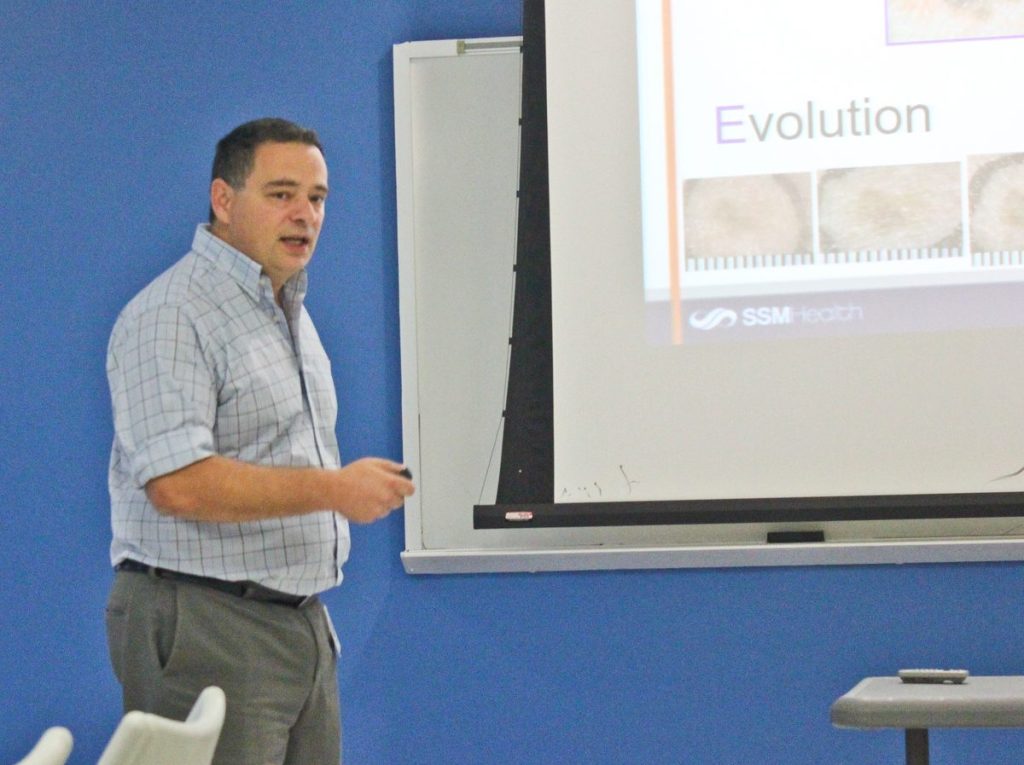
SSM Health St. Francis Hospital’s newest oncologist, Dr. Rolando Breier, gives a presentation on skin cancer during a Lunch and Learn seminar Friday. Breier’s presentation covered many types of skin lesions, both cancerous and non-cancerous, that would warrant attention in the waning summer months.
Skin cancer in the United States is becoming more prevalent and more dangerous.
In 1935, the chances of a person getting skin cancer in America was one in 1,500. In 1985, the chances increased to one in 150.
In 2017, a person has a one in 50 chance of getting skin cancer, and each year, there are 58,000 new cases and 9,000 deaths associated with the deadly disease.
It’s a problem that SSM Health St. Francis Hospital’s new oncologist, Dr. Rolando Breier, wants to nip in the bud if he can. And that started in Nodaway County with his Lunch and Learn seminar Friday afternoon.
When it comes to treatment and prevention of melanoma, Breier quite literally helped write the book. He was the co-author of the chapter on therapy for advanced melanoma in Perry’s The Chemotherapy Source Book.
To begin his lecture, Breier pointed to the glorification of sun-kissed bodies as the reason for the rise in skin cancer cases.
“We had television shows like Baywatch that showed us that ‘tan is sexy,’” Breier said. “People started to sunbathe more and visit tanning salons in hopes of getting that kind of body.
“What people don’t know is that the tans on Baywatch were all movie magic. They wore tons of sunscreen while on the set, and the tanness of their skin was all makeup.”
Even so, Breier said, people are foregoing good sun protection in favor of trying to make their skin tone a little darker. He noted that the danger of this was that there was no protection from the sun’s ultraviolet rays, which are mostly to blame for skin cancer and other skin problems.
“Ultraviolet rays are responsible for 60 to 80 percent of all skin cancer cases,” Breier said. “UVA rays get down into the skin and cause wrinkles and aging, while UVB rays cause sunburns.”
Both contribute to a person’s likelihood of developing skin cancer. But when it comes to individual risk factors, Breier broke them down into three areas.
“First, like with most cancers, a person is at a higher likelihood to develop skin cancer if someone in their family has developed it,” Breier said. “Your skin type and color can also factor in, so if someone has blonde or red hair, fair skin, blue eyes, and freckles, they’re at a higher risk than others.
“Environmentally, if someone has three or more blistering sunburns before the age of 20, works in an outdoor summer job three or more years in their adolescence, or makes frequent use of sunlamps and tanning beds at younger ages, they are at a higher risk. Even in adulthood, doing any of these things puts you in danger of getting skin cancer.”
Breier also pointed to the presence of actinic keratosis, elastosis, and marked freckling of the upper back as potential red flags. He noted that each present risk factor increases a person’s chance of getting skin cancer additively.
In order to check for skin cancer, Breier pointed to the “ABCDEs” of melanoma diagnosis.
“We first look for asymmetry, meaning that if you put a line through the middle of the melanoma and both sides come out with different amounts, it’s worth getting checked,” Breier said. “B stands for borders, so if the borders are unclear or undefined, that’s a red flag.
“C is for color, so if there is more than one color that you can see, get it checked. D means diameter, and if the diameter is over six millimeters, see a doctor. E is evolution, meaning that if it’s changed over time, it may be malignant.”
Breier noted that oncologists take skin cancer very seriously, as 15 percent of patients will die from it. For both of the most common forms of skin cancer, surgery is required.
“A basal cell carcinoma (commonly typified by the melanoma that can be spotted using the above methods) requires a removal of the melanoma itself and the skin within a two-centimeter radius in each direction,” Breier said. “Not only do we get the top skin, we dig two centimeters into the skin almost to the muscle.
“For a squamous cell carcinoma, which is typified by a flat, red, scaly patch, it’s basically the same thing. We remove the melanoma and make sure we get it all.”
Skin cancer prevention, no matter the amount or severity of one’s risk factors, is rather simple, according to Breier. And it all starts with being sun AWARE.
“Avoid unprotected UV exposure, and wear sun protective clothing, hats, and sunglasses,” Breier said. “Apply sunscreen at SPF 30 or better, and make sure to reapply when it tells you that you should.
“Routinely check skin for abnormalities. Educate your family about the dangers of skin cancer and unprotected sun exposure.”
As far as sunscreen is concerned, Breier said it is best to go between SPF 30 and SPF 50, as SPF 50+ has no major benefits over SPF 50. He also noted to look for cream instead of powder or spray, and to avoid using sunscreen that is combined with insect repellant.