
Capital spending highlights 2018 city budget
TONY BROWN/DAILY FORUM
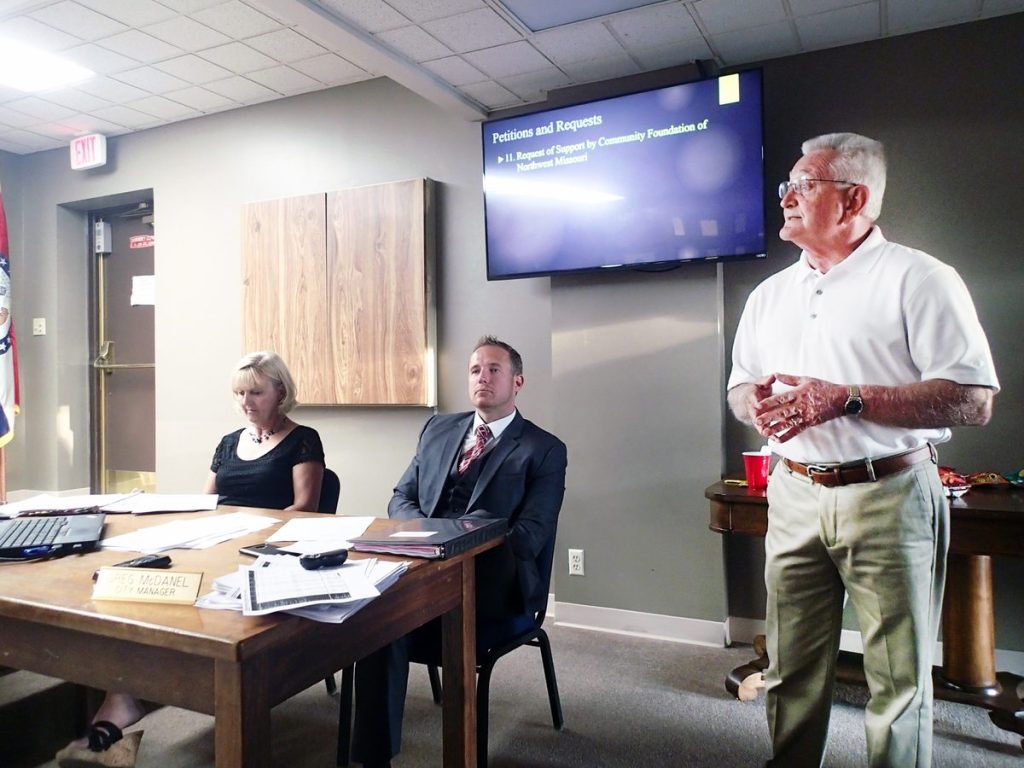
Former state lawmaker Mike Thomson addresses the Maryville City Council this week on behalf of the Community Foundation of Northwest Missouri. The foundation is one of a number of groups seeking municipal funds as the council continues deliberations regarding the fiscal 2018 budget, which will go into effect Oct. 1.
Meeting for more than three hours in a double-barreled session that included both regular business and an early evening budget workshop mapping out spending for fiscal 2018, the Maryville City Council took an initial step this week toward approving millions of dollars in capital improvement spending.
During the special budget portion of Monday’s meeting, the council also listened to staff presentations summarizing the General Fund outlook and proposed expenditures at Mozingo Lake Recreation Park, including plans for completing and opening a new lakeside conference center.
The new fiscal year begins Oct. 1.
City Manager Greg McDanel described next year’s $6.3 million General Fund budget as “bare bones” due to depleted reserves that have been spent down over the past couple of years in order to make up for scarce discretionary revenue derived from the city’s half-cent capital improvements sales tax.
Toward the end of the tax’s 10-year term, most of the proceeds were earmarked for debt service related to completed projects, such as major street reconstructions.
Last April, however, voters renewed the tax for another 20 years, meaning that while cash is flowing again for new capital projects, the council will likely trim spending on other fronts until general-spending reserves are replenished.
Only about $1.1 million in General Fund revenues are proposed for capital outlays this year, as opposed to personnel and operations.
McDanel estimates that will leave the city with $1 million in General Fund reserves by the end of next year, which is just a few thousand dollars above the city’s minimum emergency reserve threshold of 20 percent of annual operations spending.
Other financial pressures confronting City Hall for 2018 include flat sales tax revenue and a threatened 29 percent rise in health insurance premiums, which McDanel has proposed countering with higher deductibles and increased co-pays for employee doctor visits and other medical treatment.
The city manager is also suggesting the council consider strategies such as healthcare reimbursement accounts and employee wellness programs in order to keep healthcare costs, including out-of-pocket expenses for employees, under control.
Raising deductibles and co-pays, means that the city’s health insurance premiums will remain about the same next year at just under $890,000.
But while the General Fund is lackluster, Maryville’s capital improvements outlook is robust, both in terms of the city proper and Mozingo Lake Recreation Park, which has a separate revenue stream consisting of a half-cent sales tax and user fees.
Capital revenue available for city facilities, infrastructure and equipment — including a new $4 million Maryville Public Safety police and fire headquarters — is estimated at $7.2 million for fiscal 2018. Other initiatives include $1.74 million for street improvements, about six times as much money as was spent during the current year.
In addition to $1.25 million to be set aside for asphalt overlays, the proposed transportation capital improvements budget comprises $250,000 for concrete street repairs and $248,000 for “downtown enhancements” yet to be proposed.
Unfunded in the draft budget is the start of work to improve traffic flow and pedestrian access on South Main Street between South Avenue and Walmart. However, McDanel said the South Main project, adopted by the council as a major priority and presented as a selling point to voters during the sales-tax renewal campaign, will likely move forward in 2019.
As for Mozingo, the council is expected to ratify a $2.9 million budget already approved by the Mozingo Lake Advisory Board and embracing $634,000 in capital spending for both operations and maintenance, with the lion’s share of that amount earmarked for equipping and furnishing the new conference center.
Other proposed capital spending includes rebuilding the apron — essentially a parking lot for airplanes — at Northwest Missouri Regional Airport. On Monday, the council approved a $907,223 construction contract with Ideker Inc. of St. Joseph, which is expected to begin work in September and complete the project by the end of November.
Ninety percent of the apron rebuild is to be funded through a Missouri Department of Transportation block grant, with a $108,000 local match financed through a low-interest loan from the State Transportation Assistance Revolving Fund, a MoDOT program known as STAR.
Additional fiscal business before the council this week included presentations by local and regional organizations seeking municipal tax dollars for programs seen as furthering economic development or the public welfare.
One such request, unchanged from 2017 at $62,000, came from Nodaway County Economic Development, which relies on the city for about a third of its budget.
Also addressing the council was Ray Courter of the New Nodaway Humane Society, who requested an increase in the city’s $60,000 annual contribution and noted that the society has been force to dip into reserves in order to make up an $11,000 deficit.
In addition to caring for stray dogs and cats, the shelter also provides the city with animal control services.
Other groups seeking city assistance include the Maryville Public Arts Committee, which asked for an additional $3,710 over this year’s $6,000 appropriation; Northwest Missouri Enterprise Facilitation; and the Community Foundation of Northwest Missouri.
The directors of Maryville Parks & Recreation and the Maryville Public Library addressed the council as well, summarizing their budgets for the upcoming year. While technically part of the city, both entities have their own revenue streams, which are largely overseen by quasi-independent boards.
Parks Director Aaron Dobson is proposing a $1.38 million operations budget with a 20 percent contingency fund of $277,289. The Parks & Rec budget also includes $110,000 in proposed capital spending for a combined fiscal blueprint of $1.77 million.
As for the library, thanks to a voter-approved property tax increase, Director Stephanie Patterson is predicting a significant increase in revenues for fiscal 2018 from $261,214 to $417,300.
Among other things, the additional funds will be used to hire a youth services coordinator, a position that will increase the number of full-time library staff to three.
The council will continue draft budget deliberations at 5:30 p.m. Monday, Sept. 11, at City Hall. The completed spending plan is scheduled to go before the governing board for approval in a regular session set for 7 p.m. Monday, Sept. 25.




