
Sexting speaker comes to Maryville
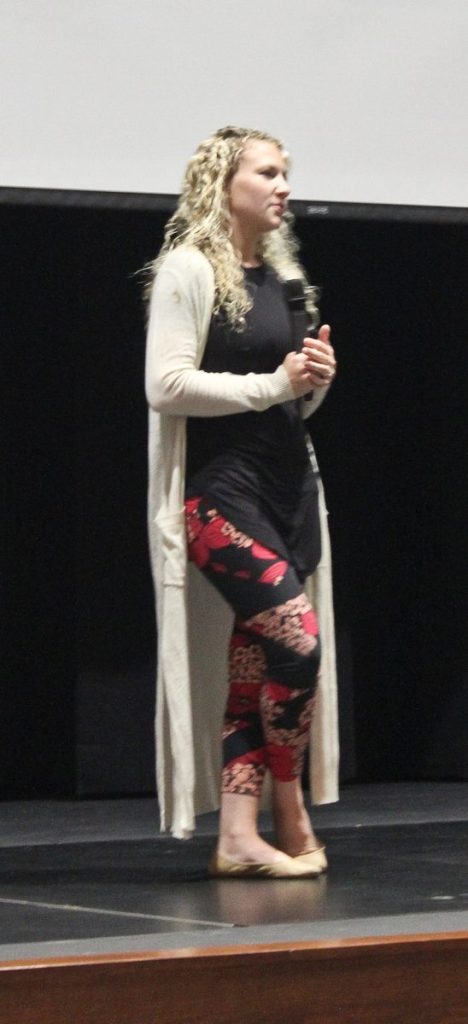
TOM PINNEY/DAILY FORUM
Bullying and sexting speaker Ally Pereira takes questions after her presentation to parents and students Monday night in the Lee and Nina Schneider Center for the Performing Arts. Pereira travels around the country telling the story of when she was a victim in a sexting scandal in hopes of halting a behavior that has become common in American high schools with the evolution of cell phone technology.
According to a 2014 report from Southern Illinois University, 24% of high-school aged teenagers have been involved in a form of sexting, or sending sexually explicit materials in the form of text messages or picture messages via cell phone. Maryville Public Safety and the Maryville R-II School District did something proactive Monday evening to help students realize the dangers.
With generous help from NorthwestCell, on Monday night and throughout the school day Tuesday, Maryville High School played host to Ally Pereira, a speaker who travels nationwide telling the story of her life.
At 16 years old, Pereira was involved in a sexting scandal when her ex-boyfriend told her they would get back together if she sent him a nude photo. She obliged, but in her words, it was the worst mistake she had made to that point.
“He didn’t respond to the message, and the next day, people were looking at their phones and then looking at me and laughing,” Pereira recalled. “My ex had sent the picture to everyone in his contact list, and it had spread even further than that.
“The picture ended up going around to four high schools, three middle schools, and four elementary schools. Teachers and community members all had my picture.”
Before the scandal, Pereira said she was a straight-A student and involved in her church. Her parents didn’t let her have a boyfriend until she entered high school, and the ex in question was her first boyfriend, and they were dating for more than a year.
Pereira was convinced she was in love with him. When they broke up suddenly because she wasn’t ready to make their relationship physical, she said it broke her heart, which was why she was so ready to try and mend fences with the illicit photo.
“He hadn’t spoken to me in four weeks,” Pereira said. “I wanted to get back together with him because I was convinced we could go all the way.
“I didn’t think; I impulsively took the picture and sent it to him. It was the worst decision of my life.”
Before long, the photo had spread like wildfire. Pereira was called into the vice principal’s office, where she initially denied sending the photo before admitting to it, at which point he called Pereira’s mother to inform her of the situation.
Pereira said her mother was initially angry, but quickly stepped in to help in whatever way she could. Meanwhile, Pereira experienced bullying both in and out of school.
“Girls would come up to me and threaten to beat me up because they didn’t want their boyfriends looking at my picture,” Pereira said. “People would stand on tables in the cafeteria, point right at me, and yell words like ‘Slut’ and ‘Whore.’
“I would get calls at home and posts on social media threatening my life. There was no hiding from it, no place to go where the picture didn’t haunt me.”
In time, Pereira’s grades fell, and her dream of being a doctor one day seemed to crumble in front of her eyes. That’s when she attempted suicide.
Through therapy, love from her family, and the few friends who stuck with her despite pressure and the risk of public ridicule, Pereira said she survived. But what also helped her were stories of two young women who had also sent photos that ended up being circulated throughout their schools. Unfortunately, the pressure was too much for the both of them, and they committed suicide.
As a result, Pereira answered a casting call for an MTV News segment on sexting, and before too long, appeared on The View and My Life is a Lifetime Movie telling her story and encouraging others not to send explicit messages like she did.
Pereira was also called on to help craft new legislation in the New Jersey assembly about sexting so that people involved in such scandals could avoid steep penalties on a case-by-case basis. She was also contacted by Valerie Jarrett, then-President Obama’s senior advisor, to help craft federal sexting legislation.
Part of Pereira’s message was to inform people of the dangers of sexting. Not only can the photo spread to places it should never be, but the people in question could face legal trouble.
“I didn’t go to the police because, at the time, I could have faced 10 years in jail for making and distributing child pornography,” Pereira said. “I would have also had to register as a sex offender until I turn 40.
“My ex would have been charged only with distribution, and he would have had to register as a sex offender as well. This mistake would have had a huge impact on both of our lives.”
While New Jersey’s laws have changed, Pereira noted most states have not changed their laws. That includes Missouri, where teens who engage in sexting could face child pornography charges.
As a result, Pereira’s discussion also includes informing teens of their legal options. She said she has written to numerous lawyers on teens’ behalf to try to persuade them against levying child pornography charges against the victims.
Maryville Public Safety Detective Ryan Glidden, who was on hand for each session, informed the audience that several recent cases of sexting here in Nodaway County have been handled in a similar case-by-case basis, and that in some of those cases, no charges were levied at all. In one particular case, Glidden said the family of the victim had asked that charges not be levied against the perpetrator because they feared repercussions from the community.
Pereira understands the sentiment. She noted that, when she gives a speech, it’s posted on social media, and “around 70 percent” of the comments she receives are along the lines of “she deserved it” or resort to slut-shaming and name-calling.
To try to mitigate that behavior, Pereira also speaks to people in the audience who participate in bullying to remind them that there are humans on the other side of the screen reading what they write and feeling the effects of their words. She noted her mother had, at one point, spent six hours sending personal messages to each person who left a negative comment on one of her posts.
Pereira’s life was turned upside down in high school based on a mistake. But she said she tells her story to people around the country to encourage them that, if they ever find themselves in her shoes, it does get better.
“I graduated from that high school in 2008 and went to college, and now I’m a vascular technician, so I get to assist doctors and scrub up sometimes for surgeries,” Pereira said. “My boss now is very understanding of my situation and very supportive.
“People also ask if I ever got another boyfriend, and I did. I was scared at first, because he lived in the same community and his parents had seen my picture, and I didn’t want them to prejudge me. But we’ve been together for 11 years, we’re married, and we have two kids. I give this talk because I’m living proof that things do get better.”