Sheriff sees cooperation as a promise kept
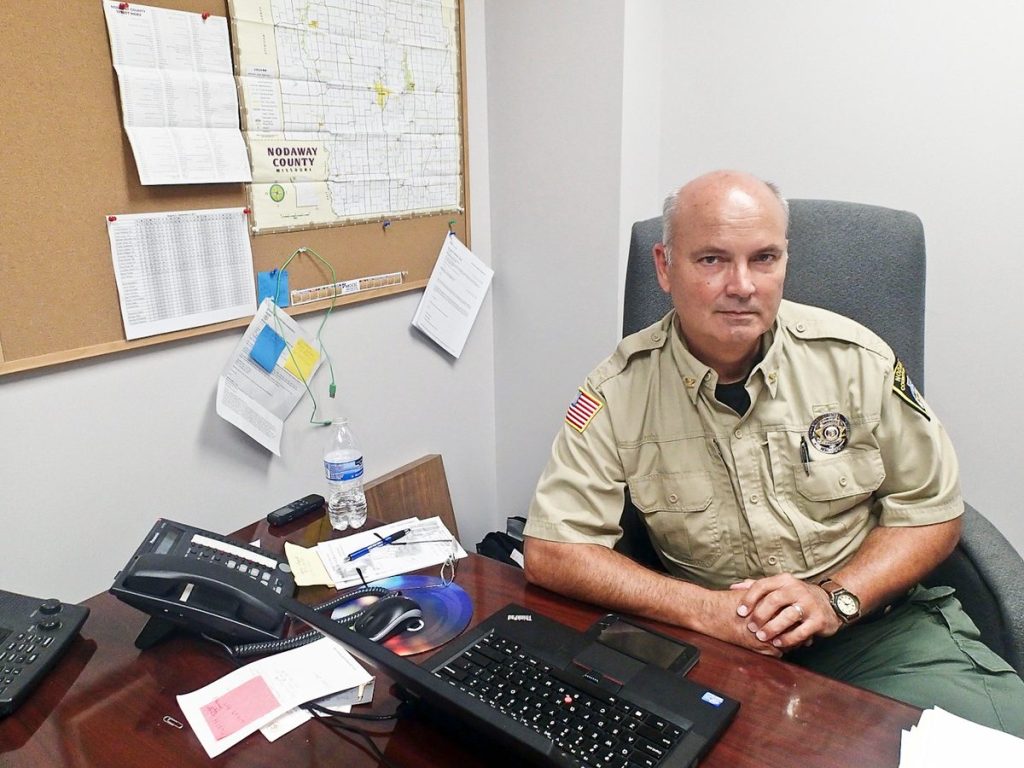
TONY BROWN/DAILY FORUM
Nodaway County Sheriff Randy Strong said Wednesday he is making good on one of the central promises made during his 2016 election campaign — a pledge to increase the level of cooperation between the Sheriff’s Office and law enforcement agencies across the region. Strong said a handshake agreement last week between himself and other senior peace officers essentially resurrects the Major Case Squad, a multi-county unit that has been out of commission for about five years.
In offering a summary this week of his first six months as Nodaway County’s top uniformed law enforcement officer, Sheriff Randy Strong claimed he has kept a major campaign promise to increase the level of cooperation between his office and other agencies across the region.
Recent developments, Strong said, include a verbal agreement last week between several law enforcement managers to resurrect the Major Case Squad, which is to be made up of officers from municipal and county agencies within Troop H, a Missouri State Highway Patrol service area consisting of 15 northwest Missouri counties.
Participation in the squad is voluntary. Efforts to formalize the organization through a written agreement are ongoing.
The squad’s purpose is to bring specialized personnel and resources to bear in the wake of serious criminal episodes, especially homicides.
Strong said one of the key elements in bringing the squad back into being has been the involvement of the St. Joseph Police Department’s Crime Scene Investigations unit, which is led by Commander Larry Smith.
Incorporating elements of CSI into the Major Case Squad’s initial response system, Strong said, will add expertise and technology to the process of securing and analyzing crime scenes, resources that agencies serving rural areas typically lack.
After several years of successful investigations, including the 2004 Bobbie Jo Stinnett murder and kidnapping case, which made national headlines, Strong said the Major Case Squad was gradually phased out due to lack of interest by participating agencies, and ceased to function completely about five years ago.
During its first incarnation, Strong said, the squad was typically called to action a couple of times a year.
Maryville Public Safety Director Keith Wood gave Strong credit Wednesday for taking the lead in re-establishing the squad. He added that MPS has joined the effort by naming Detective Sgt. Ryan Glidden as its Major Case representative.
Nodaway County’s Major Case officers are Maj. Randy Houston, who serves as Strong’s second in command, and Detective Jack Long.
Wood said he appreciates the sheriff’s efforts to strengthen inter-agency cooperation and noted that a written mutual aid agreement between MPS and the Sheriff’s Office has been in place since well before Strong was elected.
The agreement allows Maryville officers to respond to incidents that occur outside the city limits, such as last weekend’s car chase and fugitive search in northwest Nodaway County near Elmo.
During that incident, MPS officers took on a support role, using a four-wheeler to ferry deputies into and out of the search area. Deputies and officers from a couple of Iowa jurisdictions, in addition to Iowa and Missouri state troopers, participated in the manhunt as well.
When such cases arise, Wood said, local police can only respond if specifically requested by the Sheriff’s Office to do so. The department also has the option of refusing such requests if answering the call would leave Maryville without adequate law enforcement coverage.
While cooperative responses have an impact on the department’s budget, Wood said the costs even out over time due to similar aid rendered to police by sheriff’s deputies.
Strong is also working to forge a stronger relationship with the Buchanan County Drug Strike Force, which has agreed to help train a Nodaway deputy in conducting such activities as controlled drug buys, surveillance and the presentation of drug-case information to prosecutors.
Beyond pushing for more inter-agency cooperation, Strong said his first half-year in office has also included a renewed emphasis on training, partially in response to legislative requirements passed into law following prolonged racial unrest in the St. Louis suburb of Ferguson in 2014.
Deputies, the sheriff said, are currently enrolled in courses covering such topics and courtroom testimony, crisis intervention, criminal investigation, crime scene investigation, narcotics investigation, new-officer field training, and suspect and witness interviews.
Strong has also initiated training opportunities for public school teachers and administrators with regard to “active shooter” responses. That effort also includes “trauma bag” training for deputies in the use of severe-wound first aid kits purchased using a $2,100 grant from the Abrielle Neff Foundation.
All of this activity has necessitated an increase in the training budget, but Strong said the office has been able to make up the difference by transferring funds from other areas.
Actual combined Sheriff’s Office/jail spending in 2016 was $1,149,253. This year’s Sheriff’s Office/jail budget totals $1,151,177, a projected increase of $1,924.
Finally, during his opening months in office, Strong said he has confronted what he described as a chronic problem with inmate confrontations at the jail.
The sheriff claimed that at the time he was sworn in last January incidents involving some kind of conflict between prisoners or between prisoners and jail staff were occurring about twice a week.
He said he addressed the issue through personnel changes and by ensuring that issues revolving around prisoner care — especially appropriate access to medication — were resolved.
“We are in control,” Strong said of current jail operations, “but we want to offer people a little human dignity.”
He added that jail inmates are responsible for paying for their own medication, and that many have been stripped of Medicare or Medicaid benefits.
In cases where money is an issue, Strong said, his office tries to work with prisoners’ families in an effort to ensure that prescriptions are filled and administered.
“Denial of basic medical needs is not part of their punishment,” he said.