Camp Cope helps children face grief, loss
TONY BROWN/DAILY FORUM
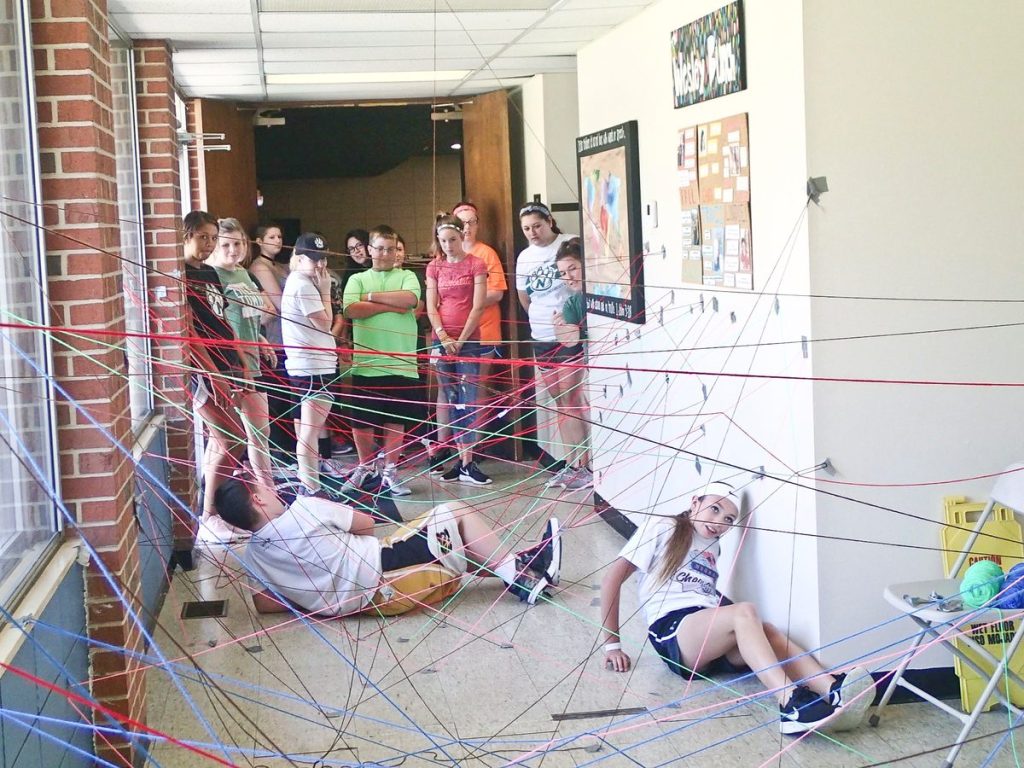
Young people attending Camp Cope this week at the Wesley Student Center in Maryville negotiate a three-dimensional yarn maze. The two-day camp was designed to provide children and teenagers with emotional strategies needed to deal with the death of a parent or other loved one as well as loss and grief caused by divorce, incarceration or military deployment.
The loss of a loved one is never easy. But the ordeals of death and separation can be especially difficult for children and teenagers.
In an effort to smooth, at least a little, what can be a very rugged road for young people facing the aftermath of tragedy, Elizabeth Dimmitt, a senior instructor of psychology at Northwest Missouri State University, organized Camp Cope, a two-day experience held this week at the Wesley Student Center adjoining the campus’ main south entrance.
The camp was divided into two day-long sessions, the first serving children ages 5-9 and the second, on Thursday, open to young people from ages 10 through 17.
Most of the 18 campers attending were coping with some kind of serious loss: the death of a family member or friend, the separation or divorce of parents, temporary loss of a parent or other loved one to incarceration or military deployment — even the death of a pet.
Other youngsters taking part are living in foster homes after having their lives disrupted in various ways.
While the program resembled other summertime programs for children, such as vacation Bible schools or parks and recreation day camps, most of the activities reinforced coping strategies designed to help people accept grief and deal with the emotional pain that comes with it.
On Thursday, for example, the youngsters made masks, which Dimmitt said were intended to symbolize “how people see me on the outside as opposed to how I really feel on the inside.”
During the exercise, the campers and their mentors — Northwest students who recently completed a special psychology of childhood grief and loss course — talked about the risks involved in removing those metaphorical masks and learning to share hidden feelings, especially with people who offer genuine affection and sympathy.
“It’s more about moving on, and not how to fix it,” Dimmitt said. “How do I survive and still honor these feelings I’m having, and what is the next step?”
She added that she hoped the camp helped children learn the grieving process involves “not forgetting, but growing through the experience I’ve had.”
Dimmitt said she came up with the idea for Camp Cope after attending a high school graduation with her husband, Wesley Student Center Director Travis Dimmitt, and realizing how many of the young people in attendance were living in single-parent households.
She also perceived a gap in community resources currently available designed to meet the needs of children dealing with grief and loss.
So, she applied for and received a Northwest Teaching and Learning Grant and designed the three-credit-hour course used to train the camp’s mentors. She also got in touch with nine similar camps across the country in an effort to put together a program consisting of activities that had already proven effective.
Games and exercises at Camp Cope included a web-like yarn maze illustrating the notion that complex problems seldom have simple answers, and that the trick is to find a solution that works for you.
The youngsters also wrote “connection letters” to their loved ones — either to keep or throw away as they saw fit — and made “memory boxes” containing small mementoes of the person absent from their lives, things like guitar picks, sea shells, cologne or a scrap from a favorite flannel shirt.
Not that all the activities lent themselves to quiet introspection and remembrance. There were plenty of songs and games — like at any other day camp — including a rousing water balloon fight and a round of “fizzy tag.”
In fizzy tag, youngsters place Alka-Seltzer tablets around their necks that have been glued to bits of string. Then they stalk each other with water sprayers in an attempt to dissolve each other’s tablets. The last person with an intact Alka-Seltzer necklace wins.
The activities varied for each camp day, since younger children navigating the pitfalls of grief and loss have different needs and points of view than older children and teens.
Younger children, Dimmitt said, can have a hard time understanding why an adult who has died doesn’t just appear the next day like a character in a cartoon show.
“They wonder what happens after people die,” she said. “They ask where do they go, and will I see them again? Those questions can be too big for 5-year-olds to wrap their minds around. They’re hard for adults to wrap their minds around.”
Older children, Dimmit said, have other concerns, such as shutting down emotionally because they don’t want to cause more pain for a surviving parent or sibling. Others feel obligated to act as caregivers.
In working with the children at Camp Cope, Dimmitt said she was impressed with the strength and honesty expressed by many of the campers.
The purpose of the program, she said, was to help children use those qualities as a starting point for moving forward.
“It’s all right to say ‘I miss them,’” Dimmitt said, “But here are some things I can do to help myself in this moment.”