
Lunch and Learn teaches hands-only CPR
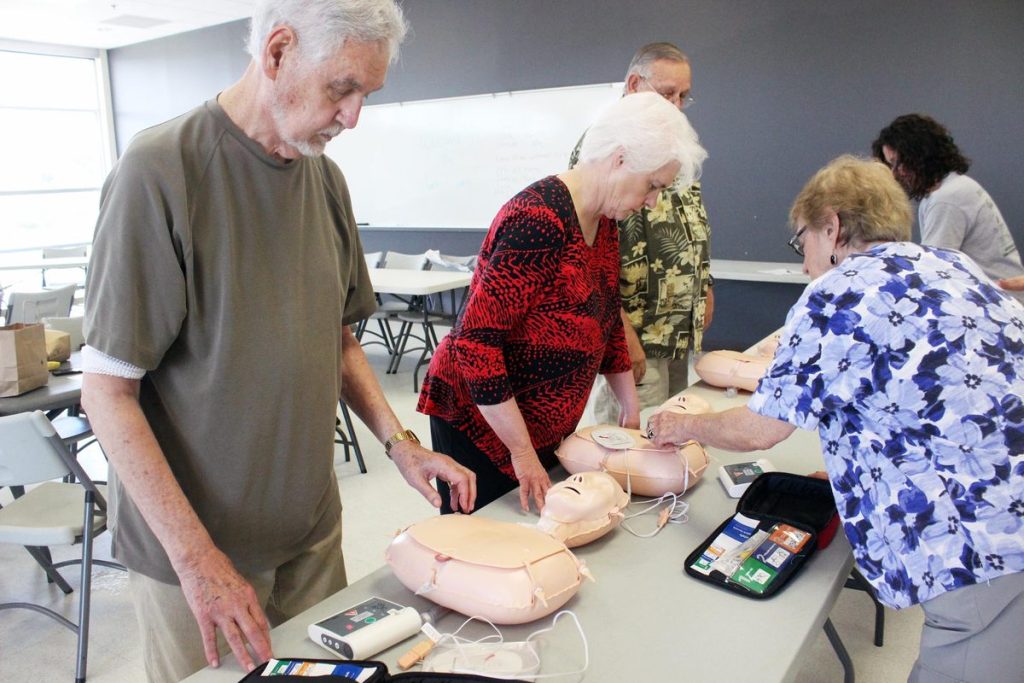
TOM PINNEY/DAILY FORUM
Participants at SSM Health St. Francis Hospital’s Lunch and Learn seminar on Friday practice hands-only CPR along with the use of Automated External Defibrillators, or AEDs. In 2016, 350,000 people died from cardiac arrest in cases where CPR could potentially have saved their lives.
As part of SSM Health St. Francis Hospital’s continuing series of pubic health education sessions, Community Resource Nurse Jackie Ross hosted a seminar on hands-only CPR Friday at the Maryville Community Center.
The seminar was evenly divided between a lecture and hands-on practice. Ross started out by going over some statistics related to the use of CPR on people experiencing heart attacks.
She said someone’s chance of surviving any sort of cardiac episode is increased when CPR is performed, but decreases by seven to 10 percent for every minute of delay.
In fact, Ross said, someone experiencing cardiac arrest has only a 7 percent chance of survival if CPR is not performed.
In 2016, 350,000 people died from cardiac arrest in cases where CPR could potentially have saved their lives.
Ross then moved on to CPR techniques, saying that the American Heart Association no longer recommends mouth-to-mouth “rescue breaths.”
She also noted that hands-only CPR is for adults and adolescents only, and is not effective on children.
“First, you have to be able to see their chest, so you have to remove any clothing covering that area,” Ross said. “After that, make sure your hands are at the bottom of the sternum.
“Then, you start compressing at about 100 beats per minute. The best way to think in those terms is to sing ‘Staying Alive” in your head, and you’ll be right about where you need to be with the rhythm.”
These days, thanks to an increasingly available technology, CPR is only part of the equation when someone is having a heart attack.
St. Francis Health Educator Lacy Auffert, who served as a co-presenter along with Ross, talked about how to deploy Automated External Defibrillators, or AEDs, which are increasingly available in public buildings and other locations.
An AED is a portable electronic device that automatically diagnoses life-threatening cardiac arrhythmias and is able to treat them through defibrillation, that is the application of an electrical current that stops the arrhythmia and allows the heart to reestablish an effective rhythm.
“Most AEDs will turn on by themselves when you open the kit,” Auffert said, “but if not, turn it on before you do anything else. It will give you instructions on how to proceed.
“After that, follow the instructions. When it prepares to assess the patient and shock them it will tell you to clear away, and that means you can’t even be touching the patient.”
Once the shock is delivered, the AED gives further instructions, which may include a command to apply CPR .
Ross said CPR should be started as quickly as possible, but that someone preparing to administer the technique should first make sure the patient is not merely asleep.
Once treatment has begun, she said, there are only a few scenarios when the rescuer should stop before first-responders arrive.
“Obviously, stop doing CPR if the person wakes up,” Ross said, “but keep them laying on their backs. Sometimes, they shoot right up and try to get up, but you have to keep them lying down or else they might be back where they started.
“If you’re alone, do CPR until you physically can’t go anymore or until an ambulance or other professional arrives. If you’re with someone, it’s best to switch off every two minutes until paramedics come and relieve you.”
To hammer the point home, Ross told a story about a man in rural Alaska who had a heart attack. A helicopter ambulance was summoned to the remote area, but in the meantime the entire village lined up and took turns performing CPR — for a total of 96 minutes — until the chopper arrived.
The man survived and suffered no neurological damage.
“CPR is effective,” Ross said. “If something happens and your heart stops, having CPR done increases your chances of living.”