
County support sought for Hughes Center
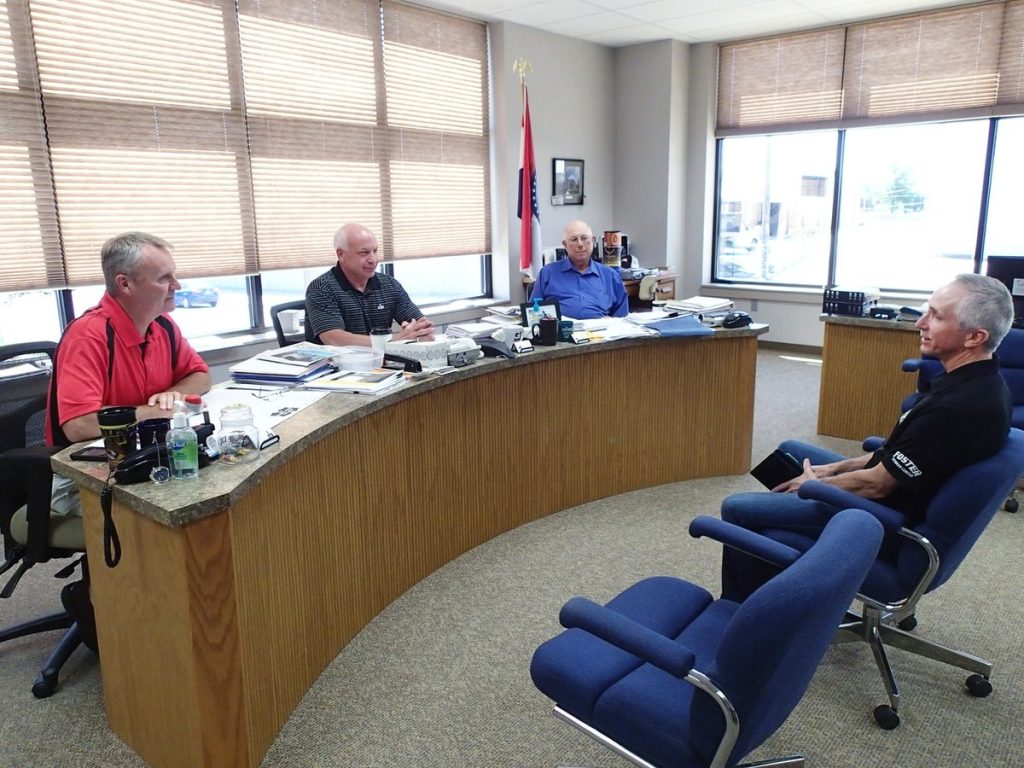
TONY BROWN/DAILY FORUM
Northwest Missouri State University President John Jasinski, right, is shown speaking with members of the Nodaway County Commission on Wednesday. Jasinski met with the governing panel to request county financial support for a new campus multipurpose center. Pictured from left seated behind the dais are North District Commissioner Chris Burns, Presiding Commissioner Bill Walker and South District Commissioner Robert Stiens.
Northwest Missouri State University President John Jasinski met briefly with the Nodaway County Commission on Wednesday in an effort to elicit additional support for a proposed $21 million campus athletics and special events facility, construction of which is set to begin this summer.
In essence, Jasinski urged the county to join the “Founding 50,” a group of more than 60 donors — and counting — who have agreed to support the project with gifts of at least $50,000.
Jasinski told the three-member governing board that interest in Founding 50 participation was “exploding,” and that current members included organizations and corporations as well as individuals.
He added that it was “exciting” to realize many donors have been inspired by the project to make “their greatest gift ever” to Northwest, whether or not that support achieved “Founding 50” status.
When completed next year, the planned 137,000 square-foot facility, to be located northwest of College Park Drive, will include recreation and exhibition space, a removable indoor flooring system, a 90-yard practice turf, a 300-meter indoor competition track, spectator seating and tiered meeting rooms.
Jasinski said he recognized the commission has a limited number of discretionary dollars available and faces budgeting and constituent pressures with regard to how they are spent. But he also said he wants as many entities as possible to be given a chance to participate in what he earlier described as Northwest’s largest public-private partnership ever.
“The last thing I want is for someone to say, ‘Well, you didn’t come ask me,’” Jasinski told the commissioners.
A significant amount of tax revenue has already been figured into the university’s formula for financing the facility, tentatively named the Hughes Family Center in honor of major donors and Northwest alumni Carl and Cheryl Hughes.
Last November, Maryville voters approved a 5-percent transient guest tax on hotel bills, which is projected to raise about $215,000 a year. Of that amount $3.45 million, or $150,000 a year, will be handed over to Northwest to help pay for and operate the multipurpose center over the next 23 years.
The remaining $65,000 is to be used to pay for various tourism and marketing efforts proposed and executed by a newly formed tourism committee whose membership includes, among others, City of Maryville staff, Maryville Parks & Recreation personnel and representatives from the Greater Maryville Chamber of Commerce and Nodaway County Economic Development.
However, since people who live in Maryville, or Nodaway County for that matter, don’t often stay at hotels inside the city limits, only a fraction of “bed tax” revenue is likely to come out of the pockets of area residents.
The same can’t be said for any dollars the commission might contribute to the Hughes Center, as a couple of commissioners were quick to point out.
North District Commissioner Chris Burns said he wasn’t sure the board had the “ammunition” it needed to convince county residents that the center was a wise use of their tax dollars.
Presiding Commissioner Bill Walker alluded to a recent dispute involving the county and City Hall following a request by Maryville officials that a small portion of county sales tax revenue earmarked for road gravel be used to help pay off remaining tax-increment financing debt associated with development of the Hy-Vee retail shopping complex.
Walker said the proposal, which the city defended as required under state law, drew an immediate and angry response from Nodaway citizens who live along or frequently use unpaved rural roads.
“People came out of the woodwork,” Walker said.
According to Northwest, 67 percent of the financing for the Hughes Center, projected for completion next year, will come from donors, meaning that about $6.5 million will be covered by other revenue sources.
Jasinski said at least $7 million in funding allocated for the Hughes Center will come under the umbrella of Northwest’s ongoing Forever Green capital campaign, an effort to raise $45 million in support of institutional needs relating to academics, scholarships and student life as well as a fourth category emphasizing donor priorities titled “Invest in Northwest.”
Earlier this month the Northwest Board of Regents approved granting the Hughes Center construction contract to general contractor E.L. Crawford of St. Joseph.
Estimated cost to build and equip the center is $18.7 exclusive of an estimated $2.3 million in debt service.




