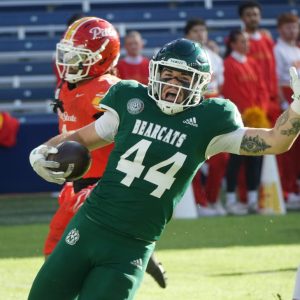
Northwest football’s Forney reflects on life-threatening accident


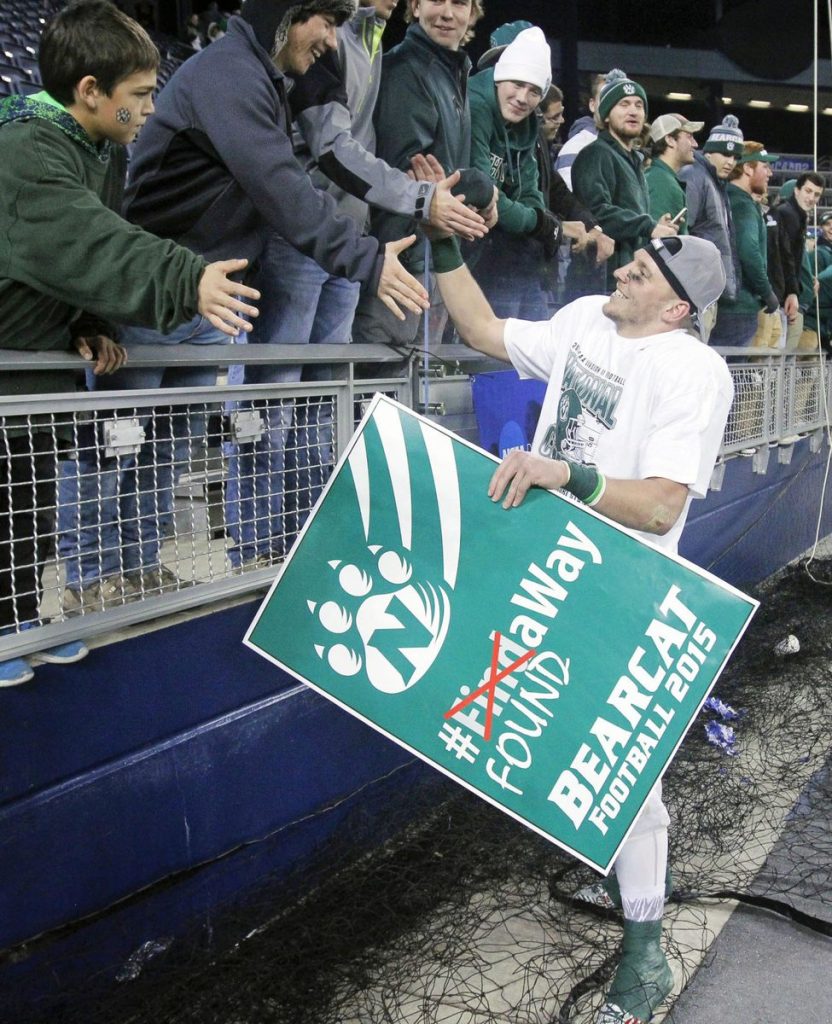
DAVID MERRILL/DAILY FORUM
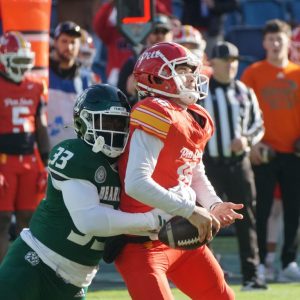
Northwest linebacker Cole Forney, then a junior, celebrates with fans after the Bearcats defeated Shepherd, 34-7, for the 2015 Division II national championship Sporting Park in Kansas City, Kansas.
Monday marked three months since a car accident nearly took Northwest Missouri State University football player Cole Forney’s life.
Forney doesn’t remember much about the accident that occurred on Jan. 17 on Interstate 29 near St. Joseph.
“I remember hitting the ice patch and I remember saying something to Jake (Jacob Vollestedt, the passenger in the pickup truck) like hold on or something,” Forney said. “It’s eight or nine days later and I’m in the ICU. I don’t remember going to the St. Joe hospital. I don’t remember being transported to KU’s hospital. They said I was awake and I was talking to them, but I don’t remember that at all.”
Forney, a Maryville native, and Vollstedt were on their way down to William Jewell College for an internship. Forney was the driver in the fiery crash.
Forney’s injury list was extensive and long enough to keep him at Kansas University’s Medical Center for one month.
The reality was that Forney had: a ruptured diaphragm, a fractured humerus (the bone connecting shoulder to the forearm), a fractured pelvis, multiple fractured ribs on the left side of his body, a lacerated liver, hyperkalemia (higher than normal potassium levels in the bloodstream), metabolic acidosis (when the liver is unable to remove needed acid from the body), a deep chest cavity, acute respiratory failure, kidney injuries, brain hemorrhaging (bruising), anemia from blood loss, a fractured elbow, and multiple other bruises, cuts, and scrapes.
Forney, who wasn’t wearing a seatbelt at the time of the accident, was ejected from the vehicle.
According to injuryphysicians.com, nearly 10,000 people are killed per year in accidents that involve persons being ejected from the vehicle.
Forney said, in the immediate aftermath, he looked at the list of injuries a lot.
He was counting his blessings.
“I was just really lucky to be alive,” he said. “When I woke up, I was all over the place at first because of all the drugs they had me on, but I just felt lucky. Not many people can say they’ve been shot out of a car from one exit and landed on the other exit, and lived to tell about it without any serious brain injuries or spine injuries.”
The hardest part for Vollstedt was not being able to see his friend and teammate at first.
“They wouldn’t let me see him for a while,” Vollstedt said. “That was tough because you don’t just want to take their word for it.”
Vollstedt, who climbed out of the truck under his own power after the accident, went to visit Forney three times a week for a couple hours at a time while he was at KU Med Center.
Once his time was done at KU Medical Center, Forney was moved to Madonna Rehabilitation Hospital in Lincoln, Nebraska, but the injuries weren’t severe enough to keep him there longer than 10 days.
Forney spent roughly two months in a wheelchair and needed help with daily tasks such as bathing, dressing, and using the bathroom.
“We had to take off one of the doors to the bathroom so I could fit in there,” he said. “I probably showered once every three or four days when I was in the wheelchair. It was such a hassle to just bathe.”
Forney got out of the wheelchair on March 28 and has been rehabbing both at home and at SSM St. Francis Hospital.
He is trying to regain the 45 pounds he lost as a result of the accident and recovery.
He was cleared to start lifting weights within the past week, but isn’t able to begin running at this time.
Forney said he has never been one to wear his seatbelt. The wreck hasn’t exactly changed his attitude on the matter — at least not completely.
“I’ve never been one to put it on,” he said. “I told people after the wreck that I would wear my seatbelt, but I still don’t wear it half the time. If I were to get in another serious accident, I would just as soon, as bad as this sounds, I’d rather go through the windshield and not have to do this all over again. Finally, this week, I’m starting to feel normal again.
“If I’m going on a long trip or something, I’ll put it on, but not 15 minutes just driving around town.
Forney said another reason he doesn’t wear a seatbelt now is due to the catheter that is near the bladder area. The seatbelt causes extreme discomfort.
“A lot of the time, I’ll put it on to start, then I’ll take it off because it’s so uncomfortable,” he said.
Forney said the accident also taught him to not take things for granted.
He said he had been injury-free until his sophomore year of college. That’s when the injuries started to pile up.
Since his sophomore season, Forney has had two ACL surgeries, a hernia surgery, and a hip labrum surgery, and a meniscus surgery.
This was all prior to the accident.
“I thought that rehab and coming back from all that was hard,” he said. “This was a whole other level. You just get a whole new sense of appreciation.”
Forney’s ultimate goal is to use his one remaining year of eligibility to play one more season with the Bearcat football team.
He knows, however, that getting back on the gridiron is a long shot.
“Realistically, I may not be ever able to play again,” he said. “I was in a coma for eight days and have scars all over my body. But, if I feel I’m ready to play again come August, I could play then. Even if it means coming in late, I’m going to keep training.”
Forney said this is easier to deal with mentally than his second torn ACL. A week before the accident, Forney said he had been in the best physical shape of his life even after the second torn ligament.
He said if he could get past that, broken bones may not stop him.
Forney has already given great thought to post-football career plans.
“I want to give back to the people who have had the biggest influence on my life,” he said. “I either want to be a coach or a strength and conditioning coach like Joe (Quinlin). I’ve thought about going to a master’s program for athletic training like Kelly (Quinlin). With all the injuries I’ve ever been through, Kelly has always been there for me. She’s always helped me. We need more people like Joe and Kelly Quinlin in the world.”
Vollstedt said that if anyone can come back and play after an accident such as this, it’s Forney.
“He’s one of the most stubborn people I know,” Vollstedt said. “Once he sets his mind on something, there’s really no stopping him. He’s going to put everything he has into coming back. It’s pretty amazing to see him up and walking like he is now.”
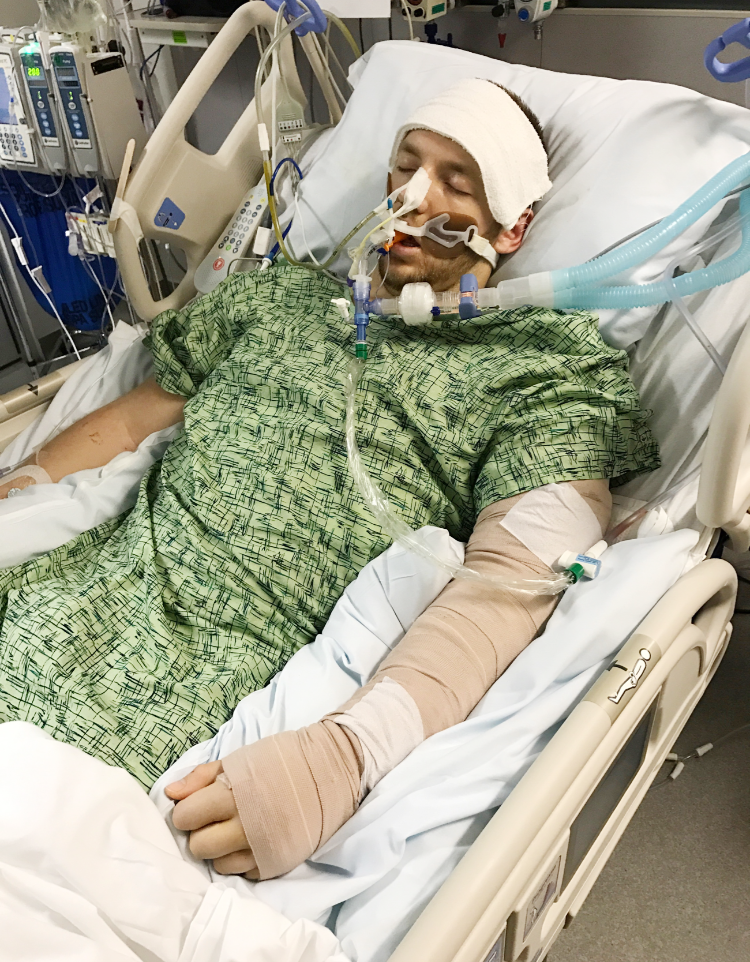
DAVID MERRILL/DAILY FORUM
Northwest Missouri State University’s Cole Forney recovers from a car accident at Kansas University Medical Center.