MIAA Commissioner talks new job, league expansion


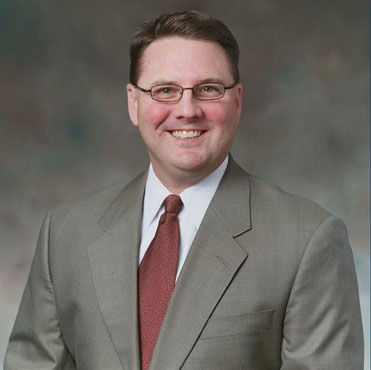
Mike Racy
Two weeks ago, the former Mid America Intercollegiate Athletic Association (MIAA) commissioner and the current MIAA commissioner had a chance to talk during the Elite Eight in Sioux Falls, South Dakota.
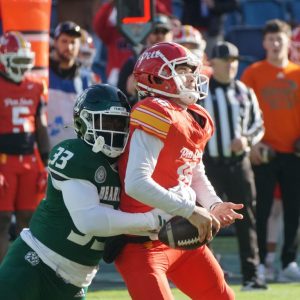
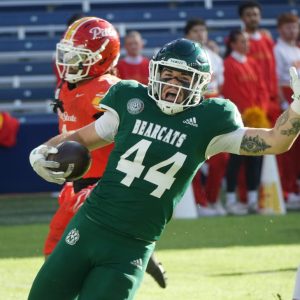
Bob Boerigter, who retired in January, watched Northwest Missouri State with the Division II football national championship and did the honorary coin flip.
His replacement, Mike Racy, took over for Boerigter the first week of February.
One of his first duties at the helm was awarding championship trophies, one of which went to Northwest.
Racy worked with Boerigter in January during the transition, though he is very familiar with the MIAA and administrative work. He worked as an attorney for Central Missouri and he graduated from Washburn in 1987.
He also spent 20 years working for the NCAA and served as the Division II Executive Vice President from 1999 to 2013.
“I have a chance to provide leadership for the conference,” Racy said. “It is a great thrill and privilege to do it. I’m fortunate to be replacing someone who served in an administrator role for 40 years and who led a conference for seven years is big shoes to fill. He has done a great job of leading the conference. I’m fortunate I’m walking into a situation that doesn’t have a lot of serious problems or big projects that needs to be done or redone.”
Racy, a native of Abilene, Kansas, was hired to become the fifth full-time commissioner in September. Prior to taking over as the commissioner, he visited all 14 campuses in the MIAA to meet with the presidents, athletic directors, senior staff members and various coaches and student-athletes.
His first stop came in St. Charles at Lindenwood and wrapped up with visits in January to Southwest Baptist in Bolivar, Missouri and Nebraska-Kearney in Kearney, Nebraska.
“It was very informative and great opportunity to engage with them,” Racy said.
Some of the issues brought up included the championship events, many of which brings teams to Kansas City. The premier event is the MIAA Basketball Tournament at Municipal Auditorium.
The league is headquartered in Kansas City and oversees 14 schools in four states.
“We got great institutions, but the conference is still evolving,” Racy said. “We brought in schools in Lindenwood, Northeastern State, Central Oklahoma, Nebraska-Kearney. I feel the membership is still evolving. I think it is important to do everything; build strong relationships within the conference and that leads to good decision and good governance. The conference is working hard on relationships and making sure they feel like they belong.
“I think it is important all of our schools are welcome and very much valued as a member of the MIAA. I think we have a solid core of current members. I am interested in the right school and the right opportunity for us to get back to 16. I think it is important because 14 is a difficult number for schedule.”
The league has evolved a lot the past 10-plus years.
Fort Hays State rejoined the league in 2006, while Nebraska-Omaha joined in 2008. In between those two years, Southwest Baptist left the league’s football ledger to go independent. Now, it is a member of the Great Lakes Valley Conference for football, but MIAA in other sports.
In 2010, the league added Lindenwood, Central Oklahoma, Northeastern State and Nebraska-Kearney to bring the league membership to 16 teams.
The teams all joined the league during the 2012-13 season, though before that happened, Nebraska-Omaha left the MIAA to move to Division I. The membership of 15 teams held steady for one year as Truman State, a founding member in 1912, left for the Great Lakes Valley Conference.
That puts the MIAA with its current 14 member schools, though the football membership took a blow in 2014 when the GLVC added Lincoln and Southwest Baptist, which had only joined back for football the year prior.
What would be the perfect number of league members?
“Twelve or 16,” Racy said. “And we don’t want to lose anyone the next couple of years. Discussions with our presidents and ADs will really center on what institutions that might be interested in the MIAA and that would bring right value in conference that are aligned with mission and purpose with current members. It would have to be a good fit, the right school and probably have to be a school in our geographic football. It is difficult to expand conferences in the current budget climate and all of our schools are in Oklahoma, Nebraska, Kansas and Missouri, I really think the schools would have to be within those four states.”