Library contest recognizes older readers
By TONY BROWN Staff writer
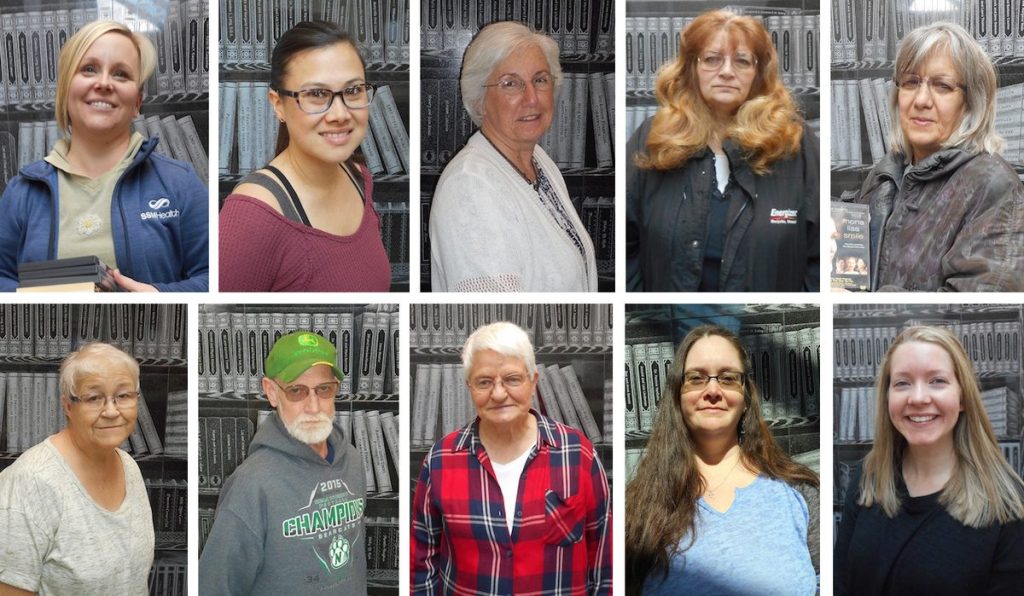
Pictured are the winners of this year’s Adult Reading Challenge sponsored by the Maryville Public Library. Top row from left: Heather Archer, Keri Bilke, Judy Crane, Melody DeMar, Pat Drury. Bottom row from left: Grace Ebrecht, David Hendrix, Barbara O’Connell, Andrea Runyon, Lesley Weichinger.
The Maryville Public Library has announced the winners of its 2017 Adult Reading Challenge.
This year’s top library readers over age 18 are Heather Archer, Keri Bilke, Judy Crane, Melody DeMar, Pat Drury, Grace Ebrecht, David Hendrix, Barbara O’Connell, Andrea Runyon and Lesley Weichinger.
The 10 bookworms were among a large group of library patrons who took up the challenge of reading as many fiction and non-fiction titles as possible during the two-month contest period.
Those reading the most volumes were allowed to choose books and movies from the library’s “prize case.”
“It was good to see people challenging themselves and reading books they might not otherwise have chosen,” said Library Director Stephanie Patterson.
Books read during the annual emphasis on older library patrons included such works as the Civil War novel “Cold Mountain” by Charles Frazier and the classic tale “To Kill a Mockingbird” by Harper Lee.
One participant, Archer, commented on how a book she checked out challenged her to use her imagination while pondering situations beyond her experience.
“It made me think about what I would do in similar circumstances,” Archer said of “The Road” by Cormac McCarthy, a post-apocalyptic story about a father and his young son trying to survive after a disaster destroys most of civilization. The novel was awarded the 2007 Pulitzer Prize for fiction.
“Could I survive?” Archer asked, putting herself in the place of the novel’s main characters. “What am I capable of doing to protect my child?”
Another winner, Melody DeMar, read “Remembering Jim Crow: African Americans Tell About Life in the Segregated South.”
Based on interviews collected by the Behind the Veil project at Duke University’s Center for Documentary Studies, the book offers an oral history of an era during which much of the nation — by law — severely limited economic, vocational and educational opportunities for African Americans.
“This was a great book,” DeMar said. “Maybe if this was read by more people there would be greater tolerance.”