Report: Stage set for manufacturing growth
TONY BROWN/DAILY FORUM
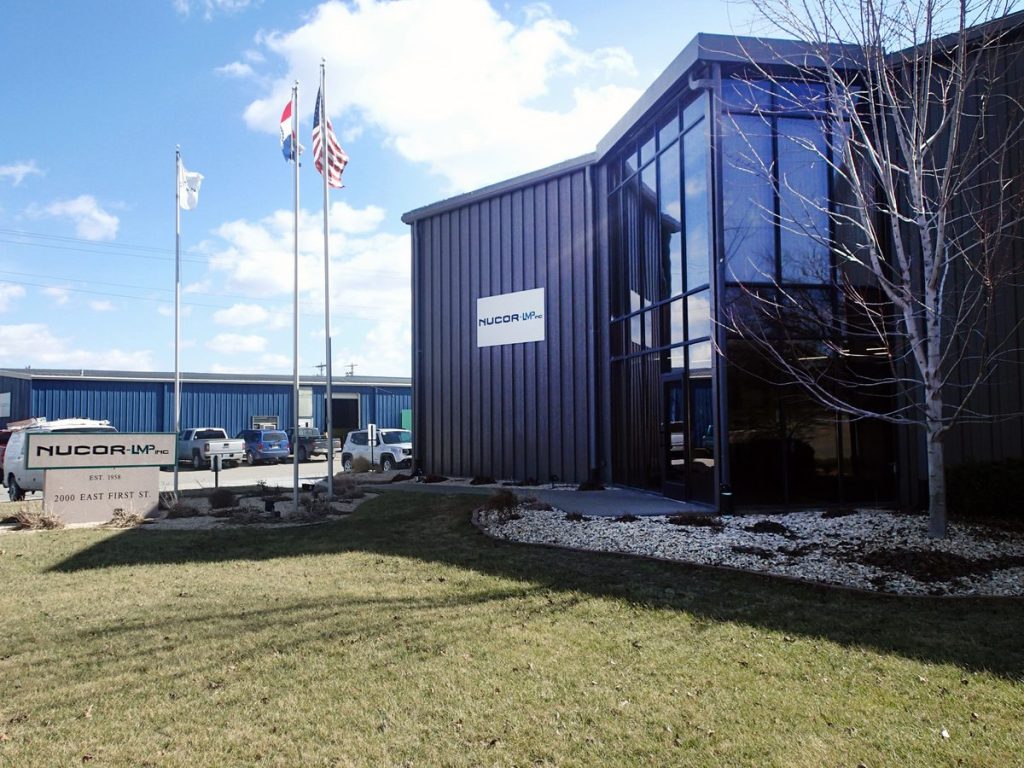
The latest Mid-America Business Conditions Index has increased for the fourth consecutive month and points to an improving regional manufacturing economy across nine Midwest and Plains states including Missouri. Nodaway County Economic Director Josh McKim said Thursday the manufacturing upturn is being felt locally but is tempered by worries about the number of trained industrial workers living in the area. Pictured is a portion of the Nucor LMP steel plant campus located on East First Street in Maryville.
A monthly survey of business supply managers suggests that manufacturing is boosting economic conditions in nine Midwest and Plains states — including Missouri.
What’s more, according to Josh McKim, executive director of Nodaway County Economic Development, the local manufacturing climate seems to be gaining strength as well, though challenges remain as rural areas continue trying to repair damage done by the Great Recession nearly a decade ago.
The Mid-America Business Conditions Index report released this week said the overall economic index for the region rose to 60.5 in February from 54.7 in January. That’s the highest figure since April 2014.
“This is the fourth consecutive month the index has increased and points to an improving regional manufacturing economy,” said Creighton University economist Ernie Goss, who oversees the survey. “I expect this to generate even healthier growth for both manufacturing and nonmanufacturing through the third quarter of this year.”
Survey results are compiled into a collection of indexes ranging from zero to 100. Any score above 50 suggests growth in that area. A score below 50 shows decline. The survey covers Arkansas, Iowa, Kansas, Minnesota, Missouri, Nebraska, North Dakota, Oklahoma, and South Dakota.
Economic optimism, as reflected by the February business confidence index, rose to 71.3 from 69.5 in January.
Missouri’s overall index shot up in February to 66.8 from January’s 53.7. Components of the state’s overall index reported new orders at 73.7, production or sales at 76.3, delivery lead time at 57.2, inventories at 53.4, and employment at 73.5. Recent surveys point to healthy growth for the next six months, with about 16,000 new jobs.
While he lacks statistics from individual industries, McKim said conversations with local managers and executives indicate “some uptick in activity” in conjunction with statewide gains for the manufacturing sector.
McKim said some of the groundwork for current growth was laid in 2015, when local plants, sensing opportunity, invested about $150 million in equipment and building upgrades. The trend continued through last year, he said, but at “not quite the same level.”
“We’ve had strong investment,” McKim said, adding that both local managers and their bosses at the corporate level have voiced optimism with regard to growth and their readiness to take advantage of an improving economy.
That’s good news for a community that has suffered a couple of economic hammer blows in recent years: the recession, which caused industrial employment in Maryville to drop from 2,422 in 2010 to 1,841 the following year, and the Energizer battery plant closing in 2013, which dropped the number of factory jobs to a historic low of 1,181.
However, McKim cautioned that just because the manufacturing sector appears to be gaining strength both local and regionally, there are no guarantees that predicted growth will occur in Maryville, where several employers including the town’s largest — Kawasaki Motors — are wrestling with a shortage of trained workers.
In an effort to close what has been described as a “skills gap,” NCED in concert with local manufacturers, Northwest Technical School, and North Central Missouri College in Trenton have launched a pilot program designed to provide post-secondary-level industrial training to existing employees.
If the program is successful it could be expanded to serve recent high school graduates and other jobseekers.
As manufacturing moves further into the post-recession era, McKim said, such initiatives are essential to an emerging economic development strategy that focuses less on the recruitment of new industry and more on making sure Maryville and Nodaway County offer a superior workforce to enterprises already here and seeking to grow.
This would be in contrast, he said, to past recoveries when rural Missouri has largely failed in terms of positioning itself to take advantage of new economic realities following a downturn.
For example, he said, when the advent of highly efficient corporate agriculture dramatically reduced the viability of small family farms 40 years ago, the region never really recovered from the resulting loss of jobs and population.
So, while the nation as a whole emerged from the economic turmoil of the 1970s and entered a period of sustained growth, many small towns were left behind.
“We can’t make that same mistake again,” McKim said.
The latest business conditions index report seems to bear out such fears.
“The growth gap between regional manufacturing and nonmanufacturing is closing,” said Creighton University’s Goss. “However, rural job growth in the nine-state region continues to significantly lag (behind) that of urban areas in the region.”
Nevertheless, the Nebraska economist believes the latest index results reflect “the highest confidence reading that we have recorded in six years.”
The Associated Press contributed to this report.