
County lists bridge projects for 2017
TONY BROWN/DAILY FORUM
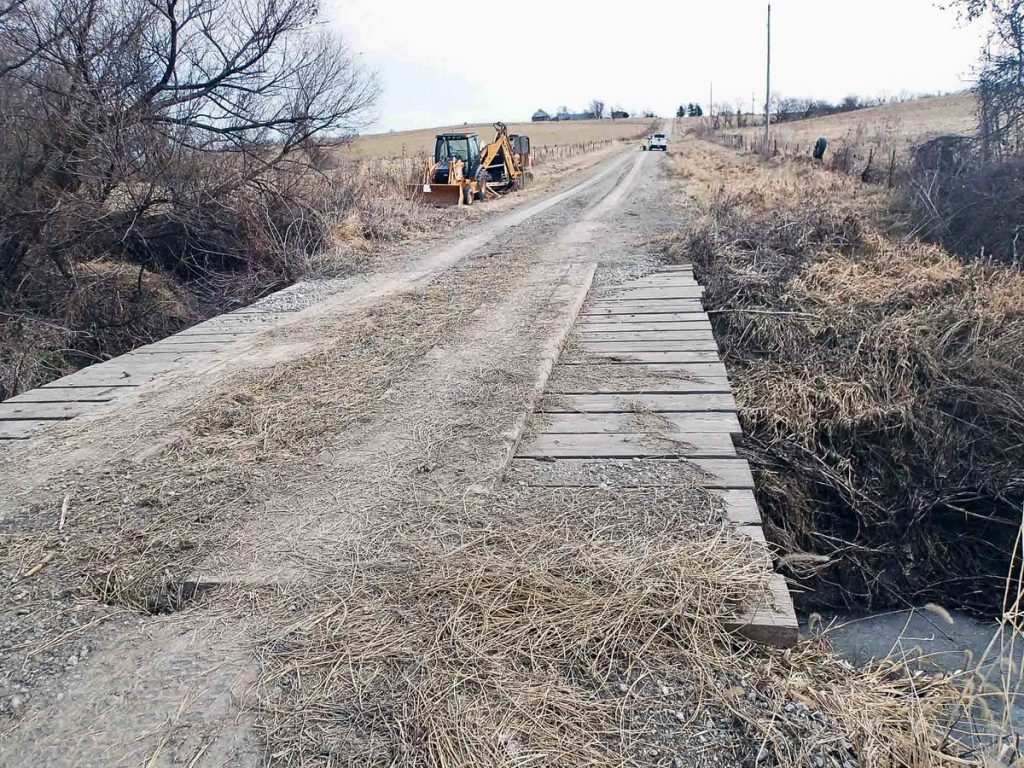
A technician from Midland Surveying, visible in the far background, takes readings at one of two bridges on 240th Street east of Mozingo Lake that the Nodaway County Road & Bridge Department has scheduled for replacement in 2017. As Missouri’s fifth-largest county in terms of geographical area, Nodaway maintains one of the state’s biggest rural transportation networks, a system that embraces more than 360 bridges, about 1,000 miles of gravel roads, and nearly 200 miles of dirt roads.
Now that 2017 has arrived, planning is under way by the Nodaway County Road and Bridge Department for its annual round of bridge replacements.
With no federal “off-system” funds in the pipeline this year — off-system being government-speak for transportation dollars set aside for rural infrastructure — the county will be using all-local tax dollars as it undertakes an ambitious construction program that includes seven projects scattered across five of Nodaway’s 15 townships.
South District Commissioner Robert Stiens, who acts as the County Commission’s lead official for transportation matters, said the 2017 bridge budget comes to a little more than $1 million, money that is derived from locally collected sales taxes on gasoline and diesel fuel.
If needed, Stiens said, additional revenue could also be allocated from use tax receipts, a levy on the storage, use, or consumption of tangible personal property purchased out of state.
While this will be an off-year for federal funding, available off-system dollars having been spent on earlier projects, material and labor costs for new bridges will be credited to the county as a “soft match” when U.S. Department of Transportation dollars reach higher levels, probably in 2018.
Like most federal and state allocations to municipal and county governments, transportation grants require a percentage contribution at the local level.
Making future bridges eligible for soft-match funding, however, requires that all projects carried out in 2017 be professionally engineered, which Stiens said will add around $25,000 to the cost of each structure.
On the plus side, since all of the bridges will be built by the county’s three-member, in-house construction team, Missouri’s prevailing-wage requirement for public infrastructure work hired out to private contractors does not apply.
Of the seven bridges on the list for rebuilding over the spring and summer, only three are on gravel roads. These include spans near the intersection of 240th Street and Mahogany Road just east of Mozingo Lake.
Road and Bridge Supervisor Ed Walker said the trio of bridges will likely be the first projects undertaken when construction season begins, since the structures will be easier to reach with heavy equipment during what is normally wetter weather in the spring.
The remaining four spans on the county’s to-do list are all on dirt roads, and three of them are currently closed to traffic.
Closed spans to be replaced include a 100-foot-long bridge in Hughes Township near the intersection of 350th Street and Fairway Road northeast of Graham, a 90-foot bridge in Atchison Township near 120th and Hallmark, and a 100-foot bridge in Union Township near 180th Street and state Route FF.
Stiens said it was important to replace closed bridges as quickly as possible because, after a certain amount of time, the Missouri Department of Transportation will remove them from its rural transportation inventory.
The remaining crossing is an 80-foot bridge in Polk Township north of Maryville in the vicinity of 220th Street and Hawk Road.
Six of the bridges will consist of pilings and concrete decking poured on site. A seventh, the shortest on this year’s list at 46 feet, is to be constructed using piling and pre-cast concrete slabs.
Estimated construction costs range from $225,000 for the Hughes Township bridge to $107,000 for the slab structure.
As Missouri’s fifth-largest county in terms of geographical area, Nodaway maintains one of the state’s biggest rural transportation networks, a system that embraces more than 360 bridges, 1,000 miles of gravel roads, and nearly 200 miles of dirt roads.




