Trauma kits headed for Nodaway schools
TONY BROWN/DAILY FORUM
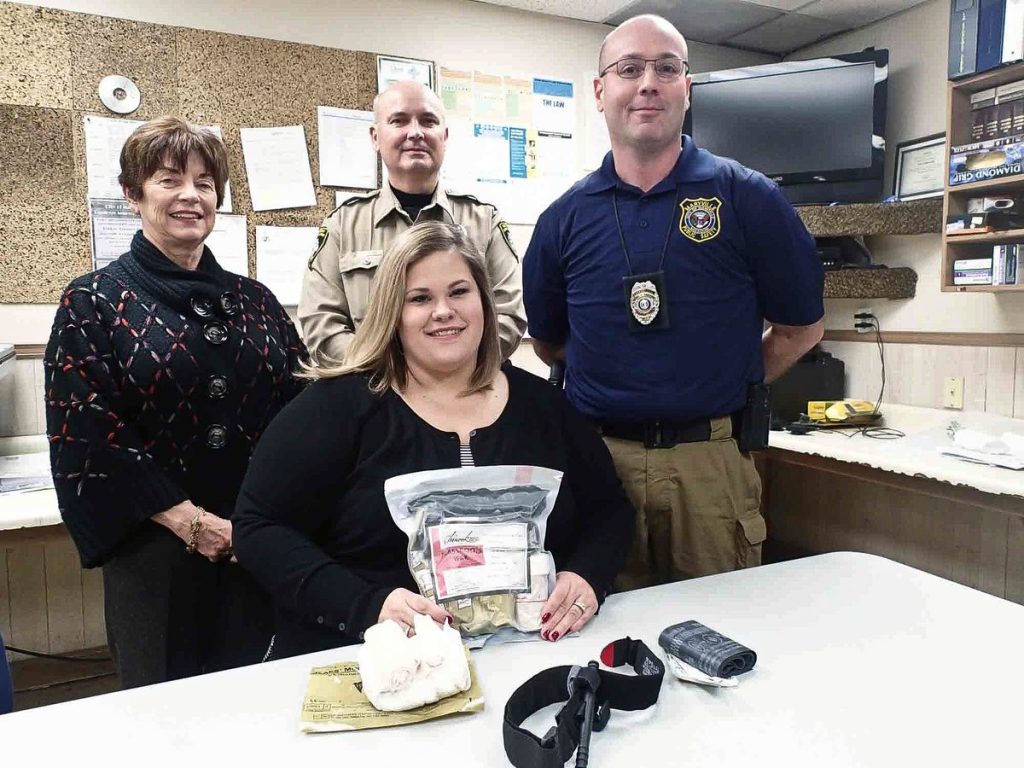
Pictured are members of a local team that has been working to fund and distribute “trauma bag” first aid kits in more than 400 area classrooms. The kits, designed primarily to treat victims suffering severe, rapid blood loss, are similar to those already carried by Maryville Public Safety police officers. Pictured from left are Jessica Loch of the Gladys Rickard Charitable Trust, Sheriff Randy Strong, paramedic and trauma bag trainer Jill Nielson, and MPS Sgt. Ryan Glidden.
Over the summer, Walmart, the Maryville Hy-Vee supermarket, and SSM Health St. Francis Hospital joined forces with Maryville Public Safety to provide police officers with fully equipped “trauma” bags — specialized first aid kits designed for treating victims who have suffered gunshot wounds or other injuries resulting in severe blood loss.
Now MPS Sgt. Ryan Glidden, who spearheaded the trauma bag initiative, has put together a second and much larger effort that will provide similar kits for every schoolroom in Nodaway County, including those in Maryville.
The kits, which differ only slightly from those carried by police, are being paid for through a $27,800 grant from the Gladys Rickard Charitable Trust and should be deployed in all seven of Nodaway County’s public school districts within a few weeks.
Other educational institutions benefitting from the program include St. Gregory’s School, operated by the St. Gregory Barbarigo Roman Catholic Parish, and Northwest Missouri State University’s Horace Mann Laboratory School.
Each of the kits, which are being purchased for $62.50 each from Chinook Medical Gear Inc. in Durango, Colorado, come in vacuum-sealed plastic designed to provide years of shelf life.
Every transparent bag contains two trauma bandages intended to staunch heavy bleeding, a pair of tourniquets, a stretchable elastic bandage designed to create localized pressure on a wound or injury, and a pair of medical shears.
Altogether, Glidden estimates that bags will be placed in about 450 classrooms, gymnasiums, vocational education shops, and other facilities.
As with the Public Safety trauma bags on which they are based, a certain amount of training is required, which will be provided by paramedic Jill Nielson of the Nodaway County Ambulance District. Sessions, which can include up to 30 faculty and staff at once, last about two hours and will begin today on the Northeast Nodaway R-V campus. Training is to continue at other school sites through next fall.
Glidden said the idea is to teach all district employees — from janitors to superintendents — how to use the kits to treat traumatic wounds. Training will continue in subsequent years in order to bring new staff up to speed.
While the effort to deploy the kits and teach people to use them is both expensive and time consuming, Glidden and Nielson believe it’s important because, in the event of an active-shooter invasion or other violent episode, officers will not stop to administer first aid until the crime scene is safe and the assailant either taken or killed.
“We’re not going to help (the injured) until the area is secured. So you’re it,” Glidden said.
Added Nielson: “Teachers are going to be the first responders.”
Even in situations where no crime is involved, such as an accident or weather emergency, Glidden said it can take a significant amount of time for police, sheriff’s deputies, or fire and rescue personnel to reach someone who is badly injured, especially in a sprawling rural county like Nodaway.
In selecting the bags’ contents, Glidden said his primary aim was to give teachers and other school employees the tools they need to respond to serious, life-threatening injuries involving rapid blood loss, the sort of wound that can claim someone’s life in just a few minutes.
“As fast as these things happen, and with the response times required, we just thought it was the best thing for teachers and staff to have their own kits,” he said, noting that the bags are simplified versions of those carried by Maryville police. This was done both to standardize the required training and to make the kits usable by the largest number of people apt to be on the scene of a crisis.
Glidden is also hoping the kits will reduce the frustration often experienced by those in the aftermath of violence by providing teachers and others with the confidence to respond.
“This gives people something so they don’t just have to sit there, like there is nothing they can do in an emergency,” he said.
Though his office is only peripherally involved in the project, Sheriff Randy Strong said Tuesday he fully supports the project and will do everything possible to get the word out about the kits and their proper use.
“We’re delighted to be involved,” Strong said. “I’ve worked with Ryan for years, and kudos to him for taking care of our teachers and our children.”
Strong said both he and Glidden were among the officers who responded to an active-shooter tragedy in 2002 at Conception Abbey 15 miles east of Maryville, where a gunman fatally shot Brother Damian Larson and Father Philip Schuster and wounded two other priests before committing suicide.
With that experience in mind, the sheriff said the possibility of another such episode in Nodaway County should never be discounted.
“It’s real, and it’s ugly,” he said of the kind of active-shooter assaults that have proliferated nationwide in recent years.
As for the involvement of the Rickard Trust, Jessica Loch said she and her two fellow trustees, Ed Mutti and Don Baker, fully support the project, and believe the trust funds, which must be used for non-profit endeavors benefitting the citizens of Nodaway County, are being well spent.
“We felt this was very important for the safety of our county and our communities,” Loch said.