
Senator briefs commission as session nears
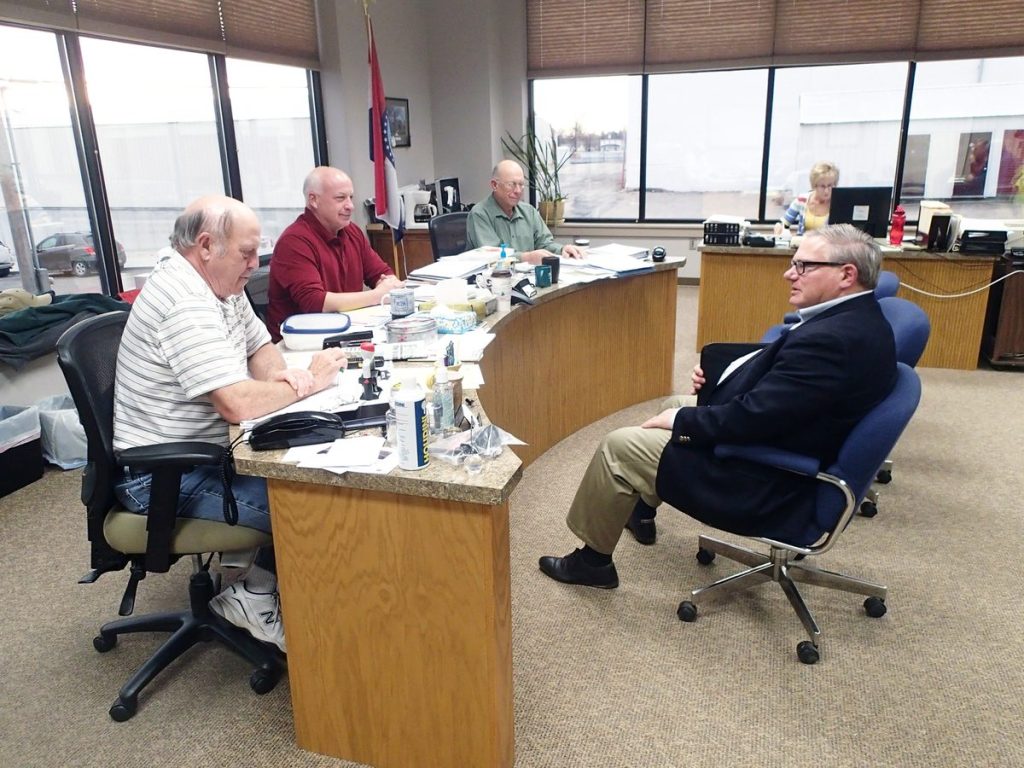
TONY BROWN/DAILY FORUM
State Sen. Dan Hegeman, R-Cosby, right, met with members of the Nodaway County Commission on Wednesday to discuss issues likely to come up during the 2017 session of the Missouri General Assembly, which begins Jan. 4. Seated clockwise behind the dais at left are commissioners Robert Westfall, Bill Walker, and Robert Stiens.
State Sen. Dan Hegeman, whose 12th District includes Nodaway County, was in Maryville on Wednesday for his annual pre-session meeting with the three-member County Commission.
Missouri’s General Assembly, which consists of both the Senate and the state House of Representatives, convenes Jan. 4 at the Capitol in Jefferson City.
Hegeman said he is in the process of meeting with as many commissioners as possible throughout the 12th District, which extends west to east from Atchison to Putnam counties and south from the Iowa line to the northern portion of Clay County.
The lawmaker, who was elected in 2014, is beginning the third year of his first four-year term in the Senate and his first with a Republican — Gov.-elect Eric Greitens — in the Executive Mansion.
He said Wednesday that he has met with Greitens, and that the conversation covered the upcoming 2017 edition of Great Northwest Days, a two-day lobbying event during which civic leaders from across northwest Missouri journey to the Capitol for meetings with lawmakers and ranking state officials.
Hegeman said he also stressed to the governor the importance of adequate water supplies across the largely rural 12th District and possibilities for development of a regional water supply district.
The senator characterized Greitens, who has never held elective office, as “very much an outsider” and someone committed to “new voices and new ideas in state government.”
Turning to the 2017 session, Hegeman told the commission he expects the Republican-dominated Legislature to spend much of its time working toward passage of pro-business measures, such as a right-to-work bill, banning closed union shops; tort reform proposals that would make it more difficult to file suit against businesses and corporations; and efforts to modify workers’ compensation requirements in a way that would ease the burden on employers.
In general, Hegeman said he expects the session to produce legislation aimed at creating “a Missouri business environment that is more effective for folks” and that will bring “more and better-paying jobs” to the state as a result of economic growth and the recruitment of new enterprises.
Ethics reform is likely to be an issue for the Legislature next year as well, especially with regard to gifts from lobbyists to the lawmakers they are trying to influence, a practice that is currently both legal and unlimited.
Hegeman said he supports “reasonable limits” on lobbyist gifts, but not to the extent that lawmakers couldn’t accept meals and other courtesies during events such as Great Northwest Days.
On the other hand, Hegeman believes keeping the current system, which allows unlimited gifts, is “equally unpractical.”
“There are folks (lawmakers) who really took advantage of some of that,” he said.
In addition, Hegeman voiced support for legislation aimed at slowing the “revolving door” that allows lawmakers to become paid lobbyists immediately after leaving office.
The current system, he said, doesn’t prevent officeholders from casting votes favoring a particular group then resigning and immediately accepting a job with the same organization.
“That just has a bad smell to it,” said Hegeman, who said he favors a mandatory two-year delay between leaving office and accepting work as a lobbyist.
On other fronts, the always nettlesome issue of trying to find more money for roads and bridges, especially in rural parts of the state served by lettered “farm-to-market” blacktops, will likely return to the Senate floor this year, said Hegeman, who warned that some urban lawmakers are pushing for the return of such routes to county ownership.
That’s almost certainly not going to happen, he said, nevertheless noting that a fiscal climate in which legislators are talking about such a step, presumably in an effort to capture more revenue for major highways and Interstates, is cause for concern.
“I’m worried about the fact that people are even bringing it up,” Hegeman said. “It used to be that sort of proposal would be a death knell (for someone’s political career), but apparently it’s not part of their equation anymore.”
The senator said that, in his view, the best option for producing additional transportation revenue — and funneling at least some of the money into rural parts of the state — is legislative approval of a ballot measure that would give voters a chance to pass a proposed 6-cent addition to Missouri’s existing 17-cents-a-gallon fuels tax, which has remained unchanged for 20 years.
While charging motorists an extra 6 cents a gallon for gasoline and diesel fuel would not create enough new revenue to significantly expand Missouri’s highway system, Hegeman believes it would bring in enough money to “maintain what we’ve got” and “truly maintain our lettered routes, not just patch them.”
On another issue affecting rural areas, Hegeman said he is considering proposing legislation that would allow townships, which in many counties, including Nodaway, bear primary responsibility for maintaining gravel roads, to merge if they cease to become fiscally viable.
Such a bill, Hegeman said, would not require action or lay down mandates, but would give counties an option when townships run out of money.
Hegeman emphasized that he has no intention of requiring counties to eliminate the township form of government, and that tools to do so are already in the hands of local commissions and the voters they represent.
On a related issue, Hegeman said he thinks the Legislature should support measures that would make it easier for rural counties to work together in establishing regional facilities, such as jails, that might be too expensive for one county alone to build and operate.
Finally, the senator said he hopes lawmakers, along with the Greitens administration, will be more receptive to proposals designed to make government more “citizen friendly” and less “regulatory and punitive.”
As an example, Hegeman said agencies such as the state Department of Natural Resources should focus less on mandating mechanical sewer plants and issuing fines for water quality violations and more on helping smaller communities find affordable solutions, such as biological and lagoon-based wastewater treatment.
Hegeman said that what he considers excessive water-quality regulations are proving fiscally ruinous for many small towns, and that purity requirements for effluent have “reached the appropriate point, probably several years ago.”
In addition to noting the issues described above, Hegeman told the commission he will file a number of bills himself next year, including a measure to allow for improved warning lights at highway construction sites, a plan to strengthen the College and University Retirement Plan, a bill that would broaden curriculum sources for career and technical education coursework, and legislation that would require proof that candidates for the office of county public administrator can be bonded.
Hegeman has also filed a joint resolution that, if approved by the voters as a constitutional amendment, would modify Missouri’s non-partisan court plan to potentially expand the number of applicants the governor may consider for judicial appointments.




