Maryville officer keeps D.A.R.E. torch burning
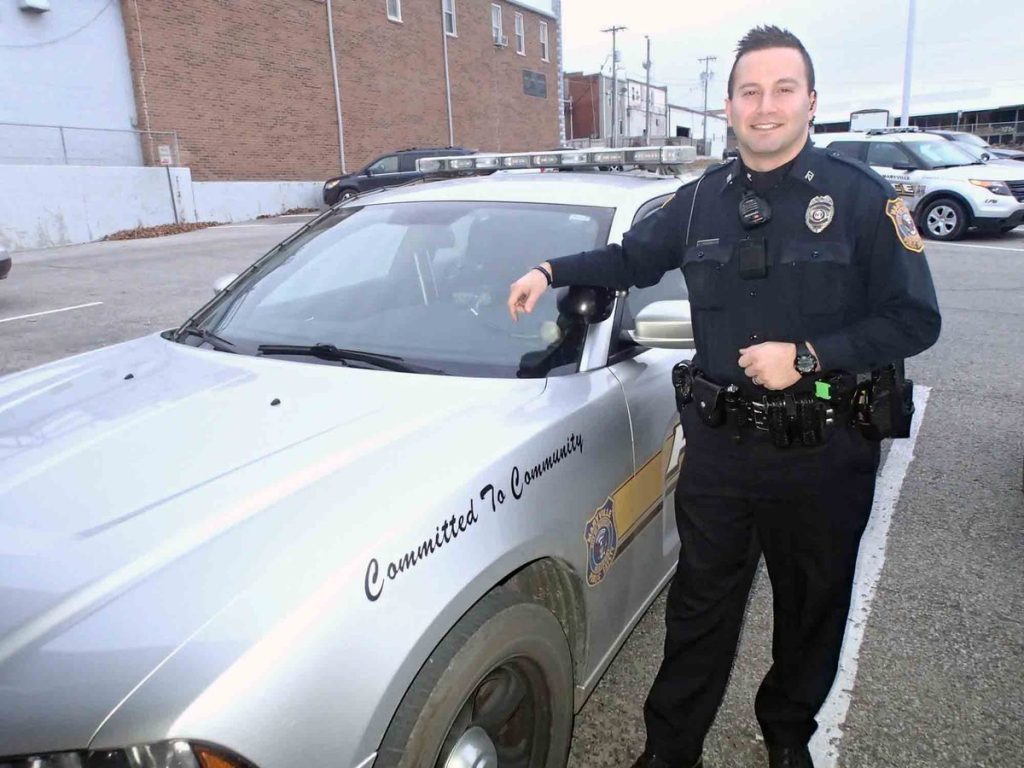
TONY BROWN/DAILY FORUM
Maryville Public Safety Officer Ian Myers is taking over the local D.A.R.E. program from Sgt. Rick Smail, who is retiring at the end of December. The drug abuse resistance program has evolved over the years, and Myers will present a curriculum to local grade-school and middle-school students that emphasizes lifestyle choices, personal responsibility, and the dangers of alcohol and tobacco use in addition to D.A.R.E.’s traditional “just say no” philosophy.
For more than a quarter of a century Maryville’s Drug Abuse Resistance Education program — D.A.R.E. — has revolved largely around one man’s passion for steering young people away from the destructive road traveled by those who abuse drugs and alcohol.
That man is Sgt. Rick Smail of Maryville Public Safety, who will retire at the end of this month before accepting a similar substance abuse prevention role with the Nodaway County Sheriff’s Office.
But though Smail, a recipient of the Missouri D.A.R.E. Officers Association’s Lifetime Achievement Award, is leaving big shoes to fill at MPS, the next generation is eagerly waiting to take up the challenge.
Officer Ian Myers, an emerging law enforcement veteran who served as a Nodaway County deputy and Rock Port police officer before joining the Maryville force two and a half years ago, has been assigned the task of continuing the local D.A.R.E. program’s tradition of success and widespread community support.
A native of Fair Grove deep in the southwest Missouri Ozarks, Myers is a graduate of the police academy at Missouri Western State University and studied journalism and communication arts at Park University and Northwest Missouri State.
Since joining MPS, he has become known for his solid people skills, sunny personality, and compassion, expressed most recently through his leadership of the Santa Cops for Kids program, which this year provided holiday gifts for about 30 children from lower-income households.
Myers also has his own family to take care of, and he and his wife, Ashley, who teaches kindergarten in Craig, stay very busy both at work and at home with their 2-year-old daughter Ainslee.
All of that — given the risks and workload associated with police work — would be a lot on anybody’s plate, but Myers said during a recent interview that he is eager to add D.A.R.E. to his lengthening list of responsibilities.
“I’m looking forward to the challenge,” he said, “and I’ve been looking forward to it for quite some time. I’m excited.”
Established in 1983 as a joint initiative created by former Los Angeles Police Department chief Daryl Gates and the Los Angeles Unified School District, D.A.R.E. is one of the signature programs of what has become known as the U.S. government’s War on Drugs.
Former first lady Nancy Reagan frequently cited D.A.R.E. as a centerpiece of her “Just Say No” campaign, which sought to convince youngsters to ignore peer pressure and commit themselves to a drug-free lifestyle.
In Maryville, as across the rest of the country, D.A.R.E. has evolved over the years, but the basic strategy of putting law enforcement officers in grade-school and middle-school classrooms to talk about the dangers of substance abuse remains intact.
What has changed is the narrow focus on drugs alone, a focus that Myers said has expanded to include health risks and other consequences associated with alcohol and tobacco.
And while the Maryville program concentrates on sixth and eighth graders, the effort also comprises presentations aimed at younger children that address a wide range of safety issues, including “stranger-danger” strategies, household poisons, and the proper use of 911.
Myers said the new D.A.R.E. curriculum stresses behavioral issues as well, such as how to deal appropriately with feelings of anger, sadness, and frustration.
He added that though the middle-school program core is still built around the avoidance of drug use, the spotlight has shifted from “just say no” to practical ways in which young people can diffuse, or remove themselves from, dangerous situations.
“We try to teach people to make smart and appropriate decisions with regard to drugs, alcohol, and tobacco,” said Myers, explaining that the paradigm has broadened from simple refusal to a “decision-making model” designed to provide children and teens with options tailored to specific situations.
Think of it like this. Instead of, “No, John, I don’t do drugs. People who do drugs are bad,” a young person confronted with peer pressure might say, “The school does random drug testing, and I’m afraid I’ll get caught and kicked off the team.”
Citing consequences, making reasonable excuses, or simply walking away from the situation, Myers said, can often serve teenagers better than a “just say no” response that makes them appear timid or unwilling to be part of the group.
Another aspect of the D.A.R.E. curriculum, Myers said, is to make young people aware that decisions matter. In other words, he wants to convince them that avoiding drugs is less a matter of being “good” and more a matter of living a good life.
Like the War on Drugs in general, D.A.R.E. is not without its critics, many of whom cite a lack of evidence that the program has reduced the rate of substance abuse among young adults.
Myers, however, argues that it’s tough to prove a negative, meaning that there’s no way to show how many people might have abused drugs but didn’t because they received drug abuse resistance training as children.
“We have to try,” he said, “We have to try. And it would be a dereliction of our duty not to try and do the things we need to do to keep our community safe.”
Myers continued that, in his view, the program has other benefits as well, such as introducing young people to peace officers in an informal, friendly setting where no one is threatened, no one is in danger, and no one is impaired or getting arrested.
In short, D.A.R.E. gives cops a human face, which Myers said is a crucial function in a time when mistrust directed against men and women who wear badges and carry guns has led to violence and tragedy.
“We’re getting to know the future of our community,” Myers said of his D.A.R.E. role. “There is no better way to build trust in law enforcement. It’s a very successful program in my opinion, and I’m doing it and I’m loving it.”