Exhibit preserves county’s wartime history
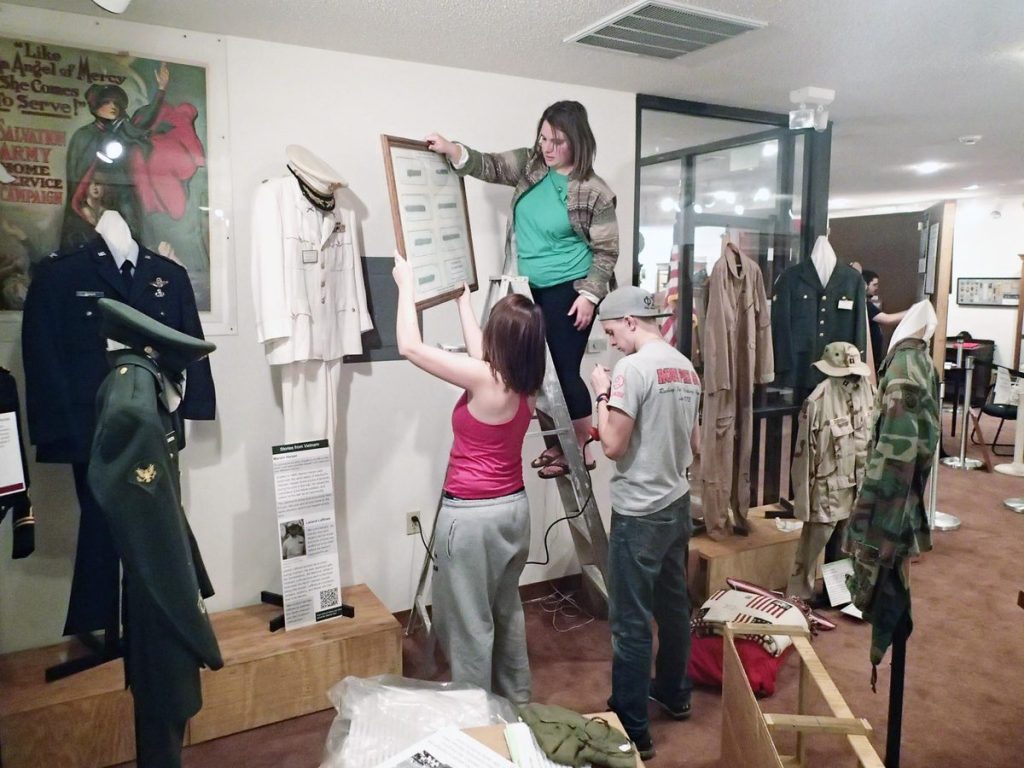
TONY BROWN/DAILY FORUM
Northwest Missouri State University students taking Elyssa Ford’s local history practicum work last week at the Nodaway County Historical Society Museum to install artifacts, text, and photographs making up a major new exhibit on how war and military service have affected the lives of Nodaway Countians.
While the Nodaway County Historical Society Museum officially closed for the winter following Saturday’s traditional bake sale, one additional event remains on the calendar that will be of special interest to military history enthusiasts.
From 6-8 p.m. on Wednesday, Dec. 7 — the 75th anniversary of the Japanese attack on Pearl Harbor that launched the United States’ entry into World War II — the museum will unveil a major new display of military artifacts and informational material centered around Nodaway Countians who served in uniform from the time of the Civil War through the early 21st century.
The permanent display, which takes up about half the museum’s second floor, is being assembled by Northwest Missouri State University students enrolled this semester in Assistant Professor Elyssa Ford’s local history practicum, a course popular with young people preparing for careers as museum professionals and archivists.
Over the last couple of months, Ford’s nine practicum students have been conducting research into U.S. military history and studying in particular how that history affected people in the Maryville area.
Uniforms and other items making up the display tell stories gleaned from more than 150 years of armed conflict involving American forces, from the 1860s through modern military operations in Iraq and Afghanistan.
While many of the items have long been part of the society’s permanent collection and will be familiar to patrons who have visited the museum before, Ford’s students have reorganized the artifacts into a number of categories, displaying the articles alongside placards containing photographs and text that add narrative and context.
In other words, rather than just hanging up a bunch of old uniforms, the students are seeking to create an experience that draws the viewer into a series of stories revealing how soldiers, sailors, airmen, and civilians felt and responded as history unfolded around them.
For anyone who has lived in Nodaway County for any length of time, the display is especially powerful if only because of the familiar names that keep popping up, names like Cornelison, Lager, Medsker, Harper, LaRose, Wilson, and Carmichael.
In researching and assembling the new exhibit, each of the nine students concentrated on a single topic or era. These include the Civil War; wartime souvenirs; Vietnam; civilian life during World War I and World War II; Pearl Harbor (a separate exhibit on the museum’s first floor); changes in uniforms across the decades; stories told by returning veterans; and artifacts relating to insignia and rank.
Besides creating separate displays within the overall exhibit, Ford’s class is also designing websites on each topic that will be accessible through the museum’s master site at www.nodawayhistorical.net.
Additionally, several of the displays include QR codes so that patrons with smartphones can access Internet resources containing more information about the artifacts they’re looking at. For example, someone viewing a display of uniform patches can go online and design a patch of their own.
Patrons interested in a more in-depth view of local military history will be able to go online and learn about Nodaway County citizens who fought in such conflicts as the Spanish American War of 1898 and the War of 1812 against England.
Signature features of the display include narrative placards presenting quotes by local residents along with background pertaining to their wartime experiences.
Vietnam veteran Marvin Harper, for example, offers this insight on comradeship and danger during one the nation’s most violent and divisive conflicts.
“You learned to know how everybody feels for you,” Harper is quoted as saying, “Hey, you are all over there in the same situation, and it can happen at any time.”
Another local resident, Tom Middleswart, a student at Northwest Missouri State University in the early 1970s when many campuses were embroiled in anti-Vietnam War protests, recalled that things were different in Maryville.
“There was none of that here,” Middleswart’s quote reads. “In fact, if you showed disrespect to a military man you were ostracized, even on the campus. I mean, I just never saw any of it.”
While history often consists of studying huge battles or the lives of powerful leaders making world-changing decisions in places like Washington, D.C., Moscow, Paris, Beijing, and Berlin, Ford said she thinks young people should also view the past as it was experienced by ordinary people in places like Maryville.
“It’s important for students to learn about the place where they’ve been living,” she said, adding that her practicum’s focus on local history makes partnering with the Historical Society a natural fit.
“These are topics that are useful to the museum,” Ford said, explaining that the chance to mount a full exhibit is a rare opportunity for most undergraduates seeking to enter the field.
“They’re learning to do the work they will do as museum professionals,” she said. “It’s the type of project that a lot of students don’t even get to do in graduate school.”
Following the Dec. 7 exhibit opening, the museum will close its doors until March 2017. However, since the military history display is permanent, patrons who miss out next week will still be able to view it in the spring.
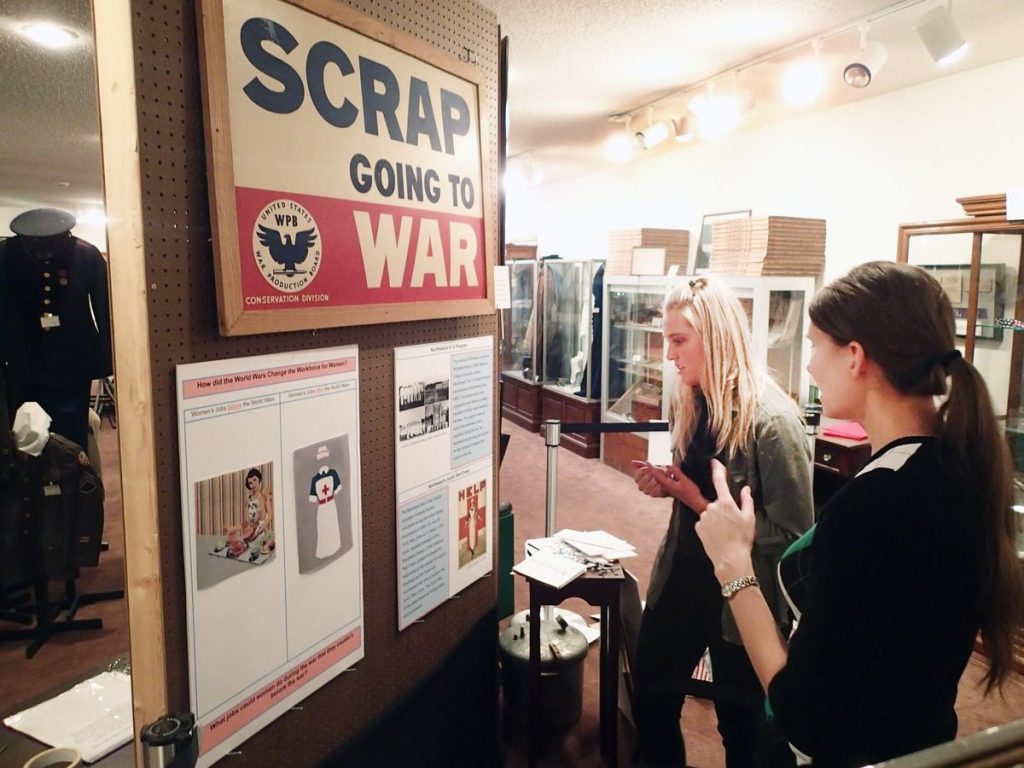
TONY BROWN/DAILY FORUM
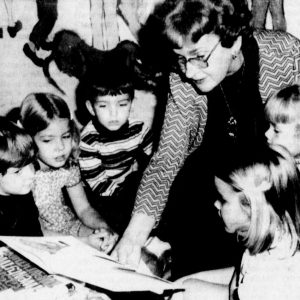
Assistant Professor of History Alyssa Ford, right, talks to Northwest Missouri State University student Chloe Haffarman, who was working last week at the Nodaway County Historical Society Museum on a display about how the lives of American civilians were affected during World War I and World War II.