Chamber sets legislative goals for 2017
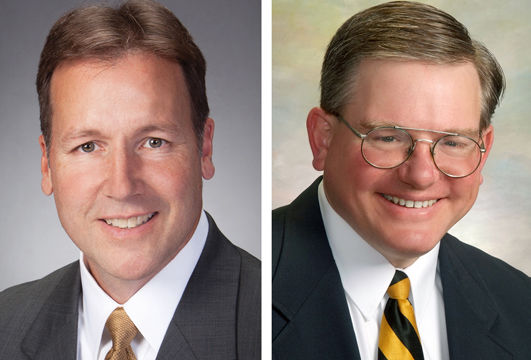
Rep. Allen Andrews, left, and Sen. Dan Hegeman
Time is running out for 2016, which means that the 34 senators and 163 representatives who make up the Missouri General Assembly will soon return to the state Capitol in Jefferson City for the start of a new session, which begins Wednesday, Jan. 4.
In another political ritual — this one unique to Nodaway County — state Sen. Dan Hegeman, R-Cosby, and state Rep. Allen Andrews, R-Grant City, are expected to be in town Thursday, Dec. 8. for the fall edition of a twice-yearly legislative breakfast hosted by the Greater Maryville Chamber of Commerce’s Governmental Affairs Committee.
The event, which will include presentations by both lawmakers, is scheduled to begin at 7:30 a.m. at the Hubbard Center for Innovation and Entrepreneurship on the campus of Northwest Missouri State University.
During the December breakfast, local lawmakers traditionally go over proposed bills and other business expected to come up during the approaching session. A similar event after the Legislature adjourns in May consists of a recap covering legislation that became law, died, or was vetoed by the governor.
In recent years, both of Nodaway’s state lawmakers have been asked to address questions related to the chamber’s annually produced Legislative Agenda.
The formal, written document is compiled by chamber members and sets forth the business advocacy group’s official stance on such topics as economic development, education, healthcare, energy, transportation, workplace issues, infrastructure, and agriculture.
While the agenda generally remains much the same from year to year, a few changes have been made for 2017, including a call for increased funding for elementary and secondary education.
During its last session, after failing for years to fully fund Missouri’s public school “foundation formula,” the General Assembly decided to solve the problem by scaling back its K-12 appropriations goal.
Lawmakers added $71 million to formula spending in 2016 but also — over Gov. Jay Nixon’s veto — limited the growth of the state’s “adequacy target,” a per-student dollar estimate that determines how much money schools should receive.
When the current foundation formula was created in 2005, the Legislature included a 5 percent cap on adequacy target growth. But lawmakers dropped that limit in 2009 in hopes of receiving more revenue from riverboat gambling and lottery proceeds.
The gambling windfall failed to materialize, and lawmakers found themselves more than $400 million short of funding the foundation formula at 100 percent, so they simply lowered the target.
In its recommendations to the Legislature this year, the chamber voices support for “a long-term financial plan to restore dollars to the formula and programs such as transportation and Parents as Teachers.”
The agenda’s elementary and secondary education section continues: “We believe the Legislature should consider revenue enhancements to benefit education such as tobacco and alcohol taxes and increasing the bonding capacity for school districts.”
The document also seeks an end to legislative “mandates” that increase costs for school districts without providing additional funds, and recommends increased appropriations for technology, STEM-field programs, and alternative education initiatives.
Finally, the chamber is asking lawmakers to resist efforts to take power away from local school boards while expanding the authority of state and federal education agencies, especially with regard to teacher evaluation, assessment, and compensation.
Turning to infrastructure, the local chamber recommends that the Legislature work toward changing what it sees as overly stringent environmental regulations with regard to wastewater treatment, claiming that existing rules unduly increase the fiscal burden on small towns.
“The chamber encourages lawmakers to consider standards which are more easily achieved,” the document states, “as well as increased access to state funding sources that will assist small rural communities in achieving these updates.”
Elsewhere, the 2017 agenda asks lawmakers to protect agriculture from “excessive regulations,” especially those put in place by the U.S. Environment Protection Agency. The document also supports reauthorization of the farm bill by Congress.